
- Home
- Solar guides
- Solar PV System Components: A Complete Guide for Irish Homeowners
Solar PV System Components: A Complete Guide for Irish Homeowners
A residential solar PV system is more than just panels on a roof. This guide walks through every component of a solar PV system installed in an Irish home, from panels and inverters to generation meters and grid connection equipment.
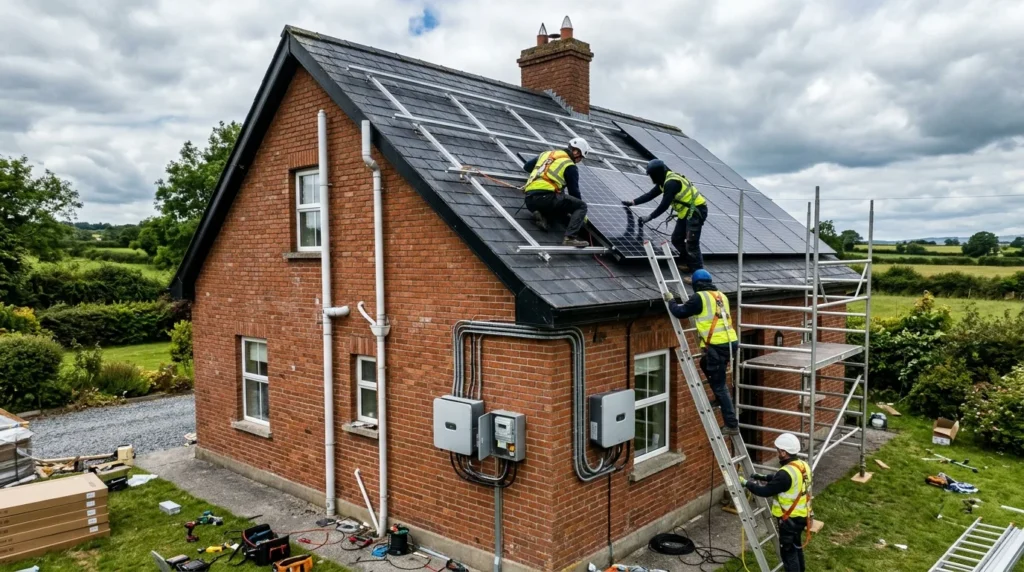
Understanding the solar PV system components in your home installation helps you ask better questions of your installer, interpret your monitoring data, and maintain your system effectively for decades to come. A modern residential solar PV system in Ireland is an engineered ensemble of components — each with a specific function, quality specification, and warranty.
Here is a complete component-by-component guide to what goes into a typical Irish home solar installation in 2026.
1. Solar PV Panels (Modules)
The panels are the most visible component and the starting point of the energy chain. Each panel contains dozens of photovoltaic cells — typically made from monocrystalline silicon — that convert photons from sunlight into direct current (DC) electricity.
Key specifications to check:
- Rated output (Wp): Standard residential panels are 400–440 W each. A 4 kWp system uses 10 panels at 400 W, or 9 panels at 445 W.
- Efficiency (%): Modern PERC mono panels achieve 20–22%; TOPCon and HJT reach 22–24%. Higher efficiency means more power per square metre.
- Temperature coefficient: How much output drops per degree above 25°C. Better panels have coefficients around -0.30% per °C.
- Product warranty: Typically 12–25 years covering manufacturing defects.
- Performance warranty: Typically 25 years guaranteeing at least 80% of original output.
Leading brands on the Irish market: Longi (Hi-MO6), JA Solar (Deep Blue 4), Jinko (Tiger Neo), REC (Alpha), Q CELLS (Q.PEAK DUO), Panasonic (EverVolt).
For a deep comparison of panel types, see monocrystalline vs polycrystalline panels.
2. Mounting System (Racking)
The mounting system anchors the panels securely to your roof structure. In Ireland, wind loading is a critical design parameter — particularly in coastal counties. A poorly specified mounting system is a safety and insurance risk.
Types of mounting systems:
Pitched Roof Mounting
The most common system for Irish homes uses aluminium rails fixed to the roof structure through specially designed roof hooks that clamp onto rafters without compromising waterproofing. Rail systems from K2 Systems, Schletter, and Esdec are widely used by Irish installers.
The roof hooks penetrate through the roof tiles and attach to the rafters. A flashing or EPDM sealant ensures the penetration is watertight. Any reputable installation includes a watertight guarantee alongside the panel warranty.
Flat Roof Mounting
For flat roofs on extensions, commercial buildings, or dormer structures, ballasted mounting frames hold panels at a 10–15° angle. The frames are weighted with concrete blocks rather than penetrating the roof membrane — important for maintaining flat roof waterproofing warranties.
BIPV (Building Integrated PV)
Solar tiles or in-roof systems replace conventional roof tiles entirely. Products like SunRoof or the Tesla Solar Roof are available in Ireland but at significant premium. Useful for heritage areas or new builds where roof aesthetics are paramount.
3. Inverter
The inverter is the most complex and critical component in a solar PV system. It converts the DC electricity produced by the panels into 230 V / 50 Hz AC electricity compatible with Ireland’s grid and your home circuits.
Types of inverters:
String Inverter
A single inverter handles all panels wired in a series string. Cost-effective and reliable. Industry leaders for Irish residential installations include:
- Fronius (Austria): Primo and Symo series; excellent monitoring and Irish market support
- SolarEdge (Israel/US): Pairs with DC power optimisers on each panel for individual panel monitoring and shade mitigation; one of the most popular choices in Ireland
- Huawei SUN2000: Strong monitoring, competitive pricing, popular with Irish installers
- Sungrow: Growing Irish market share; excellent value
Microinverter
Instead of one central inverter, each panel has its own microinverter. This eliminates string-level shading losses and allows full per-panel monitoring. Enphase IQ8 series dominates the Irish microinverter market. Premium cost but significant advantages for shaded or complex roofs. See our Enphase microinverters review.
Hybrid Inverter
Combines a solar inverter with a battery inverter in one unit. If you plan to add battery storage later (or now), a hybrid inverter is worth the premium. SolarEdge StorEdge, Fronius Symo GEN24, Sungrow SH, and GivEnergy hybrid are popular in Ireland.
For a full comparison, see our SolarEdge vs Fronius guide.
Inverter sizing: The inverter capacity (in kW) should be within ~80–110% of the panel array capacity (in kWp). Slight undersizing (95% ratio) is common in Ireland because the panels rarely produce full rated output simultaneously.
4. DC Power Optimisers (Optional but Recommended)
DC power optimisers attach to each panel and condition the DC output before it reaches the inverter. Unlike microinverters, they don’t convert to AC at the panel — they optimise each panel’s DC output independently, eliminating string-level shading losses.
SolarEdge P-series optimisers are by far the most common in Ireland, typically paired with a SolarEdge inverter. They also enable per-panel monitoring through the SolarEdge monitoring portal.
Optimisers add approximately €100–€200 per panel to system cost but can recover this through improved output on partially shaded roofs. See our full power optimisers guide.
5. Generation Meter
All SEAI-grant-eligible solar PV systems must include a calibrated solar generation meter that records cumulative electricity generated by the system. This is separate from your grid import/export meter.
The generation meter is typically installed in or near the distribution board (consumer unit / fuse board). It feeds data into your SEAI grant application paperwork and is required for MSS export tariff contracts with suppliers.
6. Smart Meter / Export Meter (ESB Networks)
To receive payments for exported electricity under the Microgeneration Support Scheme (MSS), you need a bidirectional smart meter installed by ESB Networks. This meter records:
- Electricity you import from the grid
- Electricity you export to the grid
ESB Networks upgrades your meter as part of the NC6 grid connection notification process. The upgrade is free of charge. You then contact your electricity supplier (Electric Ireland, Energia, Bord Gáis Energy, SSE Airtricity) to set up an MSS export tariff contract, paying 18–21 c/kWh for exported electricity.
7. Isolator Switches and Safety Equipment
Irish electrical regulations (ETCI) require several safety isolation points in a solar PV system:
- DC isolator at the inverter (disconnects panels from inverter in an emergency)
- AC isolator at the inverter (disconnects inverter from the grid)
- Main switch or fuse at the consumer unit (for the solar circuit breaker)
- AC surge protection device (SPD) to protect against lightning-induced voltage spikes
Fire services in Ireland also require a firefighter’s switch (DC isolator accessible from ground level) to allow safe emergency disconnection of the PV array. This is now standard practice for all residential installs.
8. DC and AC Cabling
Specialised PV twin-core DC cable (typically 4 mm² or 6 mm²) connects the panels in strings to the inverter. This cable is UV-resistant, double-insulated, and rated for outdoor exposure. It must comply with IEC 62930 / EN 50618.
Standard AC cable connects the inverter output to your consumer unit. Cable sizing must comply with ETCI wiring rules.
All cabling should be neatly routed in conduit where visible, with appropriate weatherproofing at roof penetrations.
9. Monitoring System
Modern solar inverters come with built-in monitoring systems that let you track output in real time via a smartphone app or web portal:
- Fronius Solar.web: Comprehensive monitoring, energy flow diagrams, production forecasting
- SolarEdge monitoring portal: Per-panel output data with optimisers, fault alerts
- Enphase Enlighten: Per-microinverter monitoring, strong mobile app
- Huawei FusionSolar: Detailed monitoring, clean UI
Most systems connect to your home WiFi and provide real-time data. Monitoring is invaluable for identifying performance issues, verifying output against installer projections, and understanding your self-consumption patterns.
10. Battery Storage (Optional)
A battery storage system stores surplus solar electricity generated during the day for use in the evening. In Ireland, popular battery options include the SolarEdge Energy Bank, BYD B-Box HV, Pylontech, GivEnergy, and sonnenBatterie. A typical Irish residential battery is 5–10 kWh in usable capacity.
Adding a battery increases system cost by €3,000–€8,000 depending on capacity but can push self-consumption from 35–45% to 65–80%. See our full analysis of solar battery storage in Ireland.
11. Immersion Diverter (Optional but Highly Recommended)
An immersion diverter (such as the myenergi Eddi, Solar iBoost, or Solic 200) monitors your system’s export and automatically redirects surplus electricity to your immersion heater before it leaves your home. This gives you free hot water from solar surplus and is one of the best-value additions to any Irish solar installation, costing only €300–€600 installed.
Putting It All Together
A complete Irish residential solar PV installation includes:
- Solar PV panels (typically 10–16 monocrystalline, 4–6 kWp total)
- Roof mounting system with weatherproof roof hooks
- String inverter or microinverters
- Optional DC power optimisers
- Generation meter
- Smart meter (ESB Networks, free)
- DC and AC isolators, SPD, firefighter’s switch
- DC cabling (PV cable) and AC cabling
- Monitoring system (inverter app/portal)
- Optional battery storage
- Optional immersion diverter
Understanding each component helps you evaluate quotes intelligently. See our solar quote negotiation checklist to know exactly what to look for before signing.
Get 3 free, no-obligation solar quotes
Tell us a few quick details about your home and we’ll connect you with up to 3 SEAI-registered solar installers in your area.
Frequently Asked Questions
Do I need a new fuse board (consumer unit) for solar panels?
Not necessarily. Most modern consumer units have spare capacity for a solar circuit breaker. Older fuse boxes (pre-1990s rewireable fuses) may need upgrading. Your installer should assess this during the site survey and include any required upgrades in the quote.
What is an NC6 notification for solar panels in Ireland?
The NC6 is ESB Networks’ grid connection notification process for domestic solar PV systems up to 6 kWp. Your installer submits the notification on your behalf. ESB Networks typically responds within 4–8 weeks and arranges smart meter installation or upgrade. See our [ESB Networks NC6 guide](/solar-guides/esb-networks-nc6-application) for full details.
Do I need planning permission for a solar system in Ireland?
How long do solar inverters last?
String inverters typically last 10–15 years. Most manufacturers offer a 10-year warranty with options to extend to 20 years at purchase. Budget for one inverter replacement over a 25-year system lifetime. Microinverters like Enphase IQ8 carry a 25-year warranty, matching the panel lifetime.
Can I add battery storage to an existing solar PV system?
More solar pv guides

Sources & further reading
— Sustainable Energy Authority of Ireland
— ESB Networks
— National Standards Authority of Ireland

Solar Expert Editorial
Solar advisor team
Published 15 May 2026
Get 3 free quotes for your home EV charger
We'll match you with Safe Electric-certified installers who can apply for the €300 SEAI Home Charger Grant on your behalf.
- No obligation · Free · Takes 2 minutes