
- Home
- Solar guides
- How Long Do Solar Panels Last in Ireland? Lifespan, Degradation & Warranties
How Long Do Solar Panels Last in Ireland? Lifespan, Degradation & Warranties
Quality solar panels installed in Ireland today will still be generating meaningful electricity in 2050. This guide covers the science of panel degradation, what your warranties actually guarantee, and how Ireland’s climate affects long-term performance.
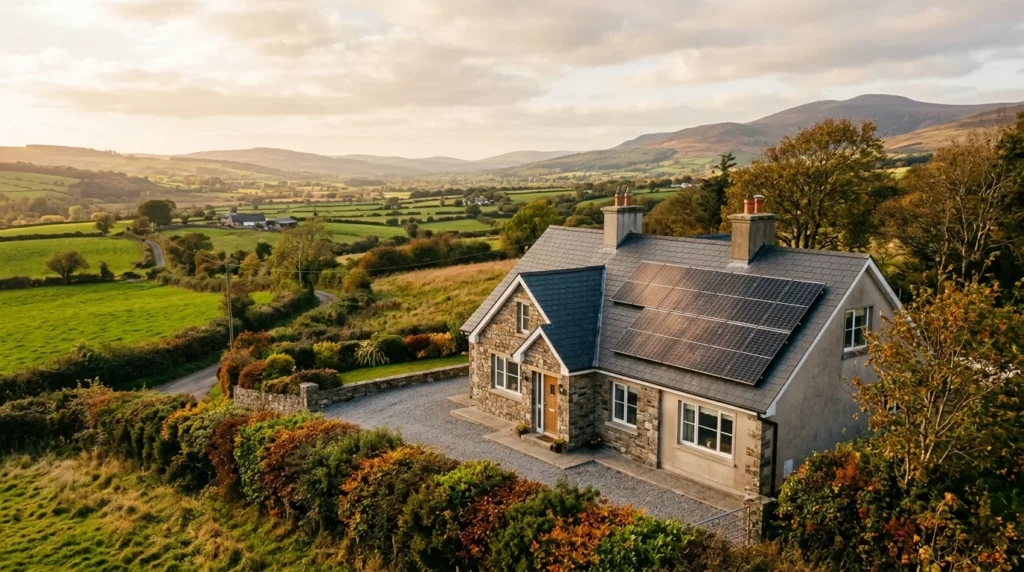
One of the most common questions Irish homeowners ask before investing in solar PV is: how long do solar panels last in Ireland? The answer is reassuring. Modern monocrystalline solar panels are genuinely long-lived technologies, with manufacturers guaranteeing at least 80% of original output after 25 years and real-world evidence suggesting many panels continue generating electricity for 30–40 years.
Understanding solar panel lifespan in Ireland — including degradation rates, inverter lifespans, and the Irish climate’s specific effects — helps you make a more informed investment decision and set realistic expectations over the life of your system.
What the Warranties Actually Guarantee
Every reputable solar panel sold in Ireland comes with two distinct warranties:
Product (Workmanship) Warranty
This covers manufacturing defects, delamination, broken cells, frame failure, and other physical problems that are not caused by accident or misuse. Premium brands like REC and Panasonic offer 25-year product warranties; mainstream brands like Longi, JA Solar, and Jinko typically offer 12–15 years. A longer product warranty is a signal of manufacturer confidence in build quality and in their financial stability to honour claims.
Performance (Output) Warranty
This guarantees that the panel will still produce at least a specified percentage of its original output after a set period. The industry standard in 2026 is:
- Year 1: No more than 2–3% degradation (first-year light-induced degradation)
- Years 2–25: No more than 0.3–0.55% degradation per year
- Year 25: At least 80–86% of original rated output
Example: A panel rated at 420 W today, with a 0.4%/year degradation rate, will produce at least 378 W after 25 years (90% of original). A panel with the industry-minimum 80% guarantee at year 25 must produce at least 336 W.
Premium panels from REC, Panasonic, and Q CELLS now offer enhanced 30-year performance warranties with year-25 guarantees of 85–87%, reflecting improved manufacturing quality.
Understanding Solar Panel Degradation
Panel degradation is the gradual reduction in power output over time. It’s caused by several mechanisms:
Light-Induced Degradation (LID)
In the first weeks to months after installation, monocrystalline panels can lose 2–3% of output due to light-induced degradation, where light exposure changes the electrical properties of the boron-doped silicon. PERC and TOPCon panels have largely mitigated this through optimised cell chemistry. Modern TOPCon panels show LID of under 1% in manufacturer testing.
UV Degradation
Prolonged UV exposure gradually yellows the EVA encapsulant layer and reduces light transmission through the glass. This is a primary driver of long-term degradation. Quality anti-reflective coatings and UV-stabilised encapsulants mitigate this — one reason premium panels degrade more slowly.
Thermal Cycling
Repeated heating and cooling causes micro-expansion and contraction in the panel materials. Over decades, this can cause micro-cracks in cells. Ireland’s relatively mild temperature range (rarely below -5°C, rarely above 30°C) means thermal cycling stress is lower in Ireland than in continental European climates, extending Irish panel lifespans.
Moisture Ingress
Water penetrating behind the panel’s backsheet or into the junction box causes accelerated degradation. Quality panels use double-glass construction or high-quality backsheets with good moisture barrier properties. Ireland’s damp climate is a reason to prioritise waterproofing quality — look for IP68-rated junction boxes and quality backsheet materials like Krempel or Isovoltaic.
Soiling
As discussed in our solar panel output guide, Ireland’s rainfall keeps panels relatively clean, mitigating soiling-related performance loss that affects panels in dryer climates.
How Ireland's Climate Affects Panel Longevity
Ireland’s oceanic climate is, on balance, gentler on solar panels than most European climates:
Advantages of Irish climate for panel longevity:
- Lower peak temperatures (max 30°C vs 40–45°C in southern Europe) → Less thermal stress
- Narrower annual temperature range (-5°C to +28°C) → Less thermal cycling
- High humidity offset by frequent rain washing → Panels stay cleaner than in dry continental climates
- Lower UV intensity in absolute terms → Slower UV degradation
Potential challenges:
- High humidity increases moisture ingress risk → Buy quality panels with good IP-rated junction boxes
- Coastal salt spray (especially in Kerry, Clare, Galway, west Donegal) → Corrosion risk on frames and mounting; use marine-grade aluminium and appropriate sealants
- Storm and wind exposure → Mounting system quality is critical; panels should be rated to withstand gusts typical for your area (up to 150 km/h in exposed coastal locations)
Real-world monitoring data from Irish systems installed in the 2010–2015 period consistently shows degradation rates of 0.3–0.45% per year — in line with or better than manufacturer specifications, confirming that Irish conditions are suitable for long-lived PV installations.
Inverter Lifespan: The Shorter-Lived Component
While panels last 25–35 years, string inverters typically last 10–15 years. This means most Irish homeowners will need to replace their inverter once during the panel lifetime. Inverter replacement in 2026 typically costs €800–€1,800 depending on capacity and brand, which should be factored into the lifetime financial calculation.
Warranty comparison:
Brand
Standard Warranty
Extended Warranty Option
Fronius
10 years
20 years (paid)
SolarEdge
12 years
25 years (paid)
Huawei
10 years
15 years (paid)
Sungrow
10 years
20 years (paid)
Microinverters (Enphase IQ8 series) carry a 25-year warranty — matching the panel warranty and eliminating the need for a mid-life inverter replacement. This is one of the key arguments for choosing a microinverter system if long-term peace of mind is a priority.
Battery Storage Lifespan
If you add battery storage, expect a 10–15 year lifespan for the battery cells, with most manufacturers guaranteeing 70% of original capacity after 10 years or 6,000 cycles. Battery replacement adds to the lifetime cost picture. See our solar battery storage guide for full economics.
End-of-Life: What Happens After 25–30 Years?
Solar panels do not simply stop working after their performance warranty expires. They continue generating electricity — just at a reduced rate. Many panels from the 1990s are still operating today at 75–80% of their original output.
When a panel genuinely needs replacing (due to physical damage, cell failure, or output well below warranty levels), Irish homeowners have several options:
- Warranty claim: If under the product warranty period, the manufacturer replaces it
- Module replacement: Individual panels can be replaced, though newer models may have slightly different dimensions
- Full system upgrade: After 25–30 years, upgrading to newer, higher-efficiency panels may make more sense than patching
Panel recycling: The EU Waste Electrical and Electronic Equipment (WEEE) Directive requires solar panel manufacturers to fund take-back and recycling schemes. In Ireland, PV Cycle operates a collection and recycling network. Panels contain glass (76%), aluminium frame (10%), silicon cells (3%), and copper wiring — all materials with recovery value.
Practical Lifetime Financial Calculation
For a 4 kWp system installed in 2026 at a net cost of €8,200 (after SEAI grant):
Net present value over 30 years at a 3% discount rate: typically €15,000–€22,000 for a mid-sized Irish system — a compelling return that grows larger as electricity prices rise.
Period
Scenario
Cumulative Savings
Year 10
Bill savings + exports at current tariff
~€10,000–€14,000
Year 20
Including one inverter replacement (-€1,200)
~€19,000–€28,000
Year 30
Continued generation at 80% output
~€27,000–€40,000
Key Takeaways
- Modern monocrystalline solar panels have a solar panel lifespan in Ireland of 25–35+ years
- Performance warranties guarantee at least 80–86% of original output at year 25
- Degradation rates of 0.3–0.45% per year are typical for quality panels
- Ireland’s mild climate is generally favourable for long panel life, with lower thermal stress than southern Europe
- String inverters last 10–15 years — budget for one replacement
- Microinverter systems (Enphase) carry 25-year warranties, avoiding mid-life replacement
- Panels do not simply stop working after 25 years; they continue generating at reduced output
- Always verify both the product warranty and performance warranty before purchasing
Get 3 free, no-obligation solar quotes
Tell us a few quick details about your home and we’ll connect you with up to 3 SEAI-registered solar installers in your area.
Frequently Asked Questions
How long do solar panels last in Ireland?
Quality monocrystalline solar panels installed in Ireland typically last 30–35 years. Most manufacturers guarantee at least 80% of original output after 25 years. Ireland’s mild climate with low peak temperatures is generally gentle on panels, often resulting in degradation rates at or below manufacturer specifications.
What is the degradation rate of solar panels?
After an initial first-year degradation of 1–3% (light-induced degradation), quality panels degrade at 0.3–0.55% per year. A 420 W panel degrading at 0.4% per year will produce approximately 378 W after 25 years — still generating significant, useful electricity.
Do solar panels need replacing in Ireland?
Does Irish rain or damp affect solar panel lifespan?
Ireland’s rainfall actually helps by keeping panels clean. The humidity is a consideration — look for panels with IP68-rated junction boxes and quality backsheets. Coastal homes in Kerry, Clare, or Galway should ensure marine-grade aluminium frames and appropriate sealants are specified.
What warranty should I look for when buying solar panels in Ireland?
Get 3 free quotes for your home EV charger
We'll match you with Safe Electric-certified installers who can apply for the €300 SEAI Home Charger Grant on your behalf.
- No obligation · Free · Takes 2 minutes
More solar pv guides

Sources & further reading
— Sustainable Energy Authority of Ireland
— PV Cycle
— International Energy Agency
Get 3 free quotes for your home EV charger
We'll match you with Safe Electric-certified installers who can apply for the €300 SEAI Home Charger Grant on your behalf.
- No obligation · Free · Takes 2 minutes