The Fundamental Difference
Every Irish home runs on alternating current (AC) — it is the type of electricity that comes from ESB Networks through your meter. Your EV’s battery, however, stores energy as direct current (DC). These two forms of electricity are fundamentally different, and understanding how each is handled in the charging process explains why home charging and rapid public charging behave so differently.
AC Charging: The Home Standard
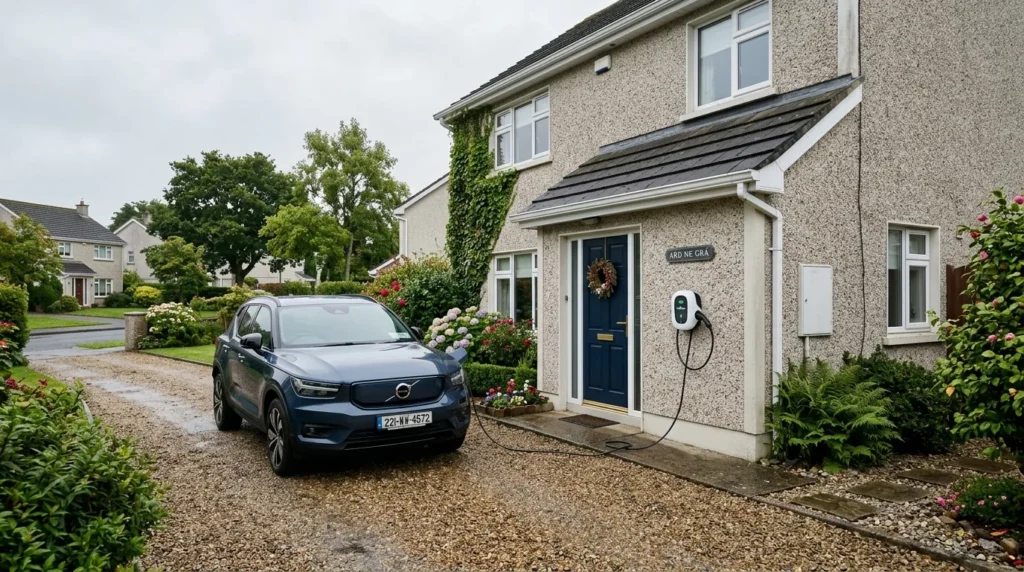
When you charge at home using a wallbox like an Easee One, Wallbox Pulsar Plus, or MyEnergi Zappi, you are doing AC charging. The electricity from your house supply goes into the wallbox essentially unchanged — still AC. The wallbox’s job is to communicate with the car, manage safety (via the Type B RCD or built-in DC fault detection), and deliver that AC supply at the agreed current level.
The critical component is the on-board charger (OBC) inside your car. The OBC converts the incoming AC into the DC that the battery needs. Because the OBC is physically inside the car and limited by size and weight constraints, its maximum power rating is typically 3.7 kW, 7.4 kW, or 11 kW for most consumer EVs.
This means:
- A Tesla Model 3 Long Range has an 11 kW OBC — it can charge at 11 kW on a three-phase supply, but only at 7.4 kW on Ireland’s standard single-phase supply.
- A Renault Zoe has a 22 kW OBC — remarkable, but only useful if you have three-phase supply.
- A Volkswagen ID.4 has an 11 kW OBC — again, capped at 7.4 kW single-phase.
- A Nissan Leaf (older 40 kWh) has a 6.6 kW OBC — it will charge at about 6.6 kW on a 7.4 kW wallbox.
For the vast majority of Irish EV drivers on single-phase supply, 7.4 kW is the practical ceiling for home AC charging regardless of which wallbox they install.
DC Charging: Bypassing the On-Board Charger
DC rapid charging works completely differently. Instead of the car converting AC to DC internally, the large and expensive AC-to-DC conversion hardware is inside the public charger itself. The charger delivers DC directly to the car’s battery, bypassing the on-board charger entirely.
This is why DC chargers can achieve such high power levels:
- 50 kW DC: found at many older ESB eCars rapid chargers
- 100–150 kW DC: common at newer motorway charging hubs
- 350 kW DC: Ionity ultra-rapid chargers (only a handful of cars can accept this)
The limiting factor for DC charging is the car’s battery management system (BMS), which controls how fast the battery will accept DC. A Hyundai Ioniq 6 can accept up to 240 kW DC. A Nissan Leaf 40 kWh is limited to 50 kW DC. Most popular Irish EVs can accept 100–150 kW DC at a compatible charger.
Speed Comparison: AC vs DC
11 kW home wallbox (3-phase)
The home wallbox is not trying to compete with rapid DC charging on speed — it is designed to charge overnight, while the car sits unused for 8–10 hours. Adding 250–300 km of range overnight from a 7.4 kW wallbox is more than enough for the vast majority of Irish commuters, who drive fewer than 50 km per day.
Connector Types: Which Goes with Which?
- AC charging: Type 2 connector (the standard in Ireland and across Europe). All SEAI-approved home chargers use Type 2.
- DC rapid charging: CCS2 (Combined Charging System) on nearly all modern EVs; CHAdeMO on older Nissan Leaf models; Tesla Supercharger (Type 2 CCS compatible in Europe).
Your car has separate charge ports for AC and DC (the CCS2 socket combines both in one physical opening with AC pins above and DC pins below). Your home wallbox only uses the AC portion.
Cost Per kWh: AC vs DC
This is where the real-world difference becomes most significant for Irish households.
Home AC charging on a smart night tariff:
- Electric Ireland Night Boost: approximately 12–13 c/kWh (2026)
- Energia Smart Drive: approximately 12–14 c/kWh (night window)
- Bord Gáis EV Tariff: approximately 11–13 c/kWh (overnight rate)
- SSE Airtricity EV: approximately 13–15 c/kWh (night window)
At 13 c/kWh, a 60 kWh battery costs roughly €7.80 to charge from empty to full at home.
Public DC rapid charging:
- ESB eCars: approximately 35–45 c/kWh (pay-as-you-go, 2026)
- Ionity: approximately 55–70 c/kWh (without membership)
- Circle K/Applegreen rapid chargers: approximately 40–50 c/kWh
At 40 c/kWh, the same 60 kWh battery costs €24 at a public rapid charger — roughly three times more expensive than home charging.
This is the core economic argument for installing a home wallbox: the infrastructure cost of €1,100–€1,500 (€500–€900 after the €600 SEAI grant) is typically recovered in fuel savings within 18–30 months, depending on how much you were previously spending on rapid charging or petrol.
Battery Health: Does DC Rapid Charging Damage Batteries?
The short answer is: occasional rapid DC charging is fine; relying on it as your primary charging method accelerates degradation slightly. Research from various studies (including work by Idaho National Laboratory) shows that vehicles primarily charged on DC rapid chargers show marginally higher battery degradation over time compared to vehicles primarily home charged.
The mechanism is heat: DC charging at very high rates generates more heat in the battery cells, and sustained heat accelerates electrode degradation. Modern EVs manage this actively with liquid battery thermal management systems, but the fundamental chemistry still applies.
Practical advice: Charge at home on AC for your daily routine. Use DC rapid charging when you need to on longer journeys. Avoid regular rapid charging from a very low state of charge, as this is when the battery is most thermally stressed.
What This Means for Your Home Charger Decision
A 7.4 kW single-phase AC charger is the correct choice. It matches or exceeds the OBC of most EVs, works with the standard Irish electricity supply, and is eligible for the SEAI grant.
11 kW or 22 kW chargers only make sense if you have three-phase supply AND a car with an OBC rated for those speeds. Installing a 22 kW charger on a single-phase supply is wasteful — the charger will only deliver 7.4 kW regardless.
DC charging at home is not practical for residential use. Home DC chargers exist but cost €10,000+ and are found only in commercial fleet contexts. The public DC charging network handles longer journeys.
Smart AC charging — scheduling overnight sessions with OCPP-enabled chargers like the Easee One or Ohme Home Pro — is the most cost-effective charging strategy available to Irish EV owners today.