
- Home
- Solar guides
- Ireland's Microgeneration Support Scheme (MSS) Explained for 2026
Ireland's Microgeneration Support Scheme (MSS) Explained for 2026
The Microgeneration Support Scheme pays Irish solar homeowners for electricity they export to the grid. This guide explains exactly what the MSS pays, which supplier offers the best rate, how to register, and what realistic export income looks like.
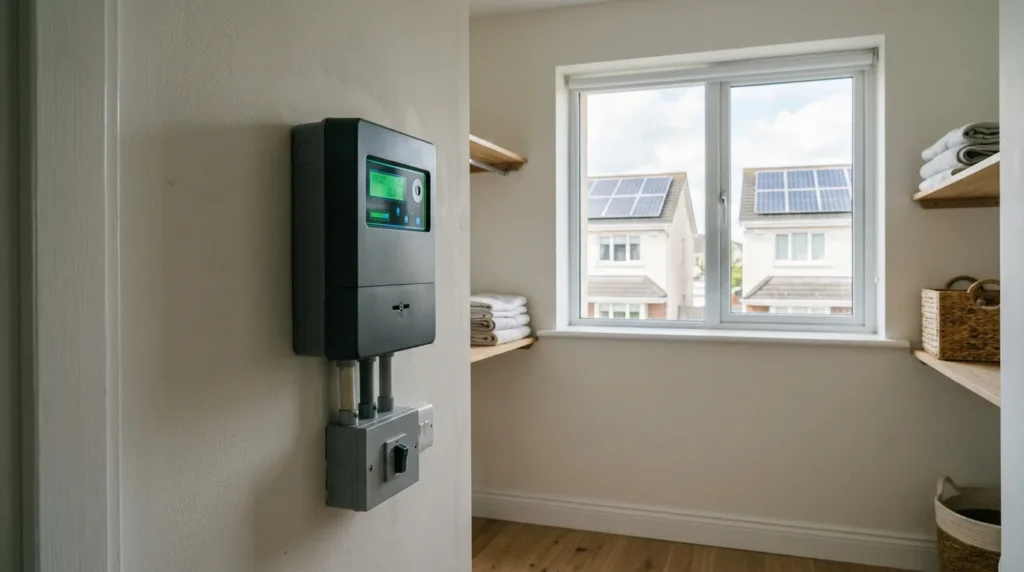
The Microgeneration Support Scheme (MSS) is Ireland’s government-mandated programme that requires electricity suppliers to pay residential and small commercial generators for surplus electricity exported to the national grid. For Irish homeowners with solar PV, the MSS means that every kilowatt-hour of solar electricity that flows to the grid earns real money — turning your roof into a mini power station with an assured buyer.
Launched in 2022 and progressively improved since then, the MSS in 2026 is a mature, well-established programme. This guide explains exactly how it works, what the current rates are, and how to make the most of it.
What Is the MSS?
The Microgeneration Support Scheme obliges electricity suppliers in Ireland to offer a Clean Export Guarantee (CEG) tariff to eligible microgeneration customers. Under the CEG, you are guaranteed a minimum payment for every kWh of clean electricity you export to the grid.
Key points:
- Minimum guaranteed by law: Suppliers must offer a CEG rate; they cannot refuse
- Variable rates: Each supplier sets their own rate above the minimum floor — you can choose the best rate
- Time-unlimited for the foreseeable future: The scheme has no announced end date, though rates can be reviewed annually
- Applies to all eligible microgeneration technologies: Solar PV is the primary beneficiary, but wind turbines and micro-CHP also qualify
MSS Export Rates in 2026
Irish electricity suppliers compete on the Clean Export Guarantee rate. In 2026, indicative rates from major suppliers:
Supplier
CEG Export Rate (2026)
Special Conditions
Electric Ireland
21 c/kWh
No minimum contract
Energia
20 c/kWh20 c/kWh
No minimum contract
Bord Gáis Energy
19 c/kWh
Combined with gas account
SSE Airtricity
18 c/kWh
Multi-fuel discount available
Pinergy
19 c/kWh
Smart tariff available
Flogas
18 c/kWh
Important: Rates are reviewed and can change — always check current rates directly with suppliers before registering. The figures above are indicative for 2026 but can vary.
How much does the export rate matter? For a 4 kWp system exporting approximately 2,000 kWh/year:
- At 21 c/kWh: €420/year
- At 18 c/kWh: €360/year
- Difference: €60/year
The rate difference between the best and worst supplier is not enormous — it’s worth choosing the highest rate, but don’t stay with a bad supplier for your main electricity just for a slightly higher export rate.
Eligibility for the MSS
To be eligible for MSS Clean Export Guarantee payments:
System requirements:
- Generation capacity of 50 kW or less (all domestic systems qualify)
- System must be connected to the ESB Networks distribution grid via the NC6 (or NC7 for 6–11 kWp) notification process
- System must have a generation meter that records cumulative output
- System must have a smart meter installed by ESB Networks (bidirectional metering)
- System must be installed by a SEAI-registered installer
Customer requirements:
- You must be the electricity account holder at the property
- The property must be your residential address (or a small business premises for commercial MSS)
- You must have an MPRN (Meter Point Reference Number) on the grid
There is no requirement to claim the SEAI grant to access the MSS — even if you missed the grant window, you can still register for the MSS at any time after installation.
How to Register for the MSS: Step by Step
Step 1: Complete Your Solar Installation
Before registering, your system must be fully installed, commissioned, and connected. Your installer should provide:
- Commissioning certificate
- Generation meter serial number and initial reading
- ESB Networks NC6 notification reference number (confirming grid connection)
Step 2: Contact ESB Networks for Smart Meter
If you don’t already have a smart meter, contact ESB Networks (1800 372 757 or via esbnetworks.ie). They will upgrade your meter at no cost. This process typically takes 4–8 weeks from notification.
Step 3: Choose Your Electricity Supplier
Compare Clean Export Guarantee rates from major suppliers. You can register with a supplier different from your current electricity supplier — but switching all your electricity can sometimes get you a better combined deal.
Step 4: Contact Your Chosen Supplier
Call or go online with your chosen supplier and request to register for the MSS Clean Export Guarantee. You will need:
- Your MPRN
- Generation meter serial number
- Confirmation of system capacity (kWp)
- Installation date
- SEAI-registered installer details
Step 5: Submit Meter Readings
Your supplier will set up your account and request periodic generation meter readings (typically quarterly or annually). They calculate your export payment based on total electricity exported (measured by the smart meter) and your agreed CEG rate.
Step 6: Receive Payments
Export payments are typically made as a credit on your electricity bill rather than a direct cash payment. Some suppliers process this quarterly, others annually. Check with your supplier for payment frequency.
How Much Can You Earn From the MSS?
Expected annual MSS income for typical Irish solar PV systems:
System Size
Annual Output
Self-Consumption
Exported
Income at 20 c/kWh
3 kWp
2,700 kWh
45% (1,215 kWh)
1,485 kWh
€297
4 kWp
3,700 kWh
45% (1,665 kWh)
2,035 kWh
€407
6 kWp
5,400 kWh
45% (2,430 kWh)
2,970 kWh
€594
4 kWp + battery
3,700 kWh
75% (2,775 kWh)
925 kWh
€185
Counterintuitive finding: Adding a battery reduces your MSS income significantly (because you export less). However, the self-consumption savings from the battery (30 c/kWh avoided imports) are worth more than the export income lost (20 c/kWh). So a battery always increases total financial return even while reducing export income. See our solar battery economics guide.
MSS vs. Old Feed-in Tariff System
Before the MSS launched in 2022, Ireland had no official export payment system for residential solar. The previous system involved micro-generator allowances that were administratively difficult. The MSS replaced this with a clear, legally-mandated minimum export payment and simplified registration.
Key improvements over the previous system:
- Clear legal obligation on suppliers to pay
- Choice of supplier for the export contract
- Competitive rates — suppliers compete on CEG rates
- Simpler registration process through standardised supplier forms
MSS for Self-Built or Earlier Systems
Systems installed before the MSS launched (pre-2022) are also eligible, provided they meet the technical requirements. If you have an older system without a Smart Meter, you need to contact ESB Networks to arrange a free smart meter upgrade before registering.
The Clean Export Premium (CEP)
Alongside the Clean Export Guarantee, the government has introduced a Clean Export Premium (CEP) for new registrants who register within a certain window of commissioning their system. The CEP provides an additional payment on top of the standard CEG rate for a defined period. Check with SEAI or your supplier for the current CEP details as the scheme is periodically updated.
Key Takeaways
- The Microgeneration Support Scheme pays Irish solar homeowners 18–21 c/kWh for exported electricity in 2026
- You must have a smart meter (free from ESB Networks) and a generation meter
- Registration is with your electricity supplier — you can choose the supplier offering the best rate
- A 4 kWp system with 45% self-consumption generates approximately €360–€420/year in MSS export income
- Adding a battery reduces export income but increases total financial returns
- Older solar systems (pre-2022) can also register — contact ESB Networks for a smart meter upgrade
Get 3 free, no-obligation solar quotes
Tell us a few quick details about your home and we’ll connect you with up to 3 SEAI-registered solar installers in your area.
Frequently Asked Questions
What is the current MSS export rate in Ireland for 2026?
How do I register for the MSS in Ireland?
Can I switch supplier after registering for the MSS?
Do I need the SEAI grant to access the MSS?
How are MSS payments made?
Get 3 free quotes for your home EV charger
We'll match you with Safe Electric-certified installers who can apply for the €300 SEAI Home Charger Grant on your behalf.
- No obligation · Free · Takes 2 minutes
More solar pv guides

Sources & further reading
— Commission for the Regulation of Utilities
— ESB Networks

Solar Expert Editorial
Solar advisor team
Published 15 May 2026
Get 3 free quotes for your home EV charger
We'll match you with Safe Electric-certified installers who can apply for the €300 SEAI Home Charger Grant on your behalf.
- No obligation · Free · Takes 2 minutes