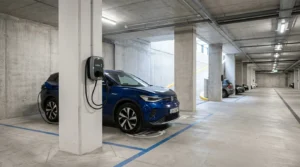
The Apartment Challenge
Ireland has over 500,000 apartments and managed residential units. For EV owners in these properties, home charging has historically been more complicated than for those in houses with driveways. You cannot simply mount a charger on a shared wall or draw power from a common supply without management company agreement. The car park may be underground, the cable run may be 100 metres, and dozens of other residents may eventually want the same.
But the situation is improving rapidly — thanks to both EU legislation and growing awareness among management companies and owners’ management companies (OMCs) of the practical and property value benefits of EV charging.
EU Right to Charge
Under the EU Energy Performance of Buildings Directive (EPBD), which Ireland has transposed into national law, apartment residents with a designated car parking space have the right to request EV charging infrastructure. Management companies cannot simply refuse — they must engage with the request.
Specifically, from 2025 onward, any residential building undergoing major renovation with more than five parking spaces must have at least 50% of those spaces pre-wired for EV charging. New residential buildings with more than three parking spaces must have every car park space pre-ducted or wired.
For existing buildings, the EPBD gives residents the right to request installation at their own cost, and management companies must not unreasonably refuse. “Unreasonable” is defined in guidance as a refusal not based on legitimate technical, safety, or structural grounds.
The SEAI Home Charger Grant for Apartments
Here is the important news: the €600 SEAI Home Charger Grant does apply to apartments, subject to conditions. As of 2026, SEAI has expanded eligibility to include:
- Residents with a designated car parking space (owned or leased)
- Installations in private areas of the development (e.g., your assigned space in a car park)
- Management company approval for installations in common areas adjacent to your space
You must still use a SEAI-approved charger and a Safe Electric registered installer. The MPRN used for the grant application should be your unit’s meter, not the common area meter.
Where the charger connects to the building’s common electricity supply rather than your unit, billing arrangements need to be agreed with the OMC — this is increasingly handled via sub-metering, where a separate smart meter on your charger allows you to be billed for exactly the energy you use.
Practical Approaches: Lobby Your OMC
The most effective first step is to formally request EV charging infrastructure from your Owners’ Management Company (OMC). A well-drafted letter citing:
- EU EPBD rights
- The cost-neutral nature of the installation (you will pay for it)
- The property value benefits of EV infrastructure
- A request for a specific agenda item at the next AGM
…is much more effective than an informal conversation.
Many Irish apartment complexes have successfully installed EV charging via two models:
Model 1: Individual Dedicated Charger
You fund the installation of a charger exclusively for your parking space. The cable runs from your unit’s consumer unit (if accessible) or from a shared distribution board with sub-metering. Cost: typically €1,500–€3,000 for an apartment installation (longer cable runs than a house), with €600 from the SEAI grant reducing the net cost to €900–€2,400.
Model 2: Shared Charging Infrastructure
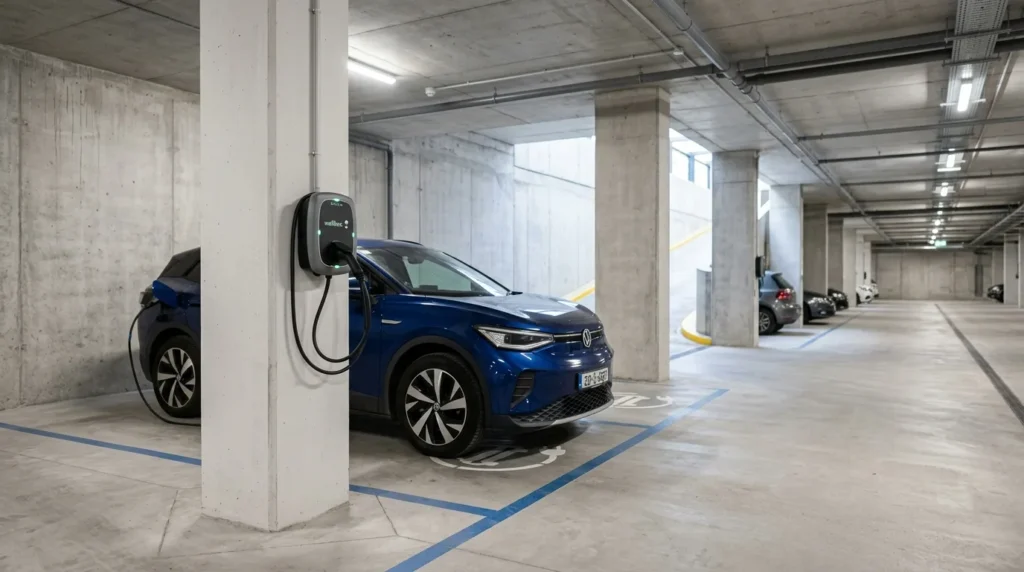
The OMC commissions a managed EV charging system for the car park — typically 4–20 charging points operated by an EV charging provider (Charge.ie, EasyGo, EV Energy, Osprey). The provider installs the infrastructure at low or no cost to the OMC in exchange for a revenue-sharing arrangement or a per-kWh management fee. Residents pay per kWh via an app, typically at 30–45 c/kWh — more expensive than home overnight rates but far cheaper than public rapid charging.
For new-build apartment developments, Model 2 with dynamic load management is increasingly the standard. Dynamic load management ensures that if multiple residents charge simultaneously, the total car park load stays within the building’s electrical capacity — the system automatically distributes available power across active chargers.
Technical Challenges for Apartment Installations
The vast majority of SEAI-approved home charger installations in Ireland are 7.4 kW (32A, single-phase). This is not arbitrary it reflects the limits of Ireland’s standard residential electricity supply:
- Single-phase 230V supply × 32A = 7,360W ≈ 7.4 kW
- This is the maximum safe continuous load on a standard domestic circuit
At 7.4 kW, a typical Irish commuter driving 40 km per day needs roughly 1.5–2 hours of charging to replace their daily driving. An overnight session of 8–10 hours can replenish 55–70 kWh — enough for 300–400 km of range on most popular EVs. For Irish driving patterns, this is more than sufficient.
Cable Runs
An underground car park may be 100 metres of cable from the distribution board. At 6mm² cable, that introduces voltage drop concerns; you may need 10mm² or even 16mm² cable. Cable cost per metre for armoured cable is €4–€8, so a 100m run adds €400–€800 in materials alone.
IP Rating
Underground or covered car parks are damp environments. Chargers in these locations need IP54 as a minimum. The Easee One (IP54), Wallbox Pulsar Plus (IP55), and Zaptec Pro (IP54, designed for multi-unit installations) are all suitable.
Load Management
Without load management, 20 residents all plugging in at 19:00 could collectively draw 140 kW — far beyond a typical apartment building’s supply capacity. Dynamic load balancing divides available capacity across active chargers in real time. The Easee ecosystem, Zaptec, and eNode are popular solutions for multi-unit deployments in Ireland.
Sub-Metering and Billing
Where the charger draws from a common supply, a smart sub-meter tracks your energy use separately from the building’s common electricity account. Monthly billing reconciliation can be handled by the OMC or by a third-party EV charging management platform.
Timeline: Realistic Expectations
Getting an EV charger in an apartment complex takes longer than a house installation. Allow:
- 1–3 months: OMC discussion, AGM approval, and resolution
- 1–2 months: Quotes, design, and ESB Networks assessment (if load upgrade needed)
- 1–4 weeks: Installation
- 4–8 weeks: SEAI grant processing
Realistic total: 3–9 months from first request to charged car. Start early, be persistent, and frame the request as a community benefit (multiple residents will want this in the next 2–3 years regardless).
Next Steps
- Write to your OMC citing EU EPBD rights and SEAI grant eligibility
- Engage a specialist EV infrastructure company for a feasibility assessment (many offer this free for managed complexes)
- Table the issue at the next OMC AGM
- Apply for the SEAI grant once OMC approval is secured
- Commission a Safe Electric registered installer
The infrastructure challenge is real but entirely solvable — and the first resident to organise it often saves later residents significant project management effort by establishing the template for the development.