
- Home
- Solar guides
- How to Choose a Solar Installer in Ireland: The 2026 Vetting Guide
How to Choose a Solar Installer in Ireland: The 2026 Vetting Guide
With hundreds of solar installers now operating in Ireland, choosing the right one is harder than it looks. This guide gives you a complete vetting framework — including SEAI registration checks, certification requirements, red flags, and the right questions to ask before signing.
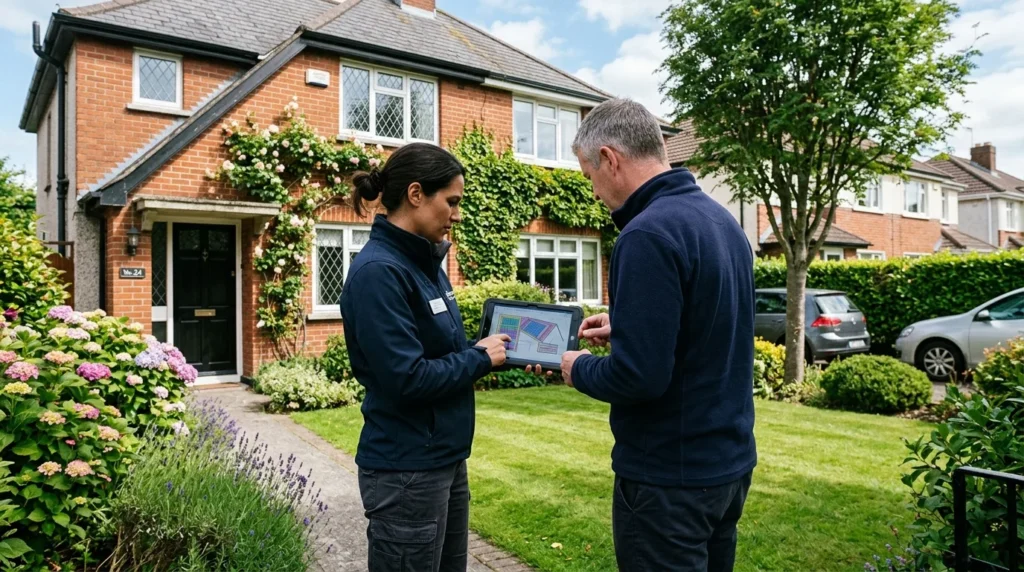
The Irish solar market has grown explosively — from a handful of specialist installers in 2018 to several hundred companies operating across all 32 counties by 2026. This rapid growth has been mostly positive: competition has driven prices down and quality up. But it has also created an uneven market where excellent SEAI-registered professionals operate alongside inexperienced traders and, occasionally, outright rogues.
Choosing a solar installer in Ireland who is competent, properly certified, and financially stable is the most important decision in your solar journey — more important than which panel brand you choose. This guide gives you the complete framework for evaluating any Irish solar company.
Step 1: Verify SEAI Registration
SEAI registration is non-negotiable — not just for grant eligibility, but as a quality floor. The SEAI Better Energy Homes scheme requires that all solar PV work be completed by a SEAI-registered solar PV installer for the installation to be grant-eligible.
How to verify:
- Go to seai.ie/grants/home-energy-grants/solar-electricity-grant/
- Use the “Find a Registered Contractor” tool
- Search by company name or installer name
- Confirm their registration is current — not expired or suspended
Important: Registrations can lapse. An installer who was registered two years ago may not be registered today. Always verify at the time of signing, not at the time of quoting.
Step 2: Check Electrical and Installation Certifications
Beyond SEAI registration, look for these additional certifications:
RECI (Register of Electrical Contractors of Ireland)
All electrical installation work in Ireland must be carried out by an RECI-registered electrical contractor. Solar PV installation involves significant electrical work (consumer unit circuits, AC wiring, DC wiring) — the company must hold current RECI registration.
Verify at: reci.ie
ECSSA (Electrical Contractors Safety and Standards Association)
ECSSA is an alternative electrical contractor certification body. RECI or ECSSA registration is required.
Safe Electric
Safe Electric certifies electrical contractors for domestic electrical work. Confirmation of Safe Electric registration is good practice.
NSAI Solar Standard (SR50)
The National Standards Authority of Ireland’s SR50 is a voluntary solar PV installation standard. Installers registered to SR50 have demonstrated adherence to Irish technical standards for solar PV installation quality.
Step 3: Check Trading History and Financial Stability
A solar installer who ceases trading in 3 years cannot honour your 5-year installation warranty or process a panel warranty claim on your behalf. Check:
Company registration:
- Look up the company on the Companies Registration Office (cro.ie)
- Check how long the company has been incorporated
- Verify the company is active (not struck off)
- Note the company directors — have they been connected to any dissolved solar companies?
Business presence:
- Does the company have a physical address (not just a PO box)?
- Do they have a local office or showroom?
- How many Google reviews do they have, and over what time period?
- Can they provide references from customers who had systems installed 5+ years ago?
Look for longevity: Companies that have been trading for 5+ years have survived the growing pains of the industry. They’ve dealt with warranty claims, ESB Networks issues, and SEAI process changes. Newer companies may be excellent, but they haven’t been proven over time.
Step 4: Evaluate the Site Survey
Any reputable solar installer will conduct a proper site survey before quoting — ideally in person, not just from Google Maps satellite imagery.
A proper site survey should include:
- Physical inspection of the roof structure (assess condition, rafter spacing)
- Roof measurement (actual dimensions, not estimated from satellite)
- Compass bearing and tilt angle measurement
- Shade assessment using a shade analysis tool (Solar Pathfinder, or software modelling)
- Consumer unit inspection (confirm it can accommodate a solar circuit without upgrade)
- Location assessment for inverter mounting
- Discussion of cable route from roof to inverter
Red flag: A quote based entirely on Google Maps imagery without a site visit — particularly for complex roofs — should be treated with caution.
Step 5: Evaluate the Quote
A professional solar quote should be fully itemised. Demand line-by-line detail:
The quote should specify:
- Panel manufacturer, model name, wattage, and efficiency
- Inverter manufacturer and model
- Presence or absence of power optimisers (and if present, which model)
- Mounting system brand
- Generation meter make/model
- Labour (number of installation days)
- Scaffolding method
- SEAI application support included?
- ESB Networks NC6 notification included?
- Whether VAT is applicable (should be zero-rated for residential solar)
A quote that just says “10 × solar panels + inverter + installation” without specific brand names is a red flag.
Compare quotes on a like-for-like basis: ensure you’re comparing the same panel brand, same inverter type, and same warranty terms — not just the bottom-line price.
Step 6: Check References
Ask every installer for at least three references from completed local installations in the past 12–18 months. Then actually contact those references. Ask:
- How was the installation process? On time, tidy?
- Any problems since installation, and how were they handled?
- Is the system performing as projected?
- Would you use them again?
Verified Google Reviews (from the company’s Google My Business profile) are useful supplementary evidence — look for recent reviews, response rate to negative reviews, and patterns in feedback.
Red Flags to Watch For
Pressure tactics:
- “This offer expires today” or “we only have one slot left this month”
- Demanding a large deposit (above 15–20%) before survey or contract signing
Too-good-to-be-true pricing:
- Quotes significantly below market (€6,000 for a 4 kWp system in 2026 should raise questions — not necessarily fake, but ask what’s been cut)
Unclear warranty terms:
- “25-year panel warranty” without specifying whether this is a product warranty or performance warranty (they’re different)
- Warranty backed only by the Irish installer, not the manufacturer
Non-specific components:
- Panels and inverters specified only by wattage, not brand
- “European-branded” as a substitute for naming the actual manufacturer
High-pressure grant urgency:
- “The SEAI grant is about to end” — this is a perennial sales tactic; the grant has existed since 2018 and has no announced end date
No proof of current SEAI registration:
- Inability to provide their SEAI contractor reference number for verification
Questions to Ask Every Installer
- Can I see your SEAI contractor reference number so I can verify current registration?
- Are you RECI-registered for electrical installation?
- Have you installed similar systems on my roof type (slate, tile, flat) in my area?
- Can you provide three recent local references I can contact?
- What specific panel model and inverter are you quoting?
- What is the annual output estimate, and what software was used to calculate it?
- What is the shading analysis result for my roof?
- Who handles the SEAI grant application and the ESB Networks NC6 notification?
- What is your installation workmanship warranty, and what does it cover?
- What happens if there’s a panel defect or underperformance claim after 10 years?
One Stop Shop vs Independent Installer
SEAI One Stop Shops (OSS) manage the entire process — grant application, survey, installation, and ESB Networks notification — in one package. Major OSS providers operating in Ireland include large national companies.
Advantages of OSS: Simpler process, grant deducted at source (no waiting for refund), single point of contact.
Disadvantages: Often priced higher; limited component choice; some OSS companies sub-contract installation to other companies you haven’t vetted.
Independent SEAI-registered installers handle their own installations and manage grant applications on your behalf (or you apply yourself).
Recommendation: Get quotes from both OSS and independent installers. Compare net price (after grant) and references. The OSS premium (if any) should be justified by genuine service value, not just convenience.
Get 3 free, no-obligation solar quotes
Tell us a few quick details about your home and we’ll connect you with up to 3 SEAI-registered solar installers in your area.
Frequently Asked Questions
How do I know if a solar installer is SEAI-registered in Ireland?
What certifications should a solar installer have in Ireland?
How many quotes should I get for solar panels in Ireland?
What is a reasonable deposit for a solar installation in Ireland?
Can I install solar panels myself in Ireland to save money?
Get 3 free quotes for your home EV charger
We'll match you with Safe Electric-certified installers who can apply for the €300 SEAI Home Charger Grant on your behalf.
- No obligation · Free · Takes 2 minutes
More solar pv guides


Sources & further reading

Solar Expert Editorial
Solar advisor team
Published 15 May 2026
Get 3 free quotes for your home EV charger
We'll match you with Safe Electric-certified installers who can apply for the €300 SEAI Home Charger Grant on your behalf.
- No obligation · Free · Takes 2 minutes