Costs & Savings

Solar Panel Leasing vs Buying in Ireland: An Honest Comparison for 2026
Home Solar guides Solar Panel Leasing vs Buying in Ireland: An Honest Comparison for 2026 Solar Panel Leasing vs Buying in Ireland: An Honest Comparison

Solar panel leasing and PPAs promise no upfront cost. But they rarely deliver the same financial return as buying. This guide gives Irish homeowners an honest comparison of leasing versus buying — with the numbers that matter.
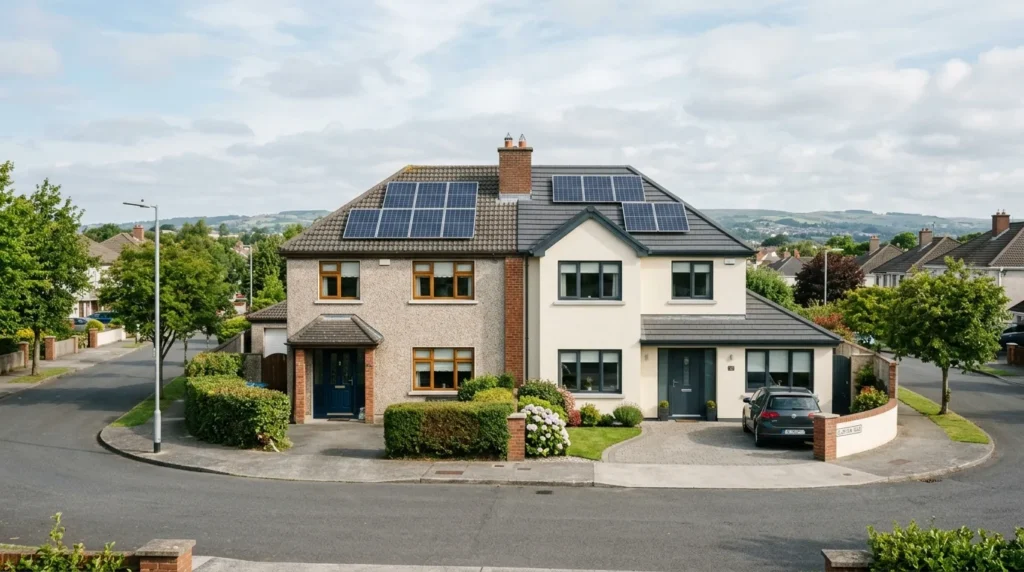
Solar panel leasing in Ireland — and its close cousin, the Power Purchase Agreement (PPA) — has grown as a financing option for homeowners who can’t or don’t want to pay upfront for solar. The core promise: get solar panels on your roof for no money down, and immediately start saving on your electricity bill.
The catch: when you don’t own the system, you give up the SEAI grant, the MSS export income, the long-term asset value, and often a significant portion of the total financial return. This guide gives you the complete picture — with real numbers — so you can make an informed decision.
You pay for the system (typically €8,000–€13,000 after the SEAI grant), own it completely, and receive all the financial benefits: self-consumption savings, MSS export income, and any property value uplift.
You pay a fixed monthly lease payment (typically €50–€120/month) to use panels installed on your roof. The leasing company owns the panels. At the end of the lease term (typically 10–20 years), you may have an option to purchase. In Ireland, true panel leasing is relatively uncommon compared to PPAs.
You sign a long-term contract (typically 10–20 years) with a solar developer who installs panels on your roof at no cost to you. You agree to buy the electricity generated at a fixed price (typically 8–18 c/kWh — below grid retail rates). The developer keeps the MSS export income and any other benefits. At contract end, you may have an option to buy the panels.
For a 4 kWp system on an Irish home, comparing outright purchase vs PPA over 20 years:
20-year net return comparison:
The financial difference is substantial. Outright ownership typically delivers 1.5–2× the lifetime financial return of a PPA.
Despite the lower financial return, PPAs have genuine advantages in specific situations:
1. Zero capital required For households with no savings and difficulty accessing loans, a PPA is the only path to solar. No credit check for the panel installation itself (though the contract is legally binding).
2. No maintenance responsibility The developer is responsible for maintaining the system. If the inverter fails, they fix it. If a panel is damaged by a storm, they replace it. You have no maintenance cost or responsibility.
3. No technology risk If solar panel technology becomes dramatically cheaper in year 5, you’re not holding a depreciated asset. The developer takes the technology risk.
4. Simplicity One contract, one party responsible. No SEAI application, no ESB Networks notification, no supplier MSS registration.
This is the most important financial point: you cannot claim the SEAI solar PV grant on a PPA system because you do not own the equipment. The grant is an owner’s incentive.
The SEAI grant of €1,800 is effectively extracted from you and retained by the developer as part of their economic model. On a system that would cost you €8,200 after grant if purchased, the developer is essentially capturing that €1,800 of public subsidy into their own return.
This is where PPAs can cause real problems for Irish homeowners.
When you sell your home with a PPA solar system:
For anyone who might sell within 10–15 years, a PPA creates real risk. Always read the exit clause carefully before signing.
A solar lease is more like a car lease: you pay a fixed monthly fee regardless of how much electricity the panels generate. If a panel is underperforming or it’s a bad summer, you still pay the same monthly amount.
A PPA ties your payment to actual generation: you only pay for the electricity produced. A bad summer month costs you less.
For most homeowners, a PPA is preferable to a lease because your payment scales with production. But both are inferior to ownership in the long run.
Consider a PPA or lease if:
For everyone else — particularly homeowners planning to stay long-term — the numbers clearly favour outright purchase with SEAI grant and SEAI green loan financing.
Before signing any PPA in Ireland:
Get independent legal advice before signing a PPA contract of 15+ years — the obligations are significant.
For the vast majority of Irish homeowners in 2026, buy your solar system — whether cash, SEAI green loan, credit union loan, or bank green mortgage. The financial return is substantially better, you own the asset, and you avoid the property sale complications of long-term third-party contracts.
If you genuinely cannot access finance, a PPA is better than no solar at all. But treat it as a last resort, not a first choice.
See our solar PV financing options guide for all the ways to finance ownership affordably.
Tell us a few quick details about your home and we’ll connect you with up to 3 SEAI-registered solar installers in your area.
We'll match you with Safe Electric-certified installers who can apply for the €300 SEAI Home Charger Grant on your behalf.
Home Solar guides Solar Panel Leasing vs Buying in Ireland: An Honest Comparison for 2026 Solar Panel Leasing vs Buying in Ireland: An Honest Comparison

Solar advisor team
Published 15 May 2026
We'll match you with Safe Electric-certified installers who can apply for the €300 SEAI Home Charger Grant on your behalf.