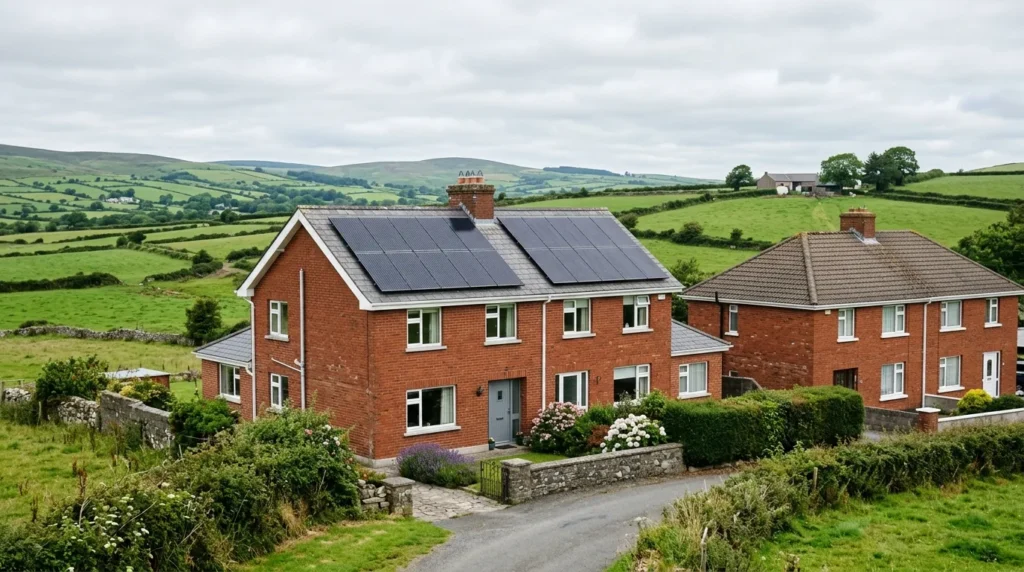
Understanding how solar panels work in Ireland starts with the photovoltaic (PV) effect — one of the most elegant discoveries in modern physics. When photons from sunlight strike a silicon semiconductor cell, they knock electrons loose and create a flow of direct current (DC) electricity. An inverter then converts that DC into the alternating current (AC) your kettle, washing machine, and lights all run on. The whole process happens silently, with no moving parts and no emissions.
What makes Ireland interesting — and often misunderstood — is the relationship between diffuse light and PV output. Many homeowners assume that Ireland’s famously grey skies make solar panels pointless. In practice, the opposite is closer to the truth. Modern monocrystalline panels are highly efficient under diffuse radiation, and Ireland’s relatively cool temperatures actually improve panel performance compared to warmer southern European countries where panels run hotter and lose efficiency.
Ireland's Solar Resource: Better Than You Think
Ireland receives between 1,000 and 1,100 kWh of solar irradiance per square metre per year (kWh/m²/yr) across most of the country, according to SEAI’s solar mapping data. The sunniest counties — Cork, Wexford, Waterford, and Carlow — regularly hit the upper end of that range. Even the northwest counties of Donegal and Sligo receive more than 950 kWh/m²/yr, which is enough to make a properly sized system financially worthwhile.
For context, Germany — Europe’s largest solar market — averages around 1,050 kWh/m²/yr at similar latitudes. Irish homeowners have been generating meaningful solar electricity for well over a decade, and the economics have only improved as panel prices have fallen by roughly 80% since 2010.
Peak Sun Hours vs. Total Irradiance
A useful planning concept is peak sun hours (PSH): the number of hours per day that the sun delivers 1,000 W/m² of irradiance. Ireland averages 2.5–3.2 PSH per day across the year, with:
- Summer months (June–August): 5–7 PSH per day
- Autumn/Spring (March–May, September–October): 2–4 PSH per day
- Winter months (November–February): 0.5–1.5 PSH per day
This seasonal variation is crucial for sizing your system and setting realistic expectations. A 4 kWp system will produce roughly 750–900 kWh in June alone but only 150–200 kWh in December. Over a full year, you can expect 850–1,050 kWh per kWp of installed capacity across most Irish locations.
The Components That Make It All Work
A residential solar PV system in Ireland is made up of several key components working together:
1. Solar Panels (PV Modules) The panels themselves contain photovoltaic cells, typically made from monocrystalline silicon. Premium brands like REC, Longi, JA Solar, and Jinko Solar dominate the Irish market. A standard 400–430 W panel measures roughly 1.75 m × 1.1 m. Most Irish domestic systems use 10–16 panels.
2. Inverter The inverter is the brain of the system. It converts DC electricity from the panels into grid-compatible 230 V AC. String inverters (from brands like Fronius, SolarEdge, and Huawei) are the most common choice. Microinverter systems from Enphase convert electricity at each individual panel. Read our guide on string vs microinverter systems for a full comparison.
3. Generation Meter All SEAI-grant-eligible systems must include a calibrated generation meter so you can track how much electricity your system produces. This data also feeds into Microgeneration Support Scheme (MSS) export calculations.
4. Export/Import Meter ESB Networks installs a smart meter (or upgrades your existing one) that records electricity you export to the grid and electricity you import. This bidirectional metering is essential for receiving export payments under the MSS.
5. Mounting System Aluminium rail systems anchor the panels to your roof. Reputable mounting brands used in Ireland include K2 Systems, Schletter, and IronRidge. The mounting must be rated for Irish wind loading — coastal counties require special consideration.
For a deep dive into all components, see our guide on solar PV system components in Ireland.
How the Grid Connection Works
Once your system is installed by a SEAI-registered installer, they apply to ESB Networks for grid connection approval. For systems up to 6 kWp (the standard domestic size), this involves a NC6 notification rather than a full application — a streamlined process that typically takes 4–8 weeks. Larger systems up to 11 kWp require an NC7 application.
After grid connection approval, your system goes live. Any electricity you generate flows first to your home appliances. Surplus electricity — whatever you don’t use at the moment of generation — flows back onto the grid automatically through your smart meter. Under Ireland’s Microgeneration Support Scheme (MSS), your electricity supplier must offer you an export tariff. In 2026, most major suppliers (Electric Ireland, Energia, Bord Gáis Energy, SSE Airtricity) pay between 18 and 21 cent per kWh for exported electricity.
What Output Can You Realistically Expect?
A typical Irish family home installs a 4–6 kWp system, which suits a south or southwest-facing roof. Expected annual output:
Self-consumption depends heavily on your usage patterns. Households with electric vehicles, heat pumps, or those who work from home consistently achieve higher self-consumption rates. A battery storage system can push self-consumption above 70%. See our analysis of solar battery storage in Ireland for more detail.
Roof Orientation and Tilt Angle
South-facing roofs at a tilt of 30–40° produce the maximum annual output in Ireland. But the falloff for other orientations is smaller than most people assume:
- South (180°): 100% of maximum output
- Southeast / Southwest (135° / 225°): ~95% of maximum
- East / West (90° / 270°): ~80–85% of maximum
- North-facing: Not recommended; output falls below 60%
A flat roof with ballasted mounting frames can achieve almost any orientation, making east-west split arrays popular on flat-roofed commercial and dormer-bungalow extensions.
Temperature and Performance
Ireland’s mild temperatures actually benefit PV performance. Solar panels lose roughly 0.35–0.45% of output per degree Celsius above 25°C (this is called the temperature coefficient). On a clear summer day in Cork, a panel might reach 45–50°C on its surface — losing 7–10% of its rated output. In hotter climates like Spain, panels might hit 70°C and lose 15–20%. Irish summers are cooler, so real-world losses are lower, partially compensating for lower irradiance versus southern Europe.
Does Shade Affect Output?
Shading is the enemy of solar PV output. Even partial shading of one panel in a string can drag down the entire string’s output in a standard string inverter system. Power optimisers (SolarEdge DC optimisers) and microinverters (Enphase IQ8 series) mitigate this by allowing each panel to operate independently. If your roof has chimneys, dormers, or nearby trees that cast shadows, a system with panel-level optimisation is strongly recommended. See our guide on power optimisers explained for details.
The Financial Case in 2026
Understanding how solar panels work in Ireland is only half the story — the other half is the economics. In 2026, a 4 kWp system costs approximately €9,000–€11,000 before the SEAI grant. The SEAI Solar PV grant provides €900 per kWp up to 4 kWp, capped at a maximum of €1,800 for systems 2 kWp and above under the current 2026 rate structure. After the grant, a 4 kWp system typically nets out at €7,200–€9,200.
With annual bill savings of €900–€1,400 and MSS export income of €200–€400 per year, payback periods of 6–9 years are common. Given that quality panels carry a 25-year performance warranty, the return on investment over a system’s lifetime is substantial. See our detailed solar panel payback period guide for a full worked example.
Key Takeaways
- How solar panels work in Ireland is no different from anywhere else — the photovoltaic effect converts sunlight to DC electricity, an inverter makes it usable
- Ireland’s 1,000–1,100 kWh/m²/yr irradiance is sufficient for a strong financial return
- Diffuse light works for PV; Ireland’s cool temperatures help efficiency
- A 4 kWp south-facing system will produce 3,600–4,200 kWh/year
- ESB Networks NC6 notification covers most domestic systems
- MSS export tariffs of 18–21 c/kWh make exporting surplus electricity worthwhile
- Payback periods of 6–9 years are typical; panels last 25+ years