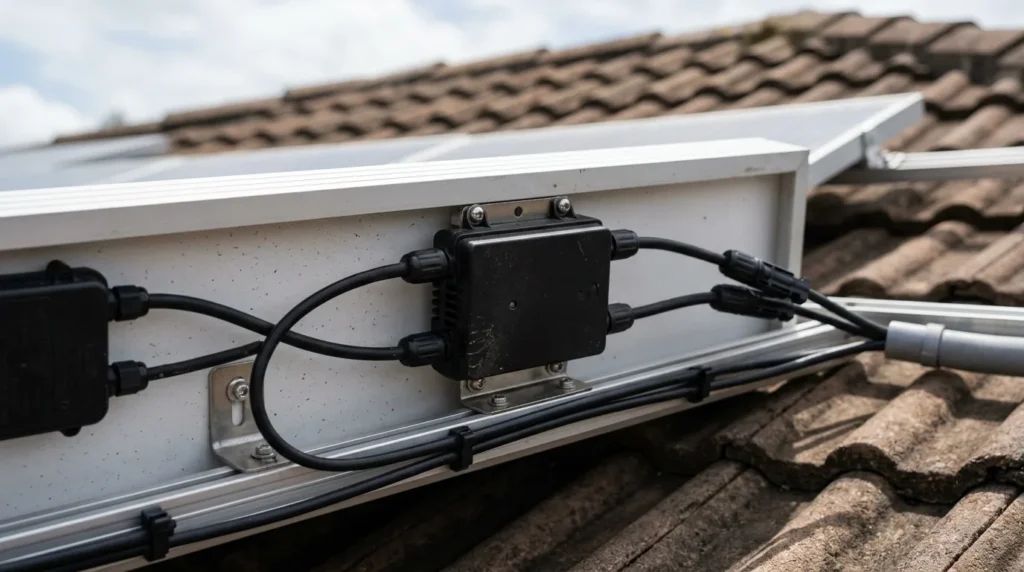
Solar power optimisers are DC devices that attach to each solar panel and condition its output independently before the electricity reaches the central inverter. They solve one of the most frustrating problems in traditional string solar PV systems: the shade cascade effect, where partial shading of just one panel drags down the output of all other panels in the same string.
But not every Irish roof needs power optimisers. This guide explains exactly when they add genuine value, when they’re an unnecessary cost, and how they compare to the alternative — microinverters.
What Is the Shade Cascade Problem?
In a traditional string inverter system, solar panels are wired in series — like links in a chain. Each panel contributes its current to the string. But here’s the key constraint: the string current is limited by the lowest-performing panel.
Imagine 10 panels in a string. Nine produce 8.5 amps each. One panel is partially shaded by a chimney and produces only 4 amps. Because the string operates at the current of the weakest panel, all 10 panels effectively produce at 4 amps — losing more than 50% of the string’s potential output during that shading event.
This is sometimes called the “Christmas light effect” — because old-style Christmas lights would all go out when one bulb failed.
Power optimisers solve this problem.
How Power Optimisers Work
A power optimiser is a small box (typically about 20 × 10 × 4 cm) that mounts on the back of each panel or on the mounting rail. Inside, it contains:
- An MPPT (Maximum Power Point Tracking) controller for that individual panel
- A DC-DC converter that adjusts the panel’s output to an optimal voltage/current for the central inverter
- Communication circuitry (for monitoring)
Each optimiser allows its panel to operate at the exact voltage and current combination that maximises output — regardless of what adjacent panels are doing. The optimised DC output from all panels feeds into the central string inverter for AC conversion.
The result: Shading on panel 6 reduces only panel 6’s output. Panels 1–5 and 7–10 continue operating at full capacity.
SolarEdge: The Dominant Power Optimiser System in Ireland
SolarEdge Technologies pioneered the panel-level DC optimiser approach and remains the dominant brand in Ireland and across Europe. The SolarEdge ecosystem consists of:
- P-series or S-series DC power optimisers (on each panel)
- SolarEdge HD-Wave inverter (central inverter, single or three-phase)
- SolarEdge monitoring portal (per-panel real-time data)
Popular SolarEdge optimiser models in Ireland:
- P370: For 250–370 W panels (older systems)
- P405: For 300–405 W panels
- P500: For 360–500 W panels (most common for 400–440 W modern panels)
- S500: For 300–500 W panels (newer, with module-level shutdown)
All SolarEdge optimisers carry a 25-year warranty — identical to panel warranties. This is a compelling differentiator: if you buy a SolarEdge system, you’re not budgeting for optimiser replacement any more than panel replacement.
SolarEdge SafeDC™: When the SolarEdge inverter is off (at night, during maintenance, or in an emergency), all optimisers automatically reduce panel voltage to approximately 1 V. This is an important safety feature — the DC string voltage is only “live” (high voltage) when the inverter is actively operating. This reduces risk for firefighters and maintenance staff.
Tigo Energy: An Alternative Optimiser Approach
Tigo Energy offers a different approach: selective optimisation — you only install optimisers on shaded or problematic panels, not all panels. The Tigo TS4-A-O optimisers can work with string inverters from any brand (Fronius, Huawei, Sungrow) without requiring a proprietary inverter.
When Tigo selective optimisation makes sense:
- Just 1–3 panels are affected by shade (chimney, aerial)
- You want to add shade mitigation to an existing Fronius or Huawei system
- You want to avoid the cost of SolarEdge optimisers on every panel when most are shade-free
Tigo pricing: Individual Tigo TS4-A-O optimisers cost approximately €80–€120 each installed, versus €100–€160 each for SolarEdge P500 optimisers installed. For selective deployment on 2–4 shaded panels, Tigo can be significantly more cost-effective than full SolarEdge.
Power Optimisers vs Microinverters: Key Differences
Both solve the shading problem — but differently:
Power Optimisers (SolarEdge)
Where DC→AC conversion happens
Central inverter required
Yes (must replace in 10–15 years)
Optimiser/microinverter warranty
Partial shading mitigation
The main practical difference: with microinverters, there is no central inverter that will need replacing. With power optimisers, you still have a central SolarEdge inverter (standard warranty 12 years, extendable to 25 years). Over 25 years, the microinverter approach may have slightly lower maintenance costs — but the SolarEdge extended warranty option levels this out.
When Power Optimisers Are Worth It in Ireland
Clear “Yes” Scenarios:
- Chimney shading on south-facing slope: The single most common scenario in Irish semi-detached houses. A chimney casting a shadow on 1–3 panels causes disproportionate string losses without optimisers.
- Neighbouring building shading: Common in tightly-packed Dublin suburban estates where morning or afternoon sun is blocked by adjacent roofs.
- Multiple roof orientations: If you have panels on both south and southeast slopes, separate MPPT tracking per panel (via optimisers) significantly outperforms string operation.
- Dormer protrusion shading: Dormer surrounds or window reveals casting shadow on nearby panels.
- Trees: Deciduous trees nearby cast shade that moves seasonally — optimisers handle this well.
Clear “No” Scenarios:
- Open rural bungalow with clean south-facing roof: No shading → optimisers provide minimal benefit. Save the money and buy a better panel or battery.
- New-build with roof designed for solar: Properly oriented, unshaded new build roofs rarely need optimisers.
- Tight budget: If the €800–€1,500 optimiser premium means you can’t afford the system at all, a basic string inverter on an unshaded roof is far better than no solar.
Real-World Shade Analysis: What to Ask Your Installer
Before your installer recommends power optimisers, insist on a professional shade analysis:
Software shade modelling: Tools like PVsyst, PVSOL, or the SolarEdge Designer app can model the shadow path from your chimney, neighbouring rooftop, or trees across the entire day and year, showing expected shading losses.
Annual shading loss percentage: Ask for the calculated shading loss without optimisers vs with optimisers. If the difference is under 3%, optimisers may not pay back. If the difference is 8–15%, they almost certainly will.
Specific panel placement: A good installer designs the panel layout to minimise shading on the strings even before recommending optimisers — moving strings away from the shadow path.
Cost and Payback for Power Optimisers
For a 10-panel (4 kWp) system with full SolarEdge optimisation:
Annual Output Loss (Shading)
Output Recovery with Optimisers
Conclusion: Power optimisers have strong financial payback when shading losses are significant (above 10%). Below 5% shading loss, the payback is too long to justify the expense.