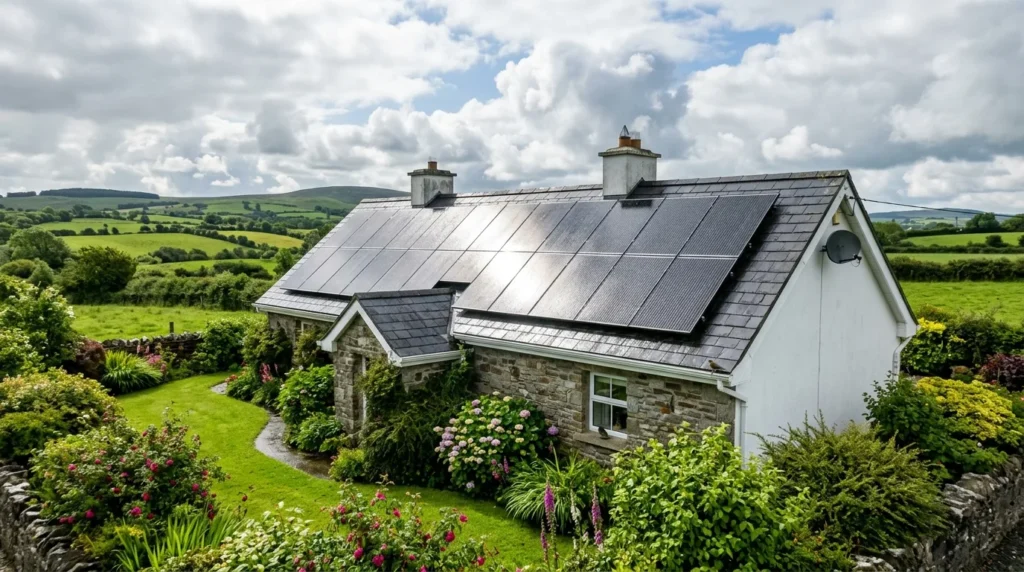
One of the most appealing things about solar PV is its genuinely low solar panel maintenance requirement. No moving parts, no fuel, no combustion — just silent electricity generation year after year. In Ireland specifically, the climate’s frequent rainfall acts as a natural cleaning mechanism that reduces maintenance needs compared to drier climates.
That said, “low maintenance” is not “zero maintenance.” A 25-year asset worth €10,000+ deserves annual attention. This guide explains what needs to be done, when, and how to spot problems before they become expensive.
Does Rain Clean Solar Panels in Ireland?
Yes — and it does a better job than most homeowners expect. Ireland’s rainfall is frequent enough to rinse dust, pollen, and light soiling from panel surfaces regularly. Studies of solar PV in the UK and Ireland consistently show that soiling losses (reduction in output due to surface contamination) are typically 1–3% per year — far lower than the 5–10% seen in drier Mediterranean or Middle Eastern climates.
The self-cleaning mechanism works because:
- Rainfall washes light dust and pollen off the glass surface
- Panels are inclined at 25–45°, so water runs off taking particles with it
- Ireland’s relatively low dust levels (no Saharan dust events common in southern Europe) mean light soiling is the norm
The exception: Bird droppings. Unlike rain-washed dust, dried bird droppings adhere strongly to the glass and create concentrated localised shading. A dropping covering a small area of a cell can disproportionately reduce that cell’s output through what is called a hot spot — where the shaded area heats up as it tries to pass current from the rest of the string, potentially causing cell damage over time.
When to clean for bird droppings:
- If you can see heavy bird droppings from ground level
- If your monitoring shows one panel producing noticeably less than adjacent panels (Enphase Enlighten and SolarEdge monitoring will show this)
- In spring (nesting season) and autumn (migration season) in areas with starling or seagull populations
How to Clean Solar Panels in Ireland
Option 1: Let the Rain Do It (Standard Approach)
For most Irish homeowners on most roofs, rainfall cleaning is sufficient. Check visually in spring and autumn. If the panels look clean from ground level and monitoring shows expected output, no cleaning is needed.
Option 2: Hosepipe Rinse from Ground
For panels with visible light soiling that a dry spell hasn’t washed off:
- Use a garden hose with a good spray attachment
- Rinse early morning (before panels heat up — thermal shock from cold water on a hot panel is theoretically possible, though rare in Ireland)
- Spray from ground level if you can reach the panels
- No detergent needed — plain water is sufficient
Option 3: Professional Panel Cleaning
If you have significant bird droppings, moss, lichen, or other stubborn contamination:
- Professional solar panel cleaning services cost approximately €100–€250 for a standard residential system
- They use specialist soft brushes, water-fed poles, and demineralised (pure) water
- Demineralised water is preferred as it leaves no limescale residue after evaporation
- Never use abrasive materials, solvents, or standard tap water (leaves mineral deposits)
- Never go on the roof yourself unless you have proper fall arrest equipment — most solar panel faults do not justify DIY roof access risk
What Not to Do
- Don’t use pressure washers — can penetrate the panel frame seals and damage the junction box
- Don’t use household detergents or dish soap — can leave a residue that attracts more dust
- Don’t walk on panels or lean on them
- Don’t clean on a hot sunny day when panels are generating at full output
Moss and Lichen: The Irish-Specific Problem
Ireland’s damp climate creates conditions that can support moss and lichen growth on roof surfaces — and potentially on the panel edges and frames. While the panel glass itself is smooth and resistant to organic growth, the mounting rails and panel frames can accumulate moss over time, particularly on north-facing adjacent sections.
Signs of a problem:
- Moss visible on panel frames or between panels and roof tiles
- Lichen (grey/green crusty growth) on panel frames or mounting
Remediation:
- Biocide treatment (diluted moss killer) applied to surrounding roof tiles
- Professional cleaning service to physically remove moss from panel frames
- Ensure adequate ventilation gap between panels and roof to reduce moisture retention
Annual Check: What to Inspect
Once a year (spring is ideal), run through this checklist:
Visual Inspection from Ground Level
- Can you see any cracked, discoloured, or heavily soiled panels?
- Are all panels still sitting properly on the mounting rails (no visible displacement)?
- Is the inverter indicator light green/normal? (Check manufacturer’s indicator guide)
- Any visible damage to cables visible at roof edge or inverter cable entry?
Monitoring Data Review
Access your inverter’s monitoring portal (Fronius Solar.web, SolarEdge monitoring, Enphase Enlighten):
- Compare total annual output against the projected annual output from your installer’s quote
- Check month-by-month output against expected monthly figures (accounting for weather)
- Look for any panels consistently underperforming versus neighbours (on Enphase or SolarEdge monitoring)
- Review any fault alerts or error codes logged during the year
What’s “normal” variation: Output within 5–10% of projection is completely normal year-to-year due to weather variation. Output more than 15% below projection warrants investigation.
Generation Meter Reading
Read your generation meter and compare to:
- The previous year’s reading
- The monitoring system’s recorded output (they should match to within 1–2%)
Large discrepancies between generation meter and monitoring data can indicate a faulty CT clamp, monitoring connection issue, or metering fault.
Inverter Maintenance
String inverters (Fronius, SolarEdge, Huawei, Sungrow) require minimal maintenance but benefit from:
Annual check:
- Confirm the inverter ventilation grille is unobstructed (no dust accumulation blocking airflow)
- Check for moisture ingress signs at cable entry points
- Confirm the green/operating indicator is illuminated
- Check for any error codes in the monitoring portal history
DC isolator check:
- The DC isolator (usually red, mounted near the inverter) should be in the “on” (closed) position during daylight hours
- Occasionally the DC isolator can be accidentally switched to “off” (e.g., during electrical work) — this stops generation
- If output drops to zero on a sunny day, check the DC isolator first
Inverter filters: Some older inverter models have dust filters that need annual cleaning. Check your specific inverter manual for filter maintenance requirements.
Five-Year Checks: Professional Inspection
Every 5 years (or if you suspect a fault), a professional PV system inspection is worthwhile:
What a professional inspection covers:
- Thermal imaging of panels (identifies hot spots, cell failures, junction box issues)
- Insulation resistance testing of DC cables
- IV curve tracing (measures each panel’s actual output vs rated output)
- Mounting system inspection (checking for corrosion, loose fixings, damaged hooks)
- Roof penetration inspection (checking waterproofing seals)
Cost: €200–€500 for a standard residential system inspection Providers: Some SEAI-registered solar installers offer inspection services; specialist PV maintenance companies operate in all major Irish cities
Monitoring: Your Year-Round Maintenance Tool
The most powerful maintenance tool you have is your monitoring system. Check it regularly:
- Daily (takes 30 seconds): Is the system generating? Is the power figure reasonable for current weather?
- Monthly: Review monthly total versus expected monthly production
- Annually: Compare annual total versus projection; check for any historical fault alerts
The monitoring app will often identify problems before you’d notice them on your electricity bill. A failing panel or degrading inverter shows up in monitoring data weeks or months before it significantly affects your electricity bill.
Common Issues and When to Call a Professional
Zero generation on a sunny day
DC isolator off, inverter fault, grid outage
Check DC isolator; check inverter display; contact installer if persistent
Output 20%+ below projection
Panel fault, shading change, soiling
Check monitoring for specific underperforming panel; clean if soiled; call installer if panel fault suspected
Hot spot, cell failure, bird dropping
Check for visible dropping; clean; call installer if persists after cleaning
Intermittent loss of generation
Inverter communication fault, WiFi dropout
Check inverter WiFi connection; reset monitoring gateway if needed
Generation meter reading doesn't match monitoring
CT clamp fault, metering issue
Various — check specific code in manual
Most are transient; persistent codes → contact installer
Always contact a SEAI-registered professional for any suspected panel, inverter, or wiring fault. Never attempt electrical repairs yourself.