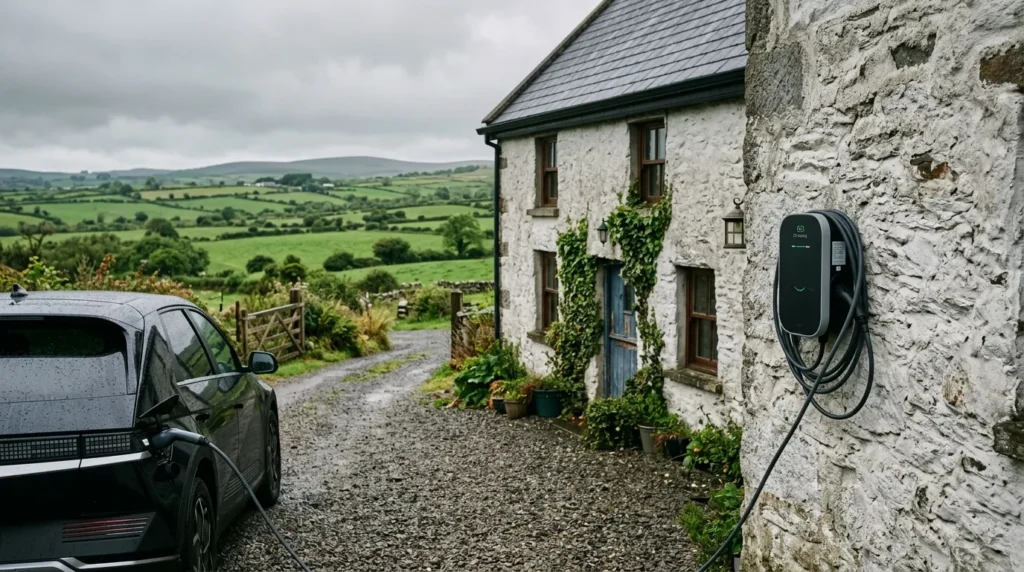
Rural Ireland: Often the Best Scenario for Home EV Charging
If you live in a rural property in Ireland — a detached farmhouse, bungalow, or country home — you are very likely in an excellent position for home EV charging. Rural properties typically feature:
- Generous parking space, usually on-site and close to the house
- Larger service heads — many rural properties have 15 kVA or larger supply heads, compared to the 7.2 kVA standard in urban areas
- Potential three-phase supply — a significant proportion of rural Irish homes have three-phase supply, enabling faster 11 kW or 22 kW AC charging
- South-facing rooftops suitable for solar PV, creating the ideal combination of EV home charging and solar generation
- Less exposure to overnight tariff complexity — rural residents often drive longer distances and benefit even more from low overnight rates
The main challenges for rural installations are longer cable runs within larger properties, potentially older electrical infrastructure, and in some areas, older ESB Networks low-voltage network infrastructure that may need assessment before a high-power charger is connected.
Checking Your Supply: Three-Phase or Single-Phase?
The first thing to establish is whether your property has single-phase or three-phase supply from ESB Networks. This determines the maximum charging speed available.
How to check:
- Look at your main fuse / service head — three-phase supplies have three fuses or MCBs (one per phase); single-phase has one.
- Check your ESB Networks connection agreement (available via your MPRN)
- Ask your electrician during the site survey — a qualified electrician can identify three-phase supply immediately from your consumer unit.
Single-phase (most homes): Maximum 7.4 kW home charging. Suitable for all EVs sold in Ireland.
Three-phase (common in rural Ireland): Maximum 22 kW home AC charging. Unlocks the faster on-board chargers of vehicles like the VW ID series (11 kW OBC) and Renault Zoe (22 kW OBC).
If you have three-phase supply and a car with an 11 kW or higher OBC, installing an 11 kW three-phase wallbox is worthwhile — it roughly halves your daily charging time compared to single-phase 7.4 kW.
ESB Networks Notification for Rural Properties
For rural properties installing chargers above 7 kW, ESB Networks notification is required before installation. In urban areas, this is usually a formality. In rural areas, it may require a more detailed network assessment.
Some older rural low-voltage (LV) networks were designed for much lower demand than modern homes with EVs, heat pumps, and electric cookers draw. ESB Networks assesses whether the connection point can support the additional load. In the majority of cases this is approved without issue, but in some areas ESB Networks may require network reinforcement work before approving a high-power charger. This work is done by ESB Networks at their cost, not yours — but it can add weeks or months to the timeline.
For a standard 7.4 kW single-phase charger, no notification is required in most cases, making it the simplest path to getting started quickly.
Cable Runs on Large Rural Properties
Rural homes often have larger floor plates and longer distances between the consumer unit and the ideal charger location. A farmhouse might have a consumer unit in the utility room at the back of the house, with the ideal charger position being at the front of a large yard — a cable run of 40–60 metres or more.
At these distances, cable sizing becomes important:
- 6mm² cable is adequate up to approximately 25–30 metres at 7.4 kW (32A)
- 10mm² cable is recommended for runs of 30–60 metres to keep voltage drop within BS 7671 limits
- 16mm² cable may be needed for very long runs (60+ metres)
Armoured cable (SWA) is the correct product for underground or exposed runs in rural settings where livestock, vehicles, or ground movement could damage unprotected cable. Your electrician should specify SWA for any outdoor buried run and ensure it is buried at least 500mm deep in appropriate ducting.
The Solar EV Charging Opportunity in Rural Ireland
Rural properties with south-facing rooftops are ideally positioned to combine solar PV with EV home charging — arguably the most cost-effective energy combination available to Irish households in 2026.
A typical 10–12 panel (4 kW peak) solar PV system on a rural Irish home generates approximately 3,500–4,000 kWh per year. An EV driven 15,000 km per year consumes roughly 3,000 kWh for home charging (at approximately 20 kWh/100 km). In summer months, a solar PV system can supply a significant proportion of EV charging needs directly from sunlight.
The MyEnergi Zappi is the charger of choice for Irish solar homes — it can divert excess solar generation to EV charging instead of exporting it to the grid at the low export tariff rate. When solar output exceeds household demand, the Zappi automatically diverts the surplus to charge the EV. This is particularly valuable in rural areas where the MPRN microgeneration export rate from SSE Airtricity, Electric Ireland, or Energia may be as low as 18–21 c/kWh — often less than the import rate for home use.
See our guide Solar EV Charging Economics in Ireland for a full financial analysis.
Outbuilding and Barn Installations
Many rural properties have outbuildings, barns, or garages separate from the main house where a car is stored or maintained. Installing a charger in an outbuilding is a perfectly valid option, but introduces additional considerations:
- Separate electrical supply: Outbuildings connected via an overhead or underground feed may have their own sub-consumer unit. The charger can be connected to this sub-board, but the main house consumer unit capacity must still be assessed.
- Dedicated circuit from main house: If the outbuilding does not have an adequate electrical supply, a new dedicated cable from the main house consumer unit may be needed — this can be a significant civil works job across a farm yard.
- Safety: Outbuildings with livestock present require careful cable routing and protection. IEC 60364-7-705 (agricultural premises) applies.
For a straightforward rural garage installation, costs are comparable to a standard house driveway installation — €1,100–€1,500 before the SEAI grant.
Smart Tariffs for Rural Drivers
Rural EV owners typically drive more kilometres than urban drivers and therefore have more to gain from cheap overnight charging. The EV-specific smart tariffs available in Ireland in 2026 offer night-rate pricing of 12–15 c/kWh:
- Electric Ireland Night Boost: night window typically 23:00–08:00 at ~13 c/kWh
- Energia Smart Drive: EV-optimised tariff with overnight rates around 12–14 c/kWh
- Bord Gáis EV Tariff: smart tariff with EV night rate approximately 11–13 c/kWh
- SSE Airtricity EV: overnight rate approximately 13–15 c/kWh
For a rural driver covering 25,000 km per year (typical for rural Ireland), switching from public rapid charging (40 c/kWh) to home night-rate charging (13 c/kWh) saves approximately €1,500–€2,000 per year in energy costs alone — making the home charger investment recover itself in under 12 months.
Summary: Rural Ireland EV Charging Checklist
- Check whether you have single-phase or three-phase supply before choosing charger power level
- Notify ESB Networks if installing above 7 kW
- Specify 10mm² or 16mm² cable for long runs
- Use armoured (SWA) cable for any outdoor or underground routes
- Consider the MyEnergi Zappi if you have or plan solar PV
- Apply for the €600 SEAI Home Charger Grant via seai.ie
- Switch to an EV smart night tariff to maximise savings