How Do EV Chargers Work? A Plain-English Guide for Irish Homeowners
Home Solar guides How Do EV Chargers Work? A Plain-English Guide for Irish Homeowners How Do EV Chargers Work? A Plain-English Guide for Irish Homeowners

Before you spend €1,100–€1,500 on a home charger, it helps to understand what the box on your wall actually does. This guide explains EV charging from the ground up — no jargon.
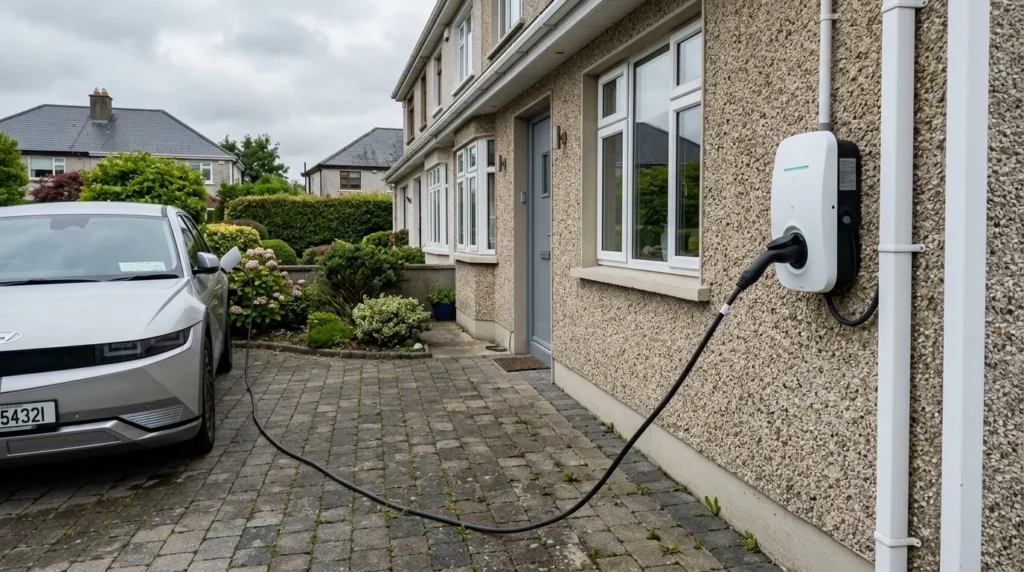
Most Irish EV owners treat their home charger like a kettle — plug it in, press go, walk away. That works perfectly well, but a basic understanding of what is happening inside the system helps you choose the right charger, troubleshoot problems, and take full advantage of smart tariffs like Electric Ireland Night Boost or Energia Smart Drive.
At its simplest, a home EV charger does three things: it takes alternating current (AC) from your household wiring, communicates with your car to agree on how much power to deliver, and regulates the flow until the battery is full.
Your home electricity supply — and everything that comes down the wires from ESB Networks — is alternating current (AC). But your car’s battery stores energy as direct current (DC). The conversion from AC to DC does not happen in the wallbox on your wall; it happens inside the car itself, in a component called the on-board charger (OBC).
This matters because the OBC has a maximum power rating. A Volkswagen ID.4, for example, has an 11 kW OBC. Even if you install a 22 kW wallbox, the car will only accept 11 kW. Installing a charger that exceeds your car’s OBC rating is not harmful, but it is unnecessary — and more expensive. For most Irish households, a 7.4 kW single-phase charger is the sweet spot: it matches or exceeds the OBC of most popular EVs and it works on a standard Irish single-phase supply.
The socket on a Type 2 charger contains a dedicated control pilot (CP) wire. When you plug in, the charger sends a small pulse-width-modulated (PWM) signal down the CP wire. The width of each pulse encodes the maximum current the charger can supply. The car reads this signal and adjusts its on-board charger accordingly.
This handshake is defined by IEC 61851-1, the international standard for EV conductive charging. It is why a 7.4 kW charger will never accidentally push 22 kW into a car — the pilot signal physically limits what the car draws. This built-in safety mechanism is one reason home EV charging is safer than many homeowners expect.
The technical term for your home charging unit is EVSE: Electric Vehicle Supply Equipment. It is not, strictly speaking, a charger — it is sophisticated supply equipment that manages safety and communication. The actual charger lives in the car.
A typical EVSE like the Easee One or Wallbox Pulsar Plus contains:
Most modern chargers sold in Ireland support OCPP (Open Charge Point Protocol), an open standard that lets the charger communicate with a cloud back-end. This is what enables:
SEAI’s Home Charger Grant requires that any charger funded under the scheme is OCPP-compliant and capable of smart charging. This is a condition of the grant, not just a nice-to-have.
Every Irish property has a Meter Point Reference Number (MPRN) — a unique identifier for your electricity connection. When you apply for the SEAI Home Charger Grant, you need your MPRN to link the grant to your specific property. You can find it on your electricity bill, or by calling your supplier.
For chargers rated above 7 kW (such as 11 kW or 22 kW three-phase units), you are also required to notify ESB Networks before installation — this is a regulatory obligation under the Distribution Code. Your MPRN is the reference ESB Networks uses to assess whether your local network can support the additional load.
A charge session is rarely a flat line. Most EVs use CC/CV charging (constant current / constant voltage):
This is why charging from 20% to 80% is much faster than charging from 80% to 100%, and why most manufacturers (and smart chargers) suggest stopping at 80% for daily use.
Most Irish homes are connected to single-phase supply, which supports a maximum of 7.4 kW for EV charging (at 32A on a 230V circuit). Some properties — particularly newer builds and rural homes served by 10 kVA or larger service heads — have three-phase supply, which supports up to 22 kW (3 × 7.4 kW).
If you are not sure what supply you have, check your main fuse — a single-phase supply typically has one fuse (or MCB) per phase, while three-phase will have three. Your ESB Networks connection agreement will also state the supply type.
One detail that catches Irish homeowners out is the Type B RCD requirement. Standard household RCDs are Type A — they detect AC fault currents. But EV chargers can generate small DC residual currents that blind a Type A RCD, leaving you unprotected.
IEC 60364-7-722 (which Ireland has adopted) requires either:
Most modern wallboxes — including the Easee One, MyEnergi Zappi, Ohme Home Pro, and Wallbox Pulsar Plus — have DC fault detection built in, which means they can be used with a standard Type A RCD on the incoming circuit. This is worth confirming with your installer before they order equipment.
The SEAI Home Charger Grant pays €600 towards the cost of supply and installation of a home EV charger. To qualify in 2026:
The grant is paid after the installation is complete and the certificate of completion is uploaded. Typical net cost after grant: €500–€900 for supply and installation, depending on the charger model and how straightforward the wiring run is.
A home EV charger is an EVSE — it supplies controlled AC power, communicates with the car via a pilot signal, and includes safety devices mandated by Irish and EU electrical standards. The actual AC-to-DC conversion happens in your car. Smart chargers add OCPP cloud connectivity so you can schedule charging to coincide with cheap night-rate tariffs, typically saving Irish EV owners €400–€700 per year compared to public rapid charging.
Understanding these basics means you can have an informed conversation with your installer, choose the right charger for your car’s OBC rating, and configure smart scheduling from day one.
Tell us a few quick details about your home and we’ll connect you with up to 3 SEAI-registered solar installers in your area.
We'll match you with Safe Electric-certified installers who can apply for the €300 SEAI Home Charger Grant on your behalf.
Home Solar guides How Do EV Chargers Work? A Plain-English Guide for Irish Homeowners How Do EV Chargers Work? A Plain-English Guide for Irish Homeowners

Solar advisor team
Published 15 May 2026
We'll match you with Safe Electric-certified installers who can apply for the €300 SEAI Home Charger Grant on your behalf.