The Terraced House Problem
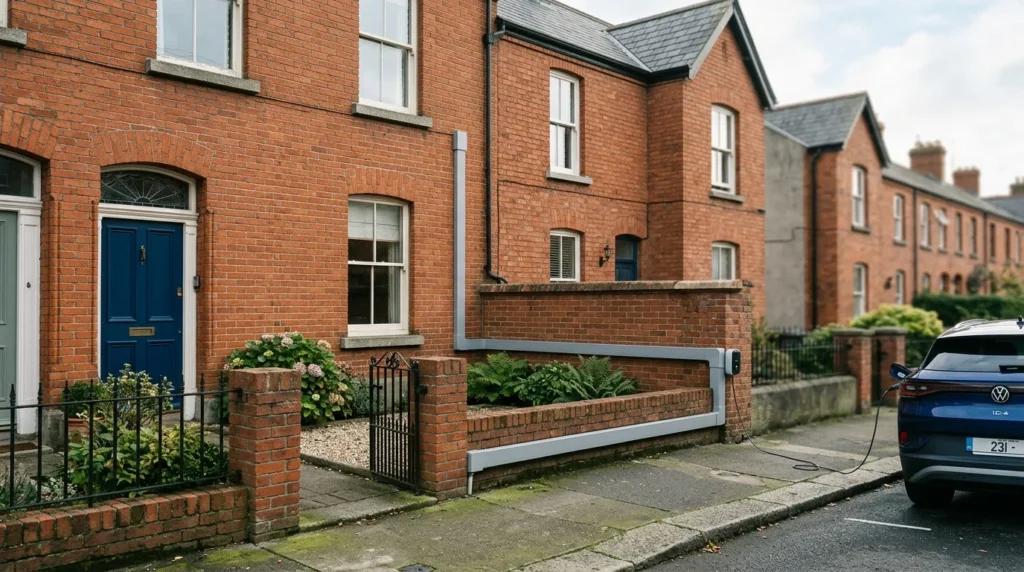
Ireland’s housing stock is dominated by Victorian, Edwardian, and 1960s–1980s terraced and semi-detached houses — millions of which have no off-street parking. For residents of these homes, the dream of plugging in at home every night faces a real obstacle: the car parks on the public road, and the distance from your consumer unit to your car may be 15–30 metres.
This is not an unsolvable problem, but it does require a different approach from the straightforward driveway installation. Let us work through your realistic options in Ireland in 2026.
Option 1: Cable from House to Kerb
The most straightforward solution for terraced houses is to run a cable from your household supply, through the front wall of the house, and down to the kerb level, where a charge point is positioned on your boundary wall or a post at the roadside edge of your property.
Is this legal? Running a cable across a public footpath — even temporarily, even in a cable protector — is generally not permitted in Ireland, as the footpath is public land maintained by the local authority. Tripping hazards and liability make this approach problematic and most councils will not issue permission. Do not plan this as a permanent solution.
On the boundary wall: If your property has a boundary wall at the footpath edge, you may be able to mount a compact charge point on that wall, with a short cable to the car. The charge point would face outward toward the car park. Planning permission may be required depending on the wall height and local authority requirements. This is technically feasible but requires careful engagement with your local council’s planning department and confirmation from your insurer about charging equipment on a boundary wall facing a public road.
Undergrounding across footpath: In some cases, local authorities will permit a homeowner to install underground ducting beneath the footpath to a flush kerb-level service box, similar to telecommunications ducts. This requires a section 254 licence from the local authority and can cost €2,000–€5,000 in civil works alone, making it an expensive solution. Some local authorities in Dublin, Cork, and Limerick have been more accommodating of these requests as EV adoption grows.
Option 2: Lamppost and Utility Pole Chargers
Several local authorities in Ireland, particularly Dublin City Council, have begun installing lamppost-integrated EV chargers — small charge units built into existing street lighting columns. These deliver typically 3.7–7.4 kW and are accessible to any nearby resident.
The key players rolling out lamppost EV charging in Ireland include:
- Connected Kerb (operating UK and expanding to Ireland)
- Believ (formerly Pod Point infrastructure)
- EasyGo and ESB eCars (expanding on-street infrastructure)
If your local authority has a lamppost charger within 50 metres of your usual parking spot, this can be a practical day-to-day solution. Cost is typically 30–45 c/kWh, which is more expensive than home night-rate charging but far cheaper than motorway DC rapid charging.
Contact your local authority (Dublin City Council, Cork City Council, etc.) to ask about planned kerbside charging rollout in your area, or check the Charge.ie network map.
Option 3: Nearby Public Charge Points
Many Irish town centres, supermarkets, shopping centres, and car parks now have public AC charge points (typically 7.4 kW or 22 kW). If you can build a regular habit of charging at a nearby public point, this may be your most practical short-term solution.
Destination charging: IKEA, Lidl, Aldi, Tesco, and many other large retailers now offer free or low-cost EV charging while you shop. If your shopping routine includes a 45-minute supermarket visit once or twice per week, plugging in while you shop can add 30–45 km of range per session.
Cost comparison: Public AC charging typically costs 25–40 c/kWh. On a 60 kWh battery, a full public charge costs €15–€24 — still considerably cheaper than petrol but roughly 2–3 times the cost of home night-rate charging.
Option 4: Install a Home Charger Now, Use It When You Get a Drive
Some terraced house owners install a home charger pre-emptively — either because they are planning to pave a front garden in the future, or because they park in a rear lane or yard when available. The SEAI grant is worth claiming while it is available (the €600 grant terms may change in future years), and the cost of retrofitting once you have off-street parking is lower if the cable infrastructure is already in place.
This is particularly relevant in parts of Dublin, Cork, and Galway where councils are allowing (or even encouraging) the replacement of front gardens with permeable paving for parking.
Option 5: Workplace Charging as Your Primary Method
If your employer provides workplace EV charging — increasingly common in Ireland in 2026, with many large employers offering free or subsidised charging — this can supplement or replace home charging for the majority of your charging needs. Combined with occasional public charging, workplace charging can make EV ownership entirely practical even without home charging.
The Revenue Commissioners provide tax relief on employer-provided EV charging as a benefit-in-kind exemption (it does not count as a taxable benefit up to specified limits).
The SEAI Grant for Terraced Houses
The €600 SEAI Home Charger Grant is available to terraced house residents — provided the charger is installed on the property (i.e., on your side of the boundary). This typically means installing a charger on the front wall of the house or in a rear yard, not on public land.
If you are in the enviable position of having rear access or a rear yard where you can park, a standard driveway-style installation on the rear wall qualifies for the full grant just as any other property would.
For wall-mounted installations on the front boundary wall, SEAI will consider grant applications on a case-by-case basis — check with SEAI directly before proceeding.
What to Do Right Now
- Map your local public charging options using the Charge.ie network map or Zap-Map
- Contact your local authority about kerbside charging rollout plans
- Ask your employer about workplace charging provision
- Check rear access — many terraced homes have rear lanes that allow a rear-yard charger
- Monitor local planning decisions — front garden parking permissions are becoming more common in Dublin suburbs
The terraced house situation is genuinely the most challenging scenario for Irish EV owners, but it is one that a combination of public infrastructure, employer charging, and creative home solutions can resolve for the vast majority of drivers.