What Is the Difference?
When you browse SEAI-approved home EV chargers in Ireland, you will quickly encounter two distinct socket configurations:
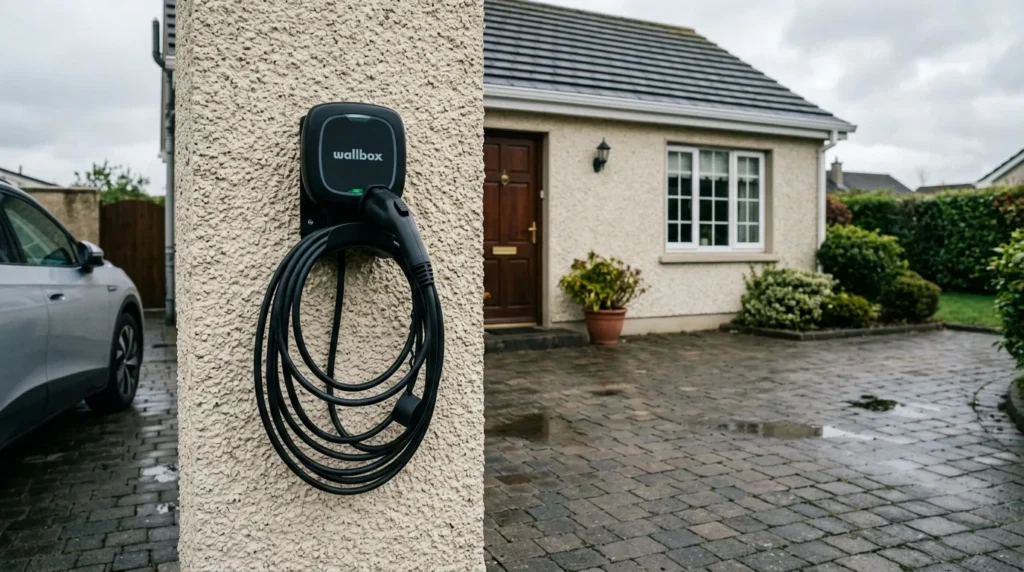
- Tethered charger: A charging cable is permanently attached to the wallbox. To charge your car, you simply lift the Type 2 plug end and connect it to the car’s charge port. The cable cannot be removed from the wallbox.
- Untethered charger (socketed): The wallbox has a Type 2 socket but no attached cable. You plug one end of a separate cable into the wallbox and the other end into the car. The cable is portable and stored separately.
Both configurations deliver identical electrical performance. A tethered 7.4 kW charger and an untethered 7.4 kW charger of the same model charge your car at exactly the same speed. The difference is purely in convenience, security, cost, and flexibility.
The Case for a Tethered Charger
Tethered chargers are the more popular choice for Irish homeowners, and for good reason:
Convenience
Arriving home after a long drive, the last thing you want is to search for a cable, unroll it, connect both ends, and then reverse the process in the morning. With a tethered charger, you grab the plug — it is always there, always ready — connect to the car, and walk inside. It takes about five seconds.
This convenience factor is underestimated by people who have not lived with both types. After a few months, the ritual of “plug in, walk away” becomes as automatic as plugging in a kettle.
No Cable to Lose or Damage
Type 2 cables cost €60–€150 for a quality unit. Leaving a loose cable in a garage or coiling it repeatedly wears out the connectors over time. With a tethered charger, the cable is part of the unit — protected, secured, and always in the right place.
Slightly Cleaner Installation
Tethered installations look neater because there is no loose cable hanging from a socket. The cable management is integral to the charger design.
Popular Tethered Models in Ireland
- Ohme Home Pro — integrates with Octopus Energy smart tariffs (compatible with Irish suppliers); 7.4 kW; excellent app
- EO Mini Pro 3 — compact, weatherproof, tethered 7.4 kW; popular choice for side-of-house installations
- Hypervolt Home 3 — stylish tethered unit with good app controls
- Project EV PRO-E — competitively priced tethered 7.4 kW, SEAI-approved
- Tesla Wall Connector — tethered only, works with any EV via Type 2, excellent for Tesla owners
All of the above are on the SEAI approved product list and eligible for the €600 Home Charger Grant.
The Case for an Untethered (Socketed) Charger
Multiple Vehicles with Different Connectors
If your household has two EVs — or an EV and a PHEV — that use different cable types or have different charging speeds, an untethered charger lets you use whichever cable is appropriate for each car. You can own a 32A Type 2 cable for your EV and a 16A Type 2 cable for a PHEV that charges more slowly.
Future-Proofing for Different Cars
EV technology is evolving rapidly. The Type 2 connector is the current EU standard and will remain so for the foreseeable future, but untethered chargers are conceptually more flexible if standards change or if you change vehicle.
Cable Upgrade Without Replacing the Charger
If your car’s on-board charger improves (you upgrade the vehicle), you can buy a higher-rated cable without changing the wallbox unit.
Popular Untethered Models in Ireland
- Easee One — the market-leading untethered smart charger in Ireland; 7.4 kW (upgradeable to 22 kW three-phase); dynamic load management; OCPP; excellent app
- Wallbox Pulsar Plus — compact untethered charger; 7.4 kW single-phase or 22 kW three-phase; strong smart features
- MyEnergi Zappi — untethered; integrates with solar PV for excess solar charging; very popular in Irish solar homes
Cable Security: A Real Concern in Ireland
One legitimate concern with untethered chargers is cable theft. Type 2 cables worth €80–€150 can be an attractive target if left plugged into a wallbox outdoors.
However, this risk is manageable:
- Premium OCPP chargers like the Easee One and Wallbox Pulsar Plus lock the cable in the socket via the CP pilot signal when charging is active or via an app-controlled lock. The cable cannot be pulled out without unlocking through the app.
- When not charging, simply store the cable indoors rather than leaving it in the socket.
With a tethered charger, the cable is permanently secured to the wallbox. Theft would require unbolting the entire wallbox from the wall — unlikely but not impossible in very exposed locations.
Cost Comparison
Untethered 7.4 kW + 32A cable
The difference is modest. The installation cost (electrician, circuit, consumer unit work) is the same regardless of configuration and typically runs €500–€800. Total installed cost before the SEAI grant is €1,100–€1,500; after the €600 grant, €500–€900.
IP Rating and Outdoor Use
Both tethered and untethered chargers installed in Ireland must be rated for outdoor use. Look for IP54 as a minimum — this provides protection against rain, which is a prerequisite for the Irish climate. The socket on an untethered charger should have a protective cap or flap when not in use to prevent water ingress.
Most SEAI-approved models meet IP54 or IP55 as standard. Check the data sheet before purchasing if your installation site is particularly exposed.
Which Should You Choose?
Choose tethered if:
- You have one EV and want maximum convenience
- You want the simplest possible daily charging routine
- You are installing in a location where cable management is important
Choose untethered if:
- You have two or more EVs (or a mix of EV and PHEV)
- You want to use the Easee One or Wallbox Pulsar Plus specifically (both are untethered only)
- You have solar panels and want the MyEnergi Zappi (untethered only)
- You travel frequently and want to bring a cable to use at Type 2 public charge points
Both choices are valid, both are SEAI-grant-eligible, and both will serve you well for the 10–15 year operational life of a quality home charger.