Home vs Public Charging: Why the Gap Matters
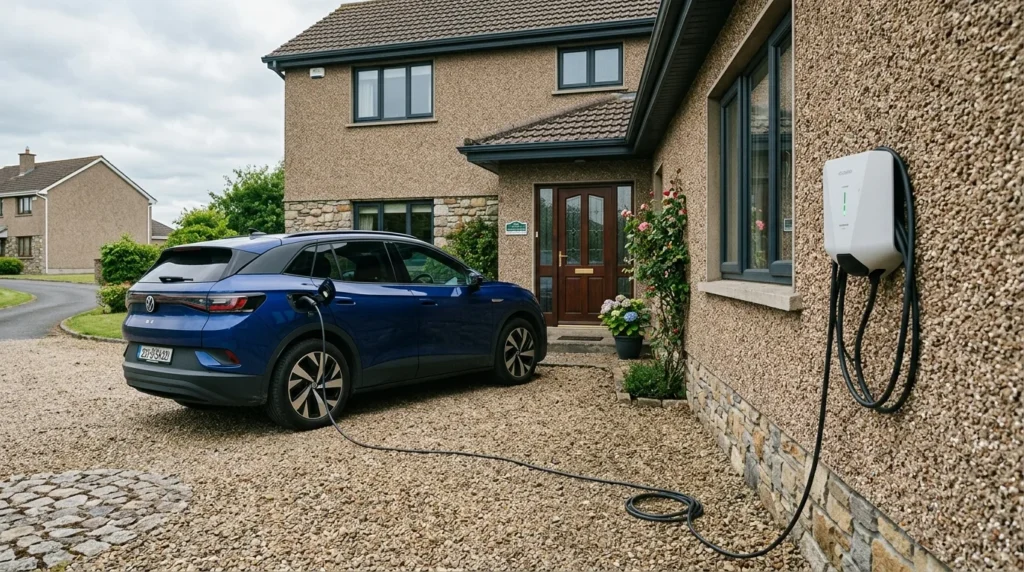
For Irish EV owners, the difference in cost between home charging and public charging is not a minor rounding issue — it is the financial case for the home charger. Understanding exactly how wide that gap is, and why, helps you justify the installation cost of a home wallbox and make informed decisions about when to use public infrastructure.
The Price Landscape in Ireland 2026
Home Night-Rate Charging
The cheapest way to charge an EV in Ireland in 2026 is on a smart electricity tariff with overnight pricing. The major Irish EV-optimised tariffs offer:
- Electric Ireland Night Boost: ~12–13 c/kWh (night window, typically 23:00–08:00)
- Bord Gáis EV Tariff: ~11–13 c/kWh (overnight)
- Energia Smart Drive: ~12–14 c/kWh (overnight)
- SSE Airtricity EV Plan: ~13–15 c/kWh (overnight)
Using 13 c/kWh as the midpoint, home overnight charging costs roughly €7.80 to fill a 60 kWh battery from empty.
Home Day-Rate Charging
If you do not switch to a TOU tariff, or if you charge during the day, you pay standard rates — approximately 30–35 c/kWh for most Irish households. That same 60 kWh battery costs €18–€21 to fill — comparable to some public AC chargers.
Public AC Charging
Publicly accessible AC charge points (7.4–22 kW) from ESB eCars, EasyGo, and destination chargers at supermarkets, hotels, and car parks:
- ESB eCars standard AC: 30–35 c/kWh (pay-as-you-go, 2026)
- Destination charging (hotels, retail): free–30 c/kWh (highly variable)
- Ionity AC: up to 40 c/kWh in some locations
Many destination chargers remain free as a customer incentive (IKEA, some Lidl/Aldi sites), which temporarily makes public AC cheaper than home charging. But free public charging is being phased out as operators monetise their investments.
Public DC Rapid Charging
The most convenient but most expensive option for routine charging:
- ESB eCars rapid (50 kW, pay-as-you-go): 40–45 c/kWh
- ESB eCars fast (100–150 kW): 40–50 c/kWh
- Ionity (no membership): 55–70 c/kWh
- Ionity (Passport membership, ~€17.99/month): ~35 c/kWh
- Circle K / Applegreen: 40–50 c/kWh
At 45 c/kWh, filling a 60 kWh battery costs €27 — 3.5 times the home night-rate equivalent.
Head-to-Head: The Numbers for a Typical Irish Driver
Assumptions: EV consuming 20 kWh/100 km, 15,000 km/year = 3,000 kWh needed annually.
The conclusion is stark: home night-rate charging costs one-third to one-fifth of public rapid charging for the same kilometres travelled.
When Does Public Charging Make Financial Sense?
Despite the cost premium, public charging has legitimate use cases:
Long Journeys
On a Dublin–Cork (254 km) return trip, an EV with 300 km range may need a rapid charge in each direction. At 45 c/kWh for a 25 kWh top-up: €11.25 per charge. On a round trip twice a month, that is €270/year in rapid charging costs — easily offset by the savings from home charging for all other driving.
The key is using rapid charging for what it is designed for: en-route top-ups on journeys that exceed your battery range. Not as a substitute for home charging.
No Home Charging Access
For Irish EV owners without off-street parking (terraced houses, apartments without dedicated spaces), public charging may be the only option. In this case, the comparison shifts: the relevant question is whether EV fuel costs on public AC charging (30 c/kWh, ~6 c/km) are still cheaper than petrol (12+ c/km). The answer is yes — still roughly 50% cheaper per km than petrol, even without home charging.
Free Public Charging Windows
When a public charger is free — many supermarket and destination chargers still are — it is always worth plugging in while you shop or visit. This is genuinely free fuel and can meaningfully supplement home charging.
The Home Charger Payback Period
Given the cost savings from home charging, how quickly does a home charger pay for itself?
Installation cost (after SEAI grant): €500–€900
Annual savings (home night-rate vs public rapid):
- Home night-rate: €390/year
- Public rapid (alternative): €1,350/year
- Annual saving: €960/year
Home night-rate vs standard day-rate (i.e., already driving an EV but without a wallbox, using a 3-pin socket or no home charging):
- With wallbox on night rate: €390/year
- Without wallbox, charging at day rate from 3-pin: ~€900/year
- Annual saving: ~€510/year
At these savings rates, the home charger pays for itself in:
- vs public rapid charging: 6–11 months
- vs day-rate home charging: 12–21 months
Few home improvements offer a comparable financial return in such a short timeframe.
The Public Charging Network's Role
Ireland’s public charging network is not redundant — it is essential for:
- Range extension on long journeys
- EV access for those without off-street parking
- Workplace and destination charging supplementing home charging
- Emergency top-ups
But for Irish EV owners with driveways, the optimal strategy is clear: home is primary, public is supplementary. Invest in a quality home charger, switch to a night-rate tariff, and use public infrastructure when you need it — not as a habit.
Membership Schemes vs Pay-As-You-Go
Some public charging networks offer lower per-kWh rates in exchange for a monthly membership fee:
- Ionity Passport: ~€17.99/month for 35 c/kWh instead of 65 c/kWh — worth it only for frequent long-distance drivers using Ionity regularly
- ESB eCars: Pay-as-you-go, no membership currently required
- Charge.ie: Network aggregator with access to multiple networks
For most Irish EV owners who do fewer than 3–4 rapid charges per month, pay-as-you-go public charging is more economical than paying a monthly membership fee.