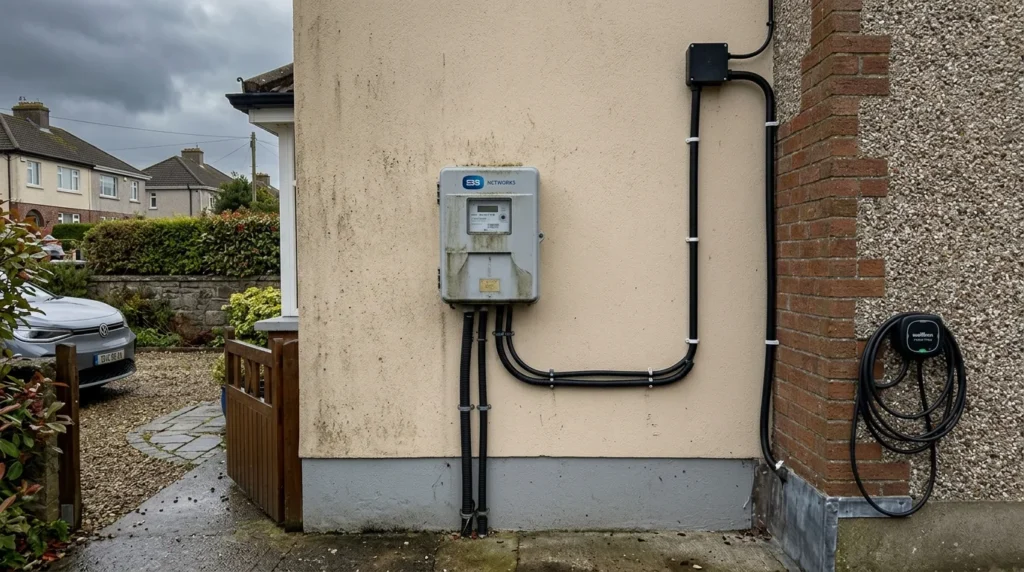
Why ESB Networks Is Involved in Home EV Charger Installations
ESB Networks is the owner and operator of Ireland’s electricity distribution network — the cables, transformers, and substations that deliver electricity from the national grid to every home and business. When you install an EV charger, you are adding a significant new electrical load to that network, and ESB Networks has a regulatory obligation to manage total network capacity.
This is why ESB Networks requires notification before the installation of home EV chargers above a certain power threshold. The notification allows ESB Networks to assess whether the local network can support the additional load without degrading supply quality for other customers.
The 7 kW Threshold: What Triggers Notification?
Under ESB Networks’ Distribution Code and associated guidelines, the notification threshold for home EV charger installations is:
Chargers rated ≤ 7 kW (including 7.4 kW standard chargers): In most cases, no notification required for standard domestic single-phase installations. The terminology can cause confusion — a “7.4 kW” charger technically exceeds “7 kW” on paper, but under ESB Networks’ current guidance (as of 2026), standard 32A single-phase domestic installations with the charger connected to an existing single-phase supply are generally treated as sub-threshold.
Chargers rated > 7 kW (11 kW, 22 kW three-phase): Notification required before installation. This includes any three-phase EV charger.
In practice, your installer will handle the notification as part of the installation service. You simply need to provide your MPRN (Meter Point Reference Number) and the charger specifications. Confirm with your installer whether notification is required for your specific installation before booking the job.
Finding Your MPRN
Your MPRN is a unique 11-digit number that identifies your electricity meter point. You can find it:
- On your electricity bill (usually prominently displayed near your supply address)
- By logging into your electricity supplier’s online account portal
- By calling your electricity supplier’s customer service line
- On the meter itself (though it may require a torch and some squinting)
The MPRN is referenced in all communications with ESB Networks about your property’s electricity supply.
How to Submit the Notification
ESB Networks manages EV charger notifications through their new connections and alterations portal and via their Customer Operations team. Your installer should submit the notification on your behalf using:
- Your MPRN
- The charger make, model, and rated power (kW)
- The proposed installation date
- Confirmation that the installation will be carried out by a Safe Electric registered electrician
The notification form is available on the ESB Networks website (esbnetworks.ie). For registered contractors, there is also a dedicated installer notification portal.
What ESB Networks Assesses
Upon receiving the notification, ESB Networks assesses:
Local Network Capacity
Can the local low-voltage (LV) network at your connection point support the additional load? This involves:
- Checking the transformer serving your area and its remaining capacity
- Assessing the LV cable from the transformer to your meter for load-carrying capability
- Checking the service head (main fuse) at your property
In most urban and suburban areas of Ireland, the LV network has adequate capacity to accommodate an EV charger without issue. In rural areas with older network infrastructure — particularly areas served by older single-phase overhead lines or small rural transformers — capacity may be more constrained.
Supply Type
Is your property connected to single-phase or three-phase supply? ESB Networks’ records will confirm this, but it is worth verifying independently before specifying a three-phase charger.
Service Head Rating
The service head (the main fuse between ESB Networks’ meter and your consumer unit) is rated in amperes. The most common rating in Ireland for domestic supplies is 31A (7.2 kVA single-phase). ESB Networks will confirm whether the existing service head is adequate for the proposed charger.
ESB Networks' Response: What Can Happen?
Approval Without Action
In the majority of cases, ESB Networks assesses the notification and confirms no further action required — installation can proceed. This typically takes 5–10 working days.
Conditional Approval
ESB Networks may approve the installation subject to conditions — for example, requiring a specific dynamic load management system to be in place (Easee Equalizer or similar) to prevent the charger from pushing total load above the service head rating.
Network Reinforcement Required
In some rural areas or areas with high EV adoption near capacity limits, ESB Networks may determine that network reinforcement is needed before the charger can be connected at the requested capacity. This means ESB Networks upgrades the local infrastructure (cables, transformer, fuse) at their own cost. However, it introduces delay — reinforcement works can take weeks to months.
Service Head Upgrade Required
If the existing service head is inadequate, ESB Networks may need to upgrade it. This is typically free to the homeowner but requires scheduling an ESB Networks technician visit.
Timeline: How Long Does Notification Take?
Installer submits notification
Same day as quote acceptance
Conditional approval or approval
1–2 working days after review
Network reinforcement (if required)
Service head upgrade (if required)
For standard urban/suburban installations: expect a total notification timeline of 1–2 weeks. For rural installations where network assessment is more detailed: allow 4–6 weeks.
Start the notification process as early as possible — submit it when you accept the installer’s quote, not on the day of installation.
What Happens If You Skip Notification?
Installing an EV charger above 7 kW without notifying ESB Networks is:
A breach of the ESB Networks Distribution Code: You are required to notify ESB Networks of significant new loads, and EV chargers above the threshold are explicitly listed.
Potentially unsafe: If ESB Networks has not confirmed that your local network can support the load, there is a risk of supply voltage degradation affecting you and your neighbours.
A problem for your SEAI grant claim: SEAI may ask for confirmation that ESB Networks notification requirements were met.
Potentially invalidating for your building insurance: An installation not carried out in compliance with all regulatory requirements may affect insurance validity.
Always comply with the notification requirement — and ensure your installer confirms in writing that they have submitted it and received ESB Networks’ approval before proceeding with installation.
The Role of Your Installer
A reputable Safe Electric registered EV charger installer will:
- Assess during the site survey whether notification is required
- Submit the notification to ESB Networks on your behalf
- Provide you with a copy of the ESB Networks approval before installation
- Include the notification process in their project timeline and quote
If an installer does not mention ESB Networks notification when quoting for a three-phase charger, that is a red flag. Ask explicitly: “Have you submitted the ESB Networks notification, and do you have approval?”