Why Your Consumer Unit Matters for EV Charging
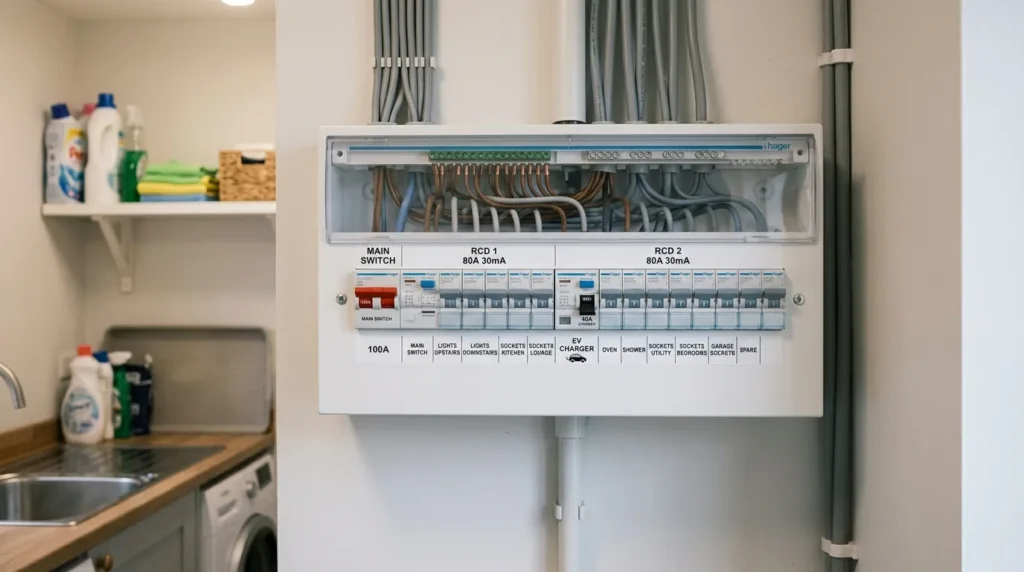
The consumer unit — also known as the fuse board or distribution board — is the nerve centre of your home’s electrical system. It distributes electricity from the ESB Networks supply to all the circuits in your home and provides protection against faults via circuit breakers (MCBs), residual current devices (RCDs), and combined units (RCBOs).
When you add a 7.4 kW EV charger, you are adding a dedicated 32A circuit to your consumer unit. This requires a spare way (slot) in the unit and appropriate protection devices. Whether your existing consumer unit can accommodate this — or whether it needs upgrading — depends on its age, type, and current loading.
Types of Consumer Unit in Irish Homes
Modern RCBO Board (Post-2000)
A modern consumer unit uses RCBOs (Residual Current Breakers with Overcurrent protection) on each circuit. Each RCBO provides both overcurrent and RCD protection for its individual circuit. Adding an EV charger circuit requires simply fitting a new 32A RCBO in a spare way.
No upgrade required if there is a spare way available. This is the easiest scenario.
Dual-RCD Consumer Unit (Common 1990s–2010s)
Many Irish homes have a consumer unit with two RCD banks — one protecting the left group of circuits, one protecting the right. MCBs are used for overcurrent protection within each bank. Adding an EV charger requires a 32A MCB in one bank, covered by the group RCD.
Upgrade may not be required if a spare MCB slot is available in the correct bank, but there are considerations:
- The group RCD must be Type A or Type B (most are Type A, which is acceptable if the charger has built-in DC fault detection)
- If the group RCD is already protecting a high number of circuits, adding the EV charger may make nuisance tripping of other circuits more likely in a fault scenario
- An electrician’s assessment is needed
Old Fuse Board (Pre-1990, Rewirable Fuses)
Older properties — particularly those that have never had a rewire — may have a fuse board with old-fashioned ceramic or glass fuses rather than MCBs or RCBOs. These boards:
- Have no RCD protection whatsoever
- Cannot safely accommodate a 32A EV charger circuit
- Are typically below current Irish wiring regulations (ET 101:2018)
Full consumer unit upgrade required. This is non-negotiable from a safety and regulatory perspective. A Safe Electric registered electrician will not install an EV charger on a fuse board that cannot be certified.
Consumer Unit Full to Capacity
A modern consumer unit with no spare ways — all slots occupied — also requires action. Options:
- Full replacement with a larger consumer unit
- Addition of a sub-board (a small distribution board fed from the main consumer unit, providing additional ways including the EV charger circuit)
- Tandem MCBs (double-pole MCBs in a single slot) — technically possible but less common and not always the best solution
The Safe Electric Certification Requirement
Safe Electric (the register of competent electrical contractors in Ireland, operated by RECI) requires that all EV charger installations comply with ET 101:2018 (the Irish National Standard for Electrical Installations in Dwellings) and I.S. 10101 (IEC 60364-7-722) (the international standard for EV charging installations).
These standards require:
- A dedicated circuit for the EV charger (not shared with other loads)
- Type B RCD protection (or built-in DC fault detection in the charger)
- 32A overcurrent protection (MCB or RCBO)
- Correct cable sizing for the circuit length
- A Record of Electrical Completion (REC) issued by the Safe Electric registered electrician
If your consumer unit cannot accommodate these requirements safely, the electrician must upgrade it before the EV charger installation can be certified.
What a Consumer Unit Upgrade Involves
A consumer unit upgrade typically takes 3–5 hours and includes:
- Isolating the main supply (coordinating with ESB Networks if a supply isolation is required, or working with the service head fuse removed)
- Removing the old consumer unit — carefully, labelling all circuits
- Installing the new consumer unit — typically a modern RCBO board with sufficient ways for existing circuits plus the new EV charger circuit
- Reconnecting all circuits to the new board with correct RCBO ratings
- Testing all circuits — continuity, insulation resistance, RCD trip times
- Issuing a Safe Electric REC for the upgraded consumer unit
The upgraded consumer unit itself benefits the entire home — not just the EV charger. Modern RCBO boards provide better individual circuit protection and make it easier to identify and reset faults.
Cost of Consumer Unit Upgrades in Ireland
New 32A RCBO in existing board (space available)
Sub-board addition (no space in main board)
Full consumer unit replacement (modern RCBO board)
Full consumer unit replacement + rewire check
These costs are additional to the EV charger installation cost (typically €500–€800 for labour and circuit). Total with a full consumer unit upgrade: €850–€1,500 for installation labour, before the charger unit itself.
The SEAI Home Charger Grant (€600) applies to the EV charger supply and installation — it does not specifically fund the consumer unit upgrade, but the combined installation can still be presented as a single quote to SEAI for grant purposes.
ESB Networks Service Head Capacity
Separate from the consumer unit is the service head — the main fuse installed by ESB Networks where their supply cable enters your property. Most Irish homes have a 7.2 kVA (31A) service head. Rural properties and newer builds sometimes have larger service heads (15 kVA, 24 kVA).
A 7.4 kW EV charger draws up to 32A. Combined with other household loads, total current could theoretically exceed the service head rating if everything runs simultaneously. In practice, this is uncommon because:
- EV charging is typically scheduled overnight when other loads are low
- The car’s battery management system tapers charging as it approaches full charge
- Dynamic load balancing (Easee Equalizer, Wallbox Power Boost) actively manages this risk
However, in households with very high electrical demand (electric showers, large induction hobs, high-output heat pumps), ESB Networks may need to assess whether a service head upgrade is required. Your electrician will advise on this during the site survey.
Service head upgrades by ESB Networks are generally free to homeowners for standard residential upgrades but require a formal application via your MPRN and can take several weeks.
Practical Advice: Get the Consumer Unit Assessed Early
The most common cause of unexpected cost overruns in Irish EV charger installations is a consumer unit that turns out to need upgrading. To avoid surprises:
- Ask every installer you contact to include a consumer unit assessment in their site survey
- Ask specifically: “Does my consumer unit need any work, and if so, is it included in your quote?”
- If quotes differ significantly, ask why — sometimes one installer has identified consumer unit work that another has not
- Budget €300–€600 as a contingency for consumer unit work even if your board looks modern