
- Home
- Solar guides
- Solar Panels on a Dormer Bungalow in Ireland: Challenges, Solutions & Sizing.
Solar Panels on a Dormer Bungalow in Ireland: Challenges, Solutions & Sizing
A residential solar PV system is more than just panels on a roof. This guide walks through every component of a solar PV system installed in an Irish home, from panels and inverters to generation meters and grid connection equipment.
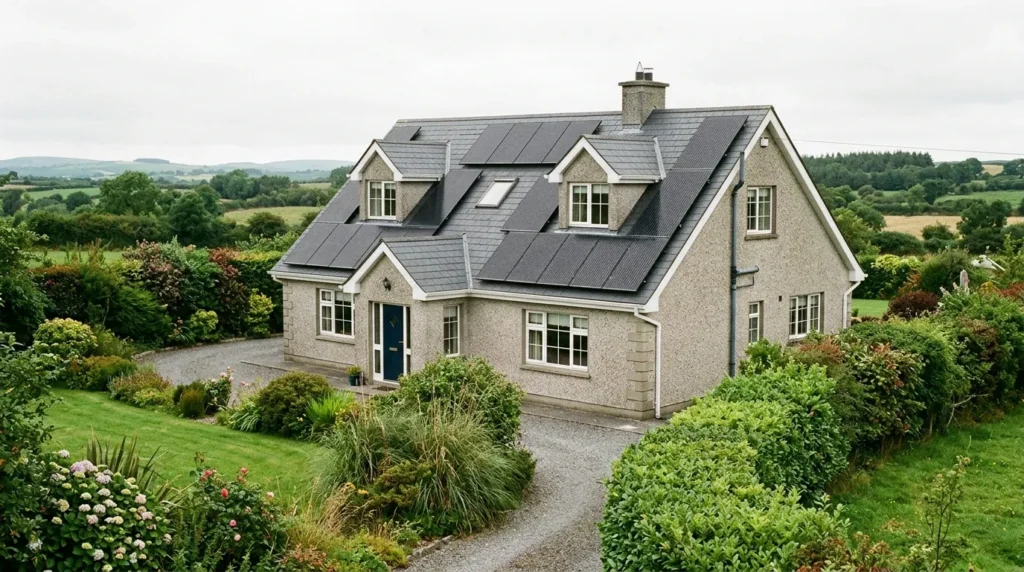
The dormer bungalow is quintessentially Irish — a sprawling single-storey footprint with a raised section housing bedrooms in the roof space, accessed by dormer windows on the front or rear elevation. They’re enormously popular across the country, from Kildare commuter belt estates to rural Co. Mayo, and they present a distinctive set of opportunities and challenges for solar panels on a dormer bungalow.
Understanding the Dormer Bungalow Roof
A typical Irish dormer bungalow has a complex roof profile:
- A main low-pitch roof at the front or rear (typically 20–30°, sometimes as low as 15°)
- A steeper upper section housing the dormers (typically 30–45° pitch)
- Dormer windows protruding through one or both main slopes
- Often a flat-roofed rear extension or garage section
This complexity creates both constraints (broken roof planes, dormer exclusion zones) and opportunities (multiple orientations, different pitch angles for different seasons).
The Key Challenge: Dormer Window Exclusion Zones
Planning regulations and fire safety rules require a minimum clearance zone around roof windows and Velux skylights — typically 30–50 cm on all sides. In a dormer bungalow with multiple dormer windows across the main roof slope, these exclusion zones can significantly fragment the available panel area.
Example: A south-facing slope of 40 m² with three dormer windows (each 1.2 m × 0.9 m with 50 cm exclusion zones) loses approximately 10–14 m² of usable panel area, reducing a potential 8 kWp array to perhaps 5–6 kWp.
A skilled solar installer will design the panel layout to work around the dormer positions, potentially using half-cut or narrow portrait-orientation panels to fit more panels in the available areas.
Low-Pitch Roof Sections and Solar Performance
Many dormer bungalows have rear extension flat roofs or low-pitch (15–20°) sections. Solar performance on low-pitch roofs differs from standard Irish pitches:
Pitch Angle
Output Relative to Optimal 35°
Notes
35° (optimal)
100%
Ideal for Ireland
25°
97%
Negligible difference
15°
92%
Small loss, acceptable
10°
87%
Noticeable loss, consider tilt frames
5°
80%
Ballasted tilt frames recommended
0° (flat)
~75%
Tilt frames to 10–15° strongly recommended
Low-pitch surfaces can still be viable — a 15° pitch on a rear-facing south section is still an excellent solar location. For truly flat extensions, ballasted tilt frames at 10–15° improve output and help panels self-clean with rain.
System Design Options for Dormer Bungalows
Option 1: Main Roof Array Only
Installing panels on the main south or southwest-facing slope only, working around dormers. This is the simplest option and often produces the best kWh/kWp ratio because the main roof typically has the best orientation.
Suitable for: Dormers on north or east-west faces only; adequate south-facing area above and below dormers.
Option 2: Split Array (Main Roof + Rear Extension)
Combining a main roof array on the upper section with a separate rear extension flat roof array (on ballasted frames). The two sections can be combined in a single system with a hybrid or twin-MPPT inverter.
Suitable for: Limited main roof space due to dormer placement; flat rear extension with good south-facing exposure.
Option 3: East-West Low-Pitch Array
If the main roof is hipped or has dormers blocking most of the south-facing area, an east-west array on the two main slopes can deliver 80–85% of a south-facing system’s output with excellent production spread across the day.
Suitable for: Houses where south-facing space is severely restricted.
Option 4: BIPV In-Roof Integration
For dormer bungalows undergoing significant renovation or re-roofing, building-integrated PV (BIPV) systems replace conventional roof tiles with solar tiles or in-roof glass modules. This eliminates the protrusion issue from dormer surrounds and gives a cleaner aesthetic. Costs are higher (typically €2,000–€4,000 more than standard mounting) but may be worth considering if the roof is due for replacement.
Typical System Sizes for Dormer Bungalows
Property Description
Usable South Roof Area
Realistic System
4-bed dormer (2 dormers, south-facing)
20–30 m²
3.5–5 kWp
4-bed dormer (dormers on north only)
35–50 m²
6–8 kWp
Dormer + flat rear extension
25–40 m² combined
5–7 kWp
Large dormer (5-bed, rear dormers)
30–45 m²
5–8 kWp
Costs for a Dormer Bungalow Installation in 2026
Complex roof geometries, multiple mounting sections, and additional scaffolding requirements make dormer bungalow installations slightly more expensive per kWp than standard house types.
System
Typical Cost (Before Grant)
After €1,800 SEAI Grant
4 kWp (main roof only)
€9,500–€12,000
€7,700–€10,200
5 kWp (split array)
€12,500–€16,000
€10,700–€14,200
6 kWp (split array + optimisers)
€14,000–€18,000
€12,200–€16,200
The additional cost of power optimisers (SolarEdge P-series) — typically €120–€160 per panel — is usually worth it on complex dormer roofs where partial shading from dormers or chimneys is likely.
Planning and Regulatory Considerations
Dormer bungalows fall under the same general planning exemption rules as other residential properties — panels are exempt from planning permission provided they don’t protrude more than 15 cm above the roof plane. However, some additional considerations apply:
- Dormer surrounds: Panels must not encroach on the structural or decorative surround of dormer windows
- Fire access: Emergency services require clear access routes on roofs — your installer should be familiar with these rules
- Conservation areas: Dormer bungalows in scenic rural areas or designated landscapes may require planning permission even for exempt-category panels — always check with your local authority if in doubt
Immersion Diverter: Particularly Valuable for Dormers
Dormer bungalows often have larger hot water cylinders than standard semis (because the attic space houses the hot water tank near the upper bedrooms). An immersion diverter device — myenergi Eddi or Solar iBoost — makes particularly good sense in a dormer bungalow because:
- Larger cylinder stores more free solar-heated water
- Occupancy patterns often include periods when electric appliances are not running (midday while children are at school)
- Rural dormer owners often use oil-fired boilers with electric immersion backup — the diverter can replace much of the oil-fired hot water use in summer
Get 3 free, no-obligation solar quotes
Tell us a few quick details about your home and we’ll connect you with up to 3 SEAI-registered solar installers in your area.
Frequently Asked Questions
Can I put solar panels on a dormer bungalow?
Yes, absolutely. Dormer bungalows are a common solar installation type in Ireland. The key is careful design around dormer windows and exclusion zones. Most dormer bungalows can accommodate 4–7 kWp on the main south-facing roof and/or rear extension.
Do dormer windows reduce the number of solar panels I can fit?
Yes. Dormer windows require exclusion zones of at least 30–50 cm on all sides, which removes some usable roof area. Multiple dormers can reduce panel count by 2–6 panels versus an uninterrupted roof. A good installer will design a layout that maximises panels in the remaining space.
Can I install solar panels on a flat-roofed rear extension of my dormer bungalow?
Are power optimisers necessary for a dormer bungalow?
They are strongly recommended if dormer surrounds, chimneys, or neighbouring rooftops cast any shade on the panels. Without optimisers, a standard string inverter system will have its entire string output reduced to match the shaded panel. SolarEdge optimisers limit the shading impact to only the affected panels.
What is the best inverter for a dormer bungalow with a split array?
Get 3 free quotes for your home EV charger
We'll match you with Safe Electric-certified installers who can apply for the €300 SEAI Home Charger Grant on your behalf.
- No obligation · Free · Takes 2 minutes
More solar pv guides

Sources & further reading

Solar Expert Editorial
Solar advisor team
Published 15 May 2026
Get 3 free quotes for your home EV charger
We'll match you with Safe Electric-certified installers who can apply for the €300 SEAI Home Charger Grant on your behalf.
- No obligation · Free · Takes 2 minutes