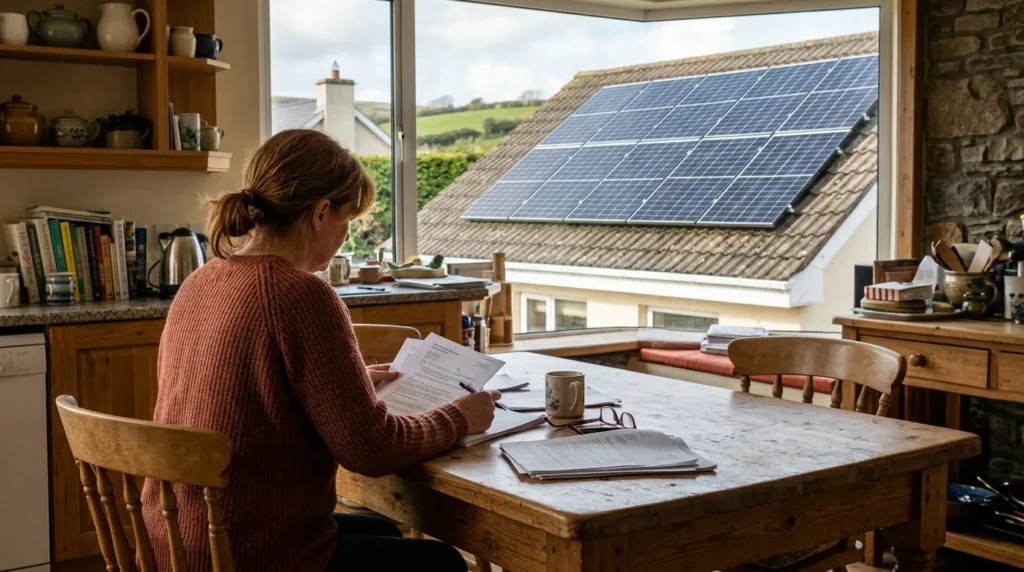
The SEAI solar PV grant is the primary government financial incentive for Irish homeowners investing in residential solar electricity systems. Administered by the Sustainable Energy Authority of Ireland (SEAI) under the Better Energy Homes scheme, the grant significantly reduces the upfront cost of a solar installation — and understanding exactly how it works is essential before you get your first quote.
This guide covers everything you need to know about the SEAI solar PV grant in 2026: the grant amounts, eligibility conditions, step-by-step application process, and the common mistakes that lead to grant refusal or payment delays.
Grant Amounts in 2026
The 2026 SEAI Solar PV grant is structured as:
Key point: The grant is €900 per kWp for the first 2 kWp, giving a maximum of €1,800 for any system 2 kWp and above. Installing a 6 kWp system gets you exactly the same grant as a 4 kWp system. The cap creates a strong incentive to size your system correctly — if you’re going bigger than 4 kWp (which is often justified with EV or heat pump loads), do it for the energy economics, not because of an incremental grant benefit.
VAT context: Since the 2023 Finance Act zero-rated VAT on residential solar, the effective value of the grant is higher than it looks. A system costing €10,000 at today’s zero-VAT rate would have cost €12,300 at the previous 23% VAT rate.
Who Is Eligible?
To qualify for the SEAI Solar PV grant in 2026, you must meet all of the following conditions:
Home Eligibility
- The property must be a domestic dwelling (not a commercial building)
- The home must have been built and occupied before 2021 (new builds after this date are required by building regulations to already include renewable energy and are therefore excluded)
- The property must be your principal private residence or a home you own and rent out (but the landlord, not the tenant, claims the grant)
- The property must be in the Republic of Ireland (not Northern Ireland)
Installation Eligibility
- The solar PV system must be installed by a SEAI-registered installer — you can find the current registered list at seai.ie
- The system must meet SEAI’s technical standards for solar PV
- The installation must include a calibrated generation meter
- Work must not begin before your grant is approved (for the standard application route) — this is the most common mistake
Financial Eligibility
- You must not have received a previous SEAI grant for solar PV at this property under the Better Energy Homes scheme
- You must be the property owner — tenants cannot apply
Two Application Routes
Route 1: Standard Better Energy Homes (DIY Application)
You apply directly through the SEAI’s online portal at seai.ie before any work starts:
- Create an SEAI account at seai.ie/grants
- Submit your grant application online — you’ll need your MPRN (Meter Point Reference Number, on your electricity bill) and basic property details
- Receive grant approval — typically within 10 working days
- Get at least two quotes from SEAI-registered installers
- Choose an installer and complete the work
- Submit completion documentation: installer’s completion form, panel spec sheets, generation meter details, ESB Networks NC6 notification reference, photos
- SEAI processes the application (typically 4–8 weeks after documentation submission)
- Grant paid directly to your bank account — you pay the installer the full amount and receive the grant separately
Timescale: Application to payment can take 12–20 weeks in total.
Route 2: SEAI One Stop Shop
Several SEAI-registered “One Stop Shop” companies handle the entire grant process on your behalf, including the application, installation, and completion paperwork. The grant is typically deducted from their invoice — you pay the net cost after grant upfront, rather than paying the full cost and waiting for a refund.
Advantages of One Stop Shop:
- Simpler — no need to navigate the SEAI portal yourself
- Grant deducted upfront — no waiting for reimbursement
- Installer manages ESB Networks NC6 process too
Disadvantages:
- One Stop Shops often (not always) charge a premium price, offsetting the grant value
- Less flexibility in choosing components — you get what the OSS specifies
- Some OSS companies have longer waiting lists than independent installers
Recommendation: Get quotes from both OSS and non-OSS SEAI-registered installers. Compare the net price after grant — if the OSS is more expensive than the net cost from a regular installer plus the grant, it’s not actually easier or better value.
Step-by-Step Application Guide
Before Starting
- Check your MPRN: Your Meter Point Reference Number is on your ESB electricity bill. You’ll need this for the SEAI application.
- Check your installer’s registration: Verify the installer is on the SEAI register at the time of your application — not just at some point in the past. Registrations can lapse.
- Do not start work: If using the standard route, no work can begin before approval. A site survey is fine; purchasing panels or beginning installation is not.
Documents Required for Completion
After installation is complete, you’ll need to submit:
- Installer completion form (provided by SEAI, completed by your installer)
- Panel data sheet (manufacturer specification sheet for the specific panel model installed)
- Inverter data sheet
- Generation meter confirmation (model and serial number)
- ESB Networks NC6 notification reference (confirming grid connection application)
- Photos: of installed panels, inverter, generation meter, and consumer unit connection
- Bank account details for grant payment
Common Mistakes That Delay or Invalidate Applications
- Starting work before grant approval: This automatically disqualifies you from the standard grant (though One Stop Shop route is exempt)
- Using a non-SEAI-registered installer: Even if the work is excellent, an unregistered installer means no grant
- Mismatch between approved and installed system: If you approved 4 kWp and install 5 kWp (or different panels than specified), you may need to resubmit
- Missing generation meter: The grant requires a calibrated generation meter — confirm your installer is including one
- MPRN errors: A wrong MPRN on the application causes processing delays
- Missing photos or documents: SEAI cannot process incomplete documentation
- Bank account in a different name: The grant is paid to the account holder — the name must match the applicant
The SEAI Home Energy Upgrade Loan (Green Loan)
Since 2023, SEAI has partnered with financial institutions to offer low-interest green loans specifically for home energy upgrades including solar PV. The SEAI Home Energy Upgrade Loan offers:
- Loan amounts: €5,000–€75,000
- Term: 2–10 years
- Interest rate: Competitive low rates (typically 3–5% APR as of 2026) — check current rates at seai.ie
- Eligibility: Owner-occupiers completing eligible energy upgrades
This loan can be combined with the SEAI grant — use the grant to reduce the capital amount, and finance the remaining balance.
Stacking the SEAI Grant with Other Incentives
The SEAI solar PV grant can be combined with:
- MSS export tariff payments (18–21 c/kWh for exported electricity)
- Zero VAT on the installation
- Home Energy Upgrade Loan (green loan)
- BER rating improvement (which increases property value and may improve mortgage terms)
It cannot be combined with other SEAI grants for the same measure at the same property. You cannot claim a solar grant and a deep retrofit grant for solar as part of the same project — only the standard solar grant applies.
What Happens After You Receive the Grant
Once your system is installed and the grant is received:
- Register with ESB Networks: Your installer does this via NC6 notification
- Contact your electricity supplier: Register for the MSS export tariff with Electric Ireland, Energia, Bord Gáis Energy, SSE Airtricity, or another supplier
- Monitor your system: Use the inverter’s app (Fronius Solar.web, SolarEdge monitoring, Enphase Enlighten) to track production
- Submit annual meter readings: Your supplier will request generation meter readings periodically for MSS payments
The system should require no further SEAI interaction — grants are one-off, and the MSS operates through your electricity supplier.