
- Home
- Solar guides
- Solar EV Charging Economics in Ireland 2026: Is the Combination Worth It?
Solar EV Charging Economics in Ireland 2026: Is the Combination Worth It?
Solar PV and an EV home charger are individually worthwhile investments for Irish homeowners. Combine them correctly and the economics improve significantly — but only if you manage the interaction intelligently.
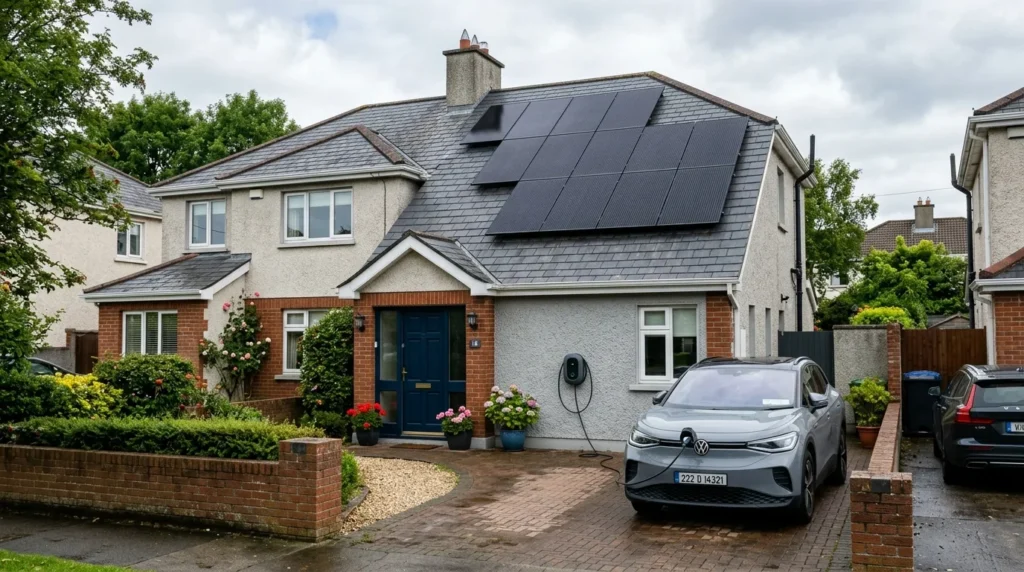
The Solar + EV Combination in Ireland
Ireland’s solar PV market has grown enormously since the SEAI Solar PV Grant was introduced and the Microgeneration Support Scheme (MSS) launched. Simultaneously, EV adoption has accelerated, making the combination of rooftop solar and home EV charging increasingly common for Irish homeowners.
The combination is financially attractive, but its economics depend on how the two systems interact. If you simply install solar panels and charge your EV in the evening from the grid (on a night tariff), you are not capturing the full potential of the combination. To maximise savings, you need a charger that actively diverts excess solar generation to the EV during daylight hours.
How Much Solar Generation Can Irish Homes Expect?
A 3.5 kW peak solar PV system (approximately 8–10 panels, the most common SEAI-grant-eligible size) generates approximately:
- 2,800–3,200 kWh/year in Ireland (south-facing, no significant shading)
- Monthly generation peaks in May–July (250–350 kWh/month) and drops in November–January (100–150 kWh/month)
A 6 kW peak system (14–16 panels, increasingly popular on larger rural properties):
- 4,800–5,400 kWh/year
For comparison, an EV driven 15,000 km/year at 20 kWh/100 km needs 3,000 kWh annually for charging.
A well-designed 6 kW solar system can theoretically supply the entire annual charging energy for a typical Irish EV. In practice, timing mismatches (solar generates by day, most EV charging happens at night) mean direct solar self-consumption for EV charging is lower — unless a diversion system is used.
The Diversion Approach: MyEnergi Zappi
The standard approach to maximising solar self-consumption for EV charging is a solar diversion charger. The MyEnergi Zappi is the market leader in Ireland and the UK for this use case.
The Zappi monitors the flow of electricity at your meter using a current transformer (CT clamp). When solar generation exceeds household demand, instead of exporting that surplus to the grid, the Zappi automatically diverts it to charge the EV at the available surplus power level.
How it works in practice:
- Solar system generates 3 kW; household uses 1.5 kW → 1.5 kW surplus
- Zappi detects the 1.5 kW surplus and begins charging the EV at 1.5 kW
- As solar output varies (clouds pass), the Zappi adjusts the charge rate in real time
- Minimum export to grid: the Zappi charges as fast as possible to maximise self-consumption
The Zappi operates in three modes:
- Eco mode: Charges at the maximum available surplus above a configurable threshold
- Eco+ mode: Waits until there is enough surplus to start at the minimum charge current (1.4 kW, or 6A at 230V), then charges as much surplus as possible
- Fast mode: Charges at maximum rate regardless of solar output (uses grid if needed)
Financial Value of Solar Diversion
The financial value of solar diversion depends on comparing what you would otherwise do with the surplus:
Export rate (microgeneration support scheme): The MSS export rate from most Irish suppliers in 2026 is approximately 18–24 c/kWh. This is the rate you receive for each kWh exported to the grid.
Night import rate (what you pay to charge the EV at night on a smart tariff): approximately 12–15 c/kWh.
At first glance, this suggests exporting (18–24 c) is worth more per kWh than the night rate saving (12–15 c). But the comparison is more nuanced:
- Grid export is curtailed: ESB Networks limits microgeneration export on many connections. Excess solar that cannot be exported (beyond the curtailment limit) has zero value unless used internally.
- Displacement value: Self-consuming solar avoids paying the full daytime import rate (30+ c/kWh) for whatever the solar would have powered. If the solar EV charging displaces daytime grid electricity at 32 c/kWh, the value per kWh is 32 c — higher than the export rate.
- Future-proofing: Export rates may reduce as solar uptake increases. Self-consumption value is locked to your own energy needs.
In most cases, solar diversion to EV is more valuable than export once your base household load is already being met from solar. The Zappi is specifically designed to capture this value.
Worked Example: 4 kW Solar + Zappi + EV in Ireland
Assumptions:
- 4 kW peak solar PV (10 panels, south-facing)
- Annual generation: 3,400 kWh
- Household base load: 4,000 kWh/year
- EV: 3,000 kWh/year charging need (15,000 km at 20 kWh/100 km)
- Without Zappi: all EV charging from grid on night tariff at 13 c/kWh
- With Zappi: 800 kWh/year of EV charging from solar diversion (realistic estimate for Irish conditions)
Without Zappi:
- EV charging cost: 3,000 × €0.13 = €390/year
- Solar self-consumption: covers household load; surplus exported at 20 c/kWh
- Estimated solar value: household savings (say €400) + export income (say €80) = €480/year
With Zappi solar diversion:
- 800 kWh from solar diversion (replaces night-rate grid electricity)
- Saving on night-rate electricity: 800 × €0.13 = €104/year
- But if those 800 kWh would instead have been exported at 20 c: 800 × €0.20 = €160/year — slightly better to export in this specific case
- If those 800 kWh displace 32 c/kWh daytime grid electricity: 800 × €0.32 = €256/year — better to divert
The Zappi is most valuable when your solar consistently produces more than household demand during working hours — typically for households where no one is home during the day. In these cases, the surplus would otherwise be exported at a low rate. Diverting it to the EV instead captures value at close to the full daytime import rate.
Combined Solar + Charger Investment and Payback
Item
Installed Cost
Annual Saving
Payback
4 kW solar PV
~€6,000 (after SEAI grant)
~€600–€900/year
7–10 years
7.4 kW home charger
~€600–€900 (after SEAI grant)
~€500–€960/year
1–2 years
Combined
~€6,600–€9,000
~€1,100–€1,860/year
4–8 years
The EV charger is the fastest-payback element of the combination. Solar PV has a longer payback but delivers value for 25+ years.
The Best Approach for Irish Solar EV Owners
- Install solar PV with an appropriate array size (4–6 kW for most Irish homes)
- Install a MyEnergi Zappi as your home charger (SEAI-approved, tethered or untethered)
- Connect the Zappi to your solar inverter via CT clamp (included with Zappi)
- Set Zappi to Eco+ mode — this maximises solar self-consumption for EV charging
- Set a night schedule for top-up charging on the night tariff — the Zappi will charge from solar during the day and top up from the grid at night as needed
- Switch to an EV night tariff for the grid top-up element (13 c/kWh)
This layered approach minimises cost per km to the lowest practically achievable level for Irish EV owners — combining free solar energy during the day with cheap grid energy at night.
Get 3 free, no-obligation solar quotes
Tell us a few quick details about your home and we’ll connect you with up to 3 SEAI-registered solar installers in your area.
Frequently Asked Questions
Do I need a battery storage system to benefit from solar EV charging?
How much solar does it take to fully power an EV in Ireland?
Is the SEAI Solar PV Grant compatible with the SEAI Home Charger Grant?
Does the Zappi charger work with all solar inverter brands?
Will adding an EV reduce my solar export income?
Get 3 free quotes for your home EV charger
We'll match you with Safe Electric-certified installers who can apply for the €300 SEAI Home Charger Grant on your behalf.
- No obligation · Free · Takes 2 minutes
More solar pv guides

Solar EV Charging Economics in Ireland 2026: Is the Combination Worth It?
Home Solar guides Solar EV Charging Economics in Ireland 2026: Is the Combination Worth It? Solar EV Charging Economics in Ireland 2026: Is the Combination
Sources & further reading

Solar Expert Editorial
Solar advisor team
Published 15 May 2026
Get 3 free quotes for your home EV charger
We'll match you with Safe Electric-certified installers who can apply for the €300 SEAI Home Charger Grant on your behalf.
- No obligation · Free · Takes 2 minutes