The Problem: Simultaneous High Loads in the Modern Irish Home
A typical Irish home in 2026 contains more high-power electrical appliances than ever before: an electric shower (8–10 kW), induction hob (3–7 kW), tumble dryer (2–4 kW), electric oven (2–3 kW), and now an EV charger (7.4 kW). The cumulative peak demand of all these running simultaneously can exceed the supply capacity of the service head — the main fuse between the ESB Networks meter and your consumer unit.
Most Irish homes have a service head rated at 7.2 kVA (approximately 31A at 230V single-phase), which limits total household draw to around 31A before the service fuse trips. An EV charger drawing 32A on its own already exceeds this — which is why EV charger circuits typically include a 32A RCBO on the consumer unit, but the charger itself rarely draws a continuous 32A in practice (cars taper charging as the battery fills).
The real risk comes from combining the EV charger with other high-draw appliances running at the same time. An electric shower (45A) plus an EV charger (32A) simultaneously would theoretically draw 77A — far exceeding the 31A service limit and causing the service fuse to blow.
Dynamic load balancing solves this problem by continuously monitoring total household electrical demand and automatically reducing EV charging current when other loads increase, keeping total consumption within the service head limit.
How Dynamic Load Balancing Works
A dynamic load balancing system consists of two components:
1. CT Clamp (Current Transformer)
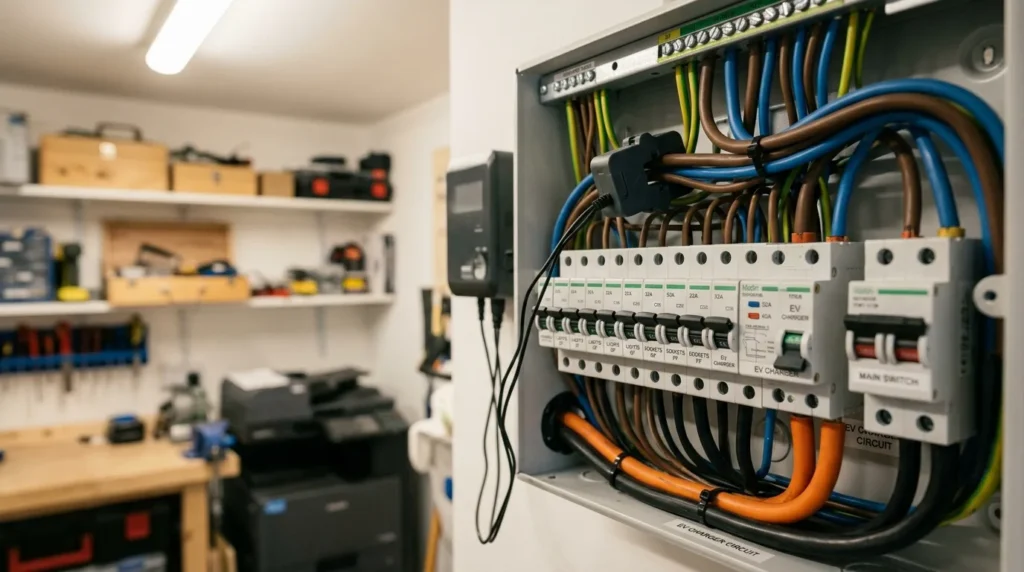
A current transformer clamp is installed around the main supply cable at your meter or consumer unit. The CT clamp measures the actual current being drawn by the household in real time, updating typically every few seconds.
2. Smart EV Charger with Load Management Firmware
The EV charger receives the CT clamp data and adjusts its charge current dynamically. The algorithm is simple:
Maximum available charger current = Service head limit − Current household draw
Example:
- Service head limit: 31A
- Current household draw (electric shower + hob): 19A
- Available for EV charger: 31A − 19A = 12A (2.76 kW)
- Charger automatically reduces from 32A to 12A
When the shower finishes:
- Current household draw drops to 3A
- Available for EV charger: 28A (6.44 kW)
- Charger automatically ramps back up
This happens in real time, continuously, without any user intervention. The car charges at whatever rate is safe given the other household loads at any moment.
Minimum Charge Current
EV chargers have a minimum charge current — typically 6A (1.4 kW) — below which they cannot safely operate. If household load is so high that available EV capacity falls below 6A, the charger pauses charging entirely. It resumes automatically when capacity becomes available.
This pause-and-resume behaviour can be slightly disconcerting if you watch it happen, but it is the correct response — better to pause briefly than to trip the service fuse.
Hardware Options in Ireland
Easee One + Easee Equalizer
The Easee Equalizer is Easee’s dedicated load management accessory. It installs at the consumer unit, clips a CT clamp around the main supply, and communicates wirelessly with one or more Easee chargers. The Equalizer enables:
- Single-household load management (one Easee One with CT monitoring)
- Multi-charger load management (multiple Easee One units sharing a service connection — ideal for homes with two EVs or small business premises)
- Phase balancing for three-phase supplies
The Equalizer adds approximately €150–€250 to the installation cost. For most single-EV households with modern consumer units and an electric shower, the Equalizer is strongly recommended.
Wallbox Pulsar Plus + Wallbox Energy Control
Wallbox’s equivalent system uses a Power Boost CT clamp module that communicates with the Pulsar Plus. The Power Boost enables dynamic load management for single or multiple Wallbox chargers. Available as an optional add-on, typically €100–€200.
MyEnergi Zappi (Built-in)
The Zappi includes CT clamp monitoring as standard — specifically designed to detect solar surplus. The same CT monitoring also enables a form of load management. While not as sophisticated as the Easee Equalizer for multi-charger scenarios, the Zappi’s built-in monitoring provides meaningful protection against overloading the supply.
Ohme Home Pro (Limited)
The Ohme Home Pro does not currently offer dynamic load management in the same way as the Easee or Wallbox systems. It relies on scheduled charging to avoid simultaneous peak loads rather than real-time CT-based adjustment. For most single-EV Irish households without a history of fuse trips, this is adequate.
When Is Dynamic Load Balancing Essential?
Essential for:
- Homes with a 7.2 kVA service head where the electric shower or other high-draw appliances run in the early morning or evening (i.e., at times when the EV may be charging)
- Homes with two or more EVs sharing a single service connection
- Business premises with multiple charge points on a limited supply
- Properties where ESB Networks has flagged supply capacity concerns during the notification process
Useful but not essential:
- Homes where EV charging is scheduled exclusively overnight (23:00–07:00) when the service head is unlikely to be under significant load
- Properties with a larger service head (15 kVA rural supply) with significant headroom
Not required:
- Three-phase supplies with ample capacity
- Homes where other high-draw appliances are on separate supply phases from the EV charger
Does Dynamic Load Balancing Slow Charging?
Yes — when other loads are high, the EV charger is throttled back and charges more slowly. However, in the context of overnight charging, this is almost never a problem. If you plug in at 19:00 and the EV charges at a reduced rate until 23:00 (when the family stops using the shower and hob), then charges at full rate from 23:00 to 06:00, the car is still fully charged by morning.
The scenarios where load management genuinely causes incomplete charges are rare — typically households with very high average electrical loads throughout the night, which is uncommon for typical Irish families.
Cost of Dynamic Load Management
Adding dynamic load balancing to a home EV charger installation adds approximately:
- CT clamp and cable: €30–€80
- Load management module (Equalizer, Power Boost, etc.): €150–€250
- Additional installation labour: €50–€150
Total addition to installation cost: approximately €200–€450. Compared to the alternative of paying ESB Networks for a service head upgrade (which may not even be possible in all areas), this is excellent value.
Summary: Should Your Irish Home Have Dynamic Load Balancing?
For most Irish homes installing a 7.4 kW charger with an electric shower and standard household appliances: yes, the Easee Equalizer or equivalent is a worthwhile addition. The cost is modest, the protection is genuine, and it avoids the frustration of a blown service fuse.
For homes that schedule EV charging exclusively to quiet overnight hours and have no history of supply issues: it is less urgent but still good practice for long-term reliability.
Ask your installer to assess your service head rating and typical household load profile during the site survey — this should inform whether dynamic load management is specified in your installation.