
- Home
- Solar guides
- Safe Electric Certificate for EV Charger Installation in Ireland
Safe Electric Certificate for EV Charger Installation in Ireland
Every home EV charger installation in Ireland must be carried out and certified by a Safe Electric registered electrician. The certification — called the REC — is required for your SEAI grant and is your guarantee of a safe, compliant installation.
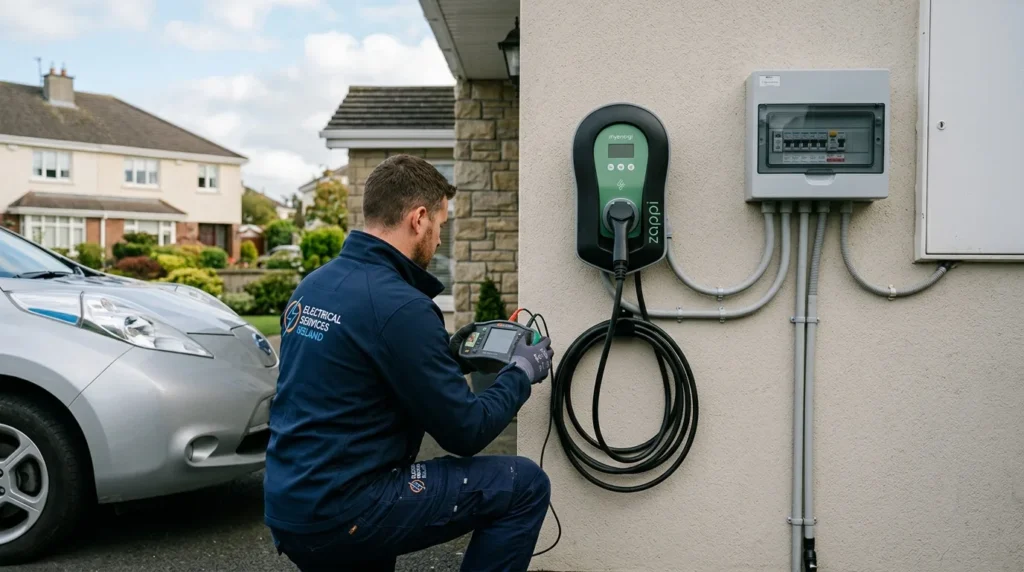
What Is Safe Electric?
Safe Electric is Ireland’s national register of competent electrical contractors, operated by the Register of Electrical Contractors of Ireland (RECI). It was established to ensure that electrical work carried out in Irish homes and businesses is done by qualified, competent, and insured professionals who meet the standards required by Irish wiring regulations.
Registration with Safe Electric is not just a business licence — it involves technical competency assessment, ongoing compliance audits, and the authority to issue legal electrical certificates. In Ireland, only Safe Electric registered electrical contractors may legally issue certificates of electrical compliance for completed work.
For EV charger installations, Safe Electric registration is a legal requirement — not a nice-to-have.
The REC: Record of Electrical Completion
The Record of Electrical Completion (REC) is the certificate issued by a Safe Electric registered electrical contractor after completing electrical installation work. It is the legal document that:
- Confirms the work was carried out to the standard required by ET 101:2018 (the Irish National Standard for Electrical Installations in Dwellings)
- Confirms the installation complies with I.S. 10101 (IEC 60364-7-722) for EV charging equipment
- Lists the tests carried out on the installation (insulation resistance, earth continuity, polarity, RCD trip time)
- Identifies the contractor, their Safe Electric registration number, and the date of work
- Is legally valid evidence of electrical compliance for insurance, property sale, and regulatory purposes
The REC is specific to the installation work carried out — not a general certificate for the entire house. An EV charger installation produces a REC covering the EV charger circuit and any associated consumer unit work.
Why the REC Is Essential
For the SEAI Home Charger Grant
The SEAI Home Charger Grant application requires you to upload the REC as part of the claim process. Without it, your grant claim will not be processed. SEAI uses the REC to confirm that:
- The work was carried out by a registered professional
- The installation meets required safety standards
- The charger is on an appropriate circuit with correct protection
No REC = no grant. This is a hard rule with no exceptions.
For Home Insurance
Your home insurance policy covers electrical damage and electrical fire risk. If an unregistered electrician carries out electrical work in your home and something subsequently goes wrong, your insurer has grounds to refuse a claim on the basis that the work was not properly certified.
A valid REC from a Safe Electric registered contractor eliminates this risk. The insurer can see that the work was certified as compliant with Irish wiring standards.
For Property Sales
When you sell your home, a solicitor will ask for electrical compliance documentation for any significant electrical works carried out. An EV charger circuit without an REC may delay a property sale or require remedial work to bring it into compliance before sale. Planning ahead by keeping your REC with your property documentation saves this headache.
For Safety
Beyond the regulatory and financial reasons, the REC represents a genuine quality check on your installation. A Safe Electric registered electrician must carry out specific tests before they can issue the REC:
- Insulation resistance test: Confirms there are no faults in the cable insulation
- Earth continuity test: Confirms the earthing path is complete and has low resistance
- Polarity test: Confirms live and neutral are correctly connected
- RCD trip time test: Confirms the RCD or RCBO trips within the required time limit on a fault current
These tests catch installation errors that might not be immediately obvious but could cause problems over time — particularly important for a circuit that will run 8-hour sessions every night for 10–15 years.
What Makes an Electrician Safe Electric Registered?
To be Safe Electric registered, an electrical contractor must:
- Hold relevant qualifications: Either a Level 6 Craft Certificate in Electrical Installation (FETAC) or equivalent, or demonstrate competence through a portfolio assessment
- Be insured: Public liability insurance and professional indemnity insurance are required
- Pass a competency assessment: Safe Electric assesses technical knowledge and skills before registration
- Comply with ongoing audits: Safe Electric conducts periodic audits of registered contractors’ work
- Be vetted for fit and proper person requirements: Background checks are part of the registration process
The Safe Electric website (safeelectric.ie) has a searchable database of currently registered contractors by county, allowing homeowners to verify registration before booking work.
How to Verify a Contractor Is Safe Electric Registered
Before commissioning any EV charger installation, verify your chosen electrician’s Safe Electric registration:
- Go to safeelectric.ie
- Click “Find a Registered Electrical Contractor”
- Search by company name, individual name, or county
- Confirm the registration is current and active
Never take a contractor’s word for registration without checking the database yourself. Safe Electric registration can lapse, be suspended, or have been incorrectly claimed.
Additionally, confirm that the specific electrician who will carry out the work (not just the company) is Safe Electric registered. Larger companies may employ both registered and unregistered workers — the person who physically installs your charger must hold the registration to issue the REC.
What to Do If You Did Not Get a REC
If a previous EV charger installation did not result in a REC being issued — this can happen with unregistered contractors or where homeowners were not aware of the requirement — you have two options:
Retrospective certification: A Safe Electric registered electrician can assess an existing installation, carry out the required tests, and issue a REC if the installation is found to be compliant. This typically costs €150–€350 for an EV charger circuit assessment.
Remedial works: If the existing installation does not meet current standards (wrong cable size, missing RCD protection, etc.), the electrician will quote for remedial work to bring it up to standard before issuing the REC.
Note that a retrospective REC cannot be used for a retrospective SEAI grant claim — the SEAI grant requires the installation to have been approved before the work was done. But a retrospective REC does protect your insurance coverage and property value.
Choosing a Registered Installer for Your EV Charger
When selecting an installer, confirm:
- Safe Electric registration (verify on safeelectric.ie)
- Experience specifically with EV charger installations (not just general electrical work)
- SEAI registration as an EV charger installer (separate requirement for grant-eligible installations)
- Willingness to provide a written quote including REC issuance
- Availability of a site survey before installation
Our guide How to Choose an EV Charger Installer in Ireland provides a full checklist for selecting and vetting installers.
Get 3 free, no-obligation solar quotes
Tell us a few quick details about your home and we’ll connect you with up to 3 SEAI-registered solar installers in your area.
Frequently Asked Questions
Do I need a Safe Electric certificate for an EV charger in Ireland?
What happens if I do not get a certificate after EV charger installation?
How much does a Safe Electric certificate cost?
Can any electrician install an EV charger and issue a certificate?
How long is a Safe Electric certificate valid?
Get 3 free quotes for your home EV charger
We'll match you with Safe Electric-certified installers who can apply for the €300 SEAI Home Charger Grant on your behalf.
- No obligation · Free · Takes 2 minutes
More solar pv guides

Safe Electric Certificate for EV Charger Installation in Ireland
Home Solar guides Safe Electric Certificate for EV Charger Installation in Ireland Safe Electric Certificate for EV Charger Installation in Ireland Every home EV charger
Sources & further reading

Solar Expert Editorial
Solar advisor team
Published 15 May 2026
Get 3 free quotes for your home EV charger
We'll match you with Safe Electric-certified installers who can apply for the €300 SEAI Home Charger Grant on your behalf.
- No obligation · Free · Takes 2 minutes