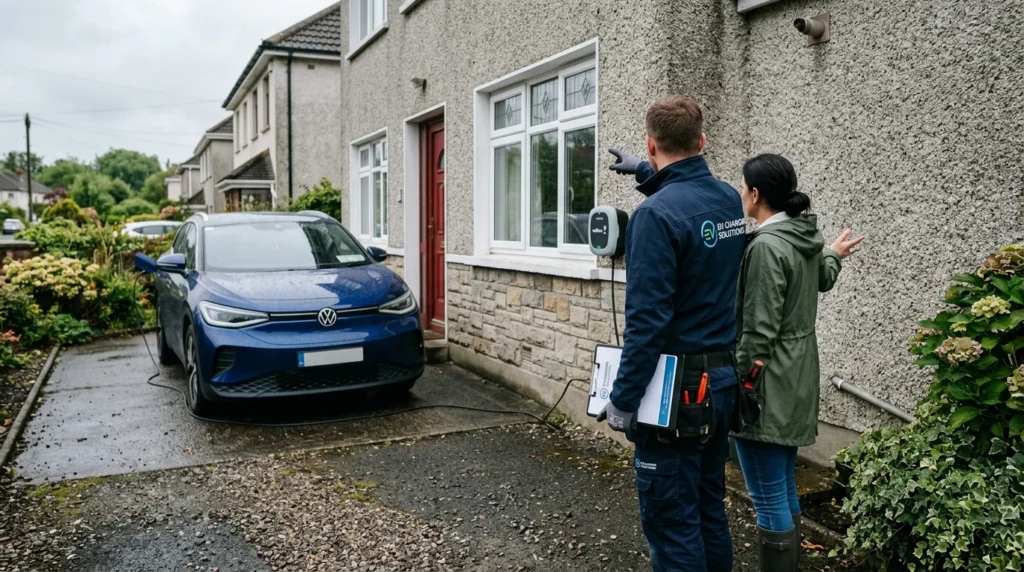
Why Installer Selection Matters More Than You Think
Many Irish EV buyers spend weeks researching charger brands — Easee vs Wallbox vs Zappi — and then choose an installer by searching Google and picking the first result. This is backwards. The charger is standardised, mass-produced, and warrantied by the manufacturer. The installation is bespoke, performed once by a specific individual, and largely irreversible without additional cost.
A good installation is invisible — it just works, passes certification, and lasts 15 years without issues. A poor installation can trip fuses repeatedly, fail the Safe Electric certification (blocking your SEAI grant), develop cable faults over time, or in worst cases create fire risks that only manifest years later.
The 30 minutes spent properly vetting an installer is one of the most valuable things you can do before commissioning a home EV charger.
Mandatory Qualification 1: Safe Electric Registration
Every EV charger installer in Ireland must be Safe Electric registered. This is a legal requirement — only Safe Electric registered contractors may issue the Record of Electrical Completion (REC) that is mandatory for:
- Your SEAI Home Charger Grant claim
- Compliance with Irish wiring regulations (ET 101:2018)
- Insurance validity and property sale documentation
How to verify: Go to safeelectric.ie → Find a Registered Electrical Contractor → search by company name or contractor name. The registration must be current and active.
Do not rely on the contractor’s word. Look them up in the register yourself before booking. Safe Electric registration can lapse or be suspended, and some unregistered contractors misrepresent their status.
Mandatory Qualification 2: SEAI Registered EV Charger Installer
For your installation to be eligible for the €600 SEAI Home Charger Grant, the installer must also be registered on the SEAI list of registered EV charger installers. This is a separate registration from Safe Electric, maintained by SEAI at seai.ie.
How to verify: Go to seai.ie → Grants → Home Charger Grant → Find a Registered Installer. Search by county or company name.
An installer who is Safe Electric registered but not on the SEAI installer list cannot facilitate your grant claim. Always verify both registrations.
Desirable: EV-Specific Experience
Beyond the minimum registrations, look for installers with demonstrated experience specifically in EV charger installations — not just general domestic electrical work.
Indicators of EV-specific experience:
- They ask about your car’s on-board charger rating during the site survey
- They are familiar with multiple charger brands and can give unbiased brand advice
- They mention Type B RCD requirements or DC fault detection proactively
- They know the ESB Networks notification process and handle it routinely
- They can configure the charger app and scheduled charging as part of the handover
EV charger installation involves knowledge beyond standard domestic wiring — the IEC 60364-7-722 standard, OCPP configuration, dynamic load management — that general electricians who have done only a few EV charger installations may not have mastered.
Getting Quotes: The Right Process
Always get quotes from at least two installers, ideally three. For a project costing €1,100–€1,500 before the grant, a second opinion costs only time.
What a Good Quote Includes
A professional EV charger installer quote should clearly specify:
- The charger brand and model number (confirm it is SEAI-approved)
- Whether the charger is tethered or untethered, and cable length if tethered
- Installation labour cost (circuit, consumer unit work, charger mounting)
- Cable type and routing method specified
- Whether dynamic load management (CT clamp, Equalizer) is included or excluded
- Consumer unit assessment — is an upgrade included or noted as potentially needed?
- ESB Networks notification — is this handled by the installer?
- Safe Electric REC (Record of Electrical Completion) — is this included?
- SEAI grant assistance — will the installer help with the application?
- Warranty on the installation work (not just the charger unit)
- VAT breakdown (13.5% on labour, 23% on equipment)
A quote that lacks several of these elements is not a complete quote — and may hide costs that emerge on the day.
Red Flags in Quotes
- No site survey: Any installer quoting purely over the phone without seeing the property is not quoting accurately.
- Very low price: EV charger installations below €600 for labour alone (before charger cost) should be questioned — experienced Safe Electric registered electricians charge competitive rates.
- No mention of Safe Electric certification: If a quote does not reference the REC or Safe Electric certificate, ask explicitly.
- Charger not specified: A quote that says “7.4 kW charger” without naming the brand and model cannot be checked against the SEAI approved list.
- Grant handling not mentioned: A professional installer should be familiar with the SEAI grant and either assist with it or clearly explain that you handle the application yourself.
Questions to Ask Every Installer
Before booking, ask the following questions and evaluate the quality of the answers:
“What is your Safe Electric registration number?” — Then verify it on safeelectric.ie.
“Are you registered on the SEAI installer list?” — Verify on seai.ie.
“Have you installed [specific charger model] before?” — An experienced Easee One or Zappi installer has done dozens, not one or two.
“Will you handle the ESB Networks notification if required?” — For three-phase chargers, this is non-negotiable.
“Does your quote include a consumer unit assessment, and what happens if the board needs upgrading?” — You need to know if an upgrade will cost extra and approximately how much.
“Will you help with the SEAI grant application process?” — Most professional installers assist with or manage the grant paperwork.
“What warranty do you provide on the installation work itself?” — Charger unit warranty is from the manufacturer; the installer’s workmanship warranty is separate.
“Can you provide references from recent EV charger installations?” — A confident, experienced installer will have these readily available.
Comparing Quotes: What to Weigh
When you have two or three quotes, compare:
- Total price (supply + installation + any extras) — like-for-like, same charger model
- Completeness of scope — a lower quote that excludes consumer unit work or ESB Networks notification may be more expensive in total
- Timeline — how quickly can they schedule? (Most Irish installers book 2–4 weeks out for residential work)
- Communication quality — did they answer your questions directly and clearly? This predicts how they will communicate on the day
- References — did the references speak positively about quality and tidiness of work?
The cheapest quote is rarely the best value. The most professional, responsive installer at a fair price is.
Finding Registered Installers in Ireland
- SEAI installer list: seai.ie → Home Charger Grant → Find a Registered Installer
- Safe Electric contractor search: safeelectric.ie → Find a Registered Contractor
- EV charger brand finder tools: Easee, Wallbox, Zappi/myenergi all maintain installer finders on their Irish product pages
- Personal recommendation: Ask your EV-owning neighbours or local EV clubs — this is often the most reliable source
Avoid choosing installers solely from general Google search ads, where registration status is not verified.