Panels, Inverters & Sizing


Bifacial solar panels generate electricity from both the front and rear surfaces. They’re increasingly common in commercial solar farms — but are they worth the premium for Irish residential installations? This guide gives you the facts.
Bifacial solar panels — modules that generate electricity from both their front (main) surface and their rear surface by capturing light reflected from the ground or surrounding surfaces — are the fastest-growing panel technology in the global solar market. They’ve transformed large-scale solar farms across Europe and are increasingly specified in Irish commercial projects.
For residential installations in Ireland, the picture is more nuanced. This guide explains what bifacial panels actually are, when they provide genuine additional output in Irish conditions, and whether the premium is justified for typical Irish homes.
A standard (monofacial) panel is opaque on the rear — a white or black backsheet reflects no light and the cell generates electricity only from the front surface. A bifacial panel replaces the opaque backsheet with a transparent glass layer (glass-glass construction) or a transparent backsheet. This allows:
Bifacial gain is the percentage increase in output compared to an identical monofacial panel. Under ideal conditions (white sand, snow, or high-albedo roof surface), bifacial gains of 10–20% additional output are achievable. In typical European conditions on a pitched roof, gains are typically 3–8%.
Major solar manufacturers now offer bifacial versions of their leading products:
The bifacial factor indicates what proportion of the front-side efficiency is achieved on the rear side under standard test conditions. A panel with 22% front efficiency and 80% bifacial factor theoretically delivers 17.6% rear efficiency — but in practice, real rear-side gains depend entirely on what light is available.
1. Ground or roof albedo (reflectivity) The single most important factor. Typical albedo values:
Irish residential pitched roofs — covered in dark concrete tiles, grey fibre cement slates, or natural slate — have relatively low albedo (0.10–0.20). This significantly limits the rear-side light available to bifacial panels on conventional pitched roofs.
2. Panel height above surface Rear-side gain increases with mounting height (more sky visible to the rear). Conventional pitched roof mounts hold panels close to the roof surface (20–30 cm) — limiting the “view factor” of the rear panel to reflected light.
3. Diffuse sky contribution In Ireland’s predominantly diffuse sky conditions, rear-side generation also benefits from direct sky diffuse radiation reaching the rear. On a well-elevated mount, bifacial panels in Ireland can generate meaningful rear-side output from the sky component alone.
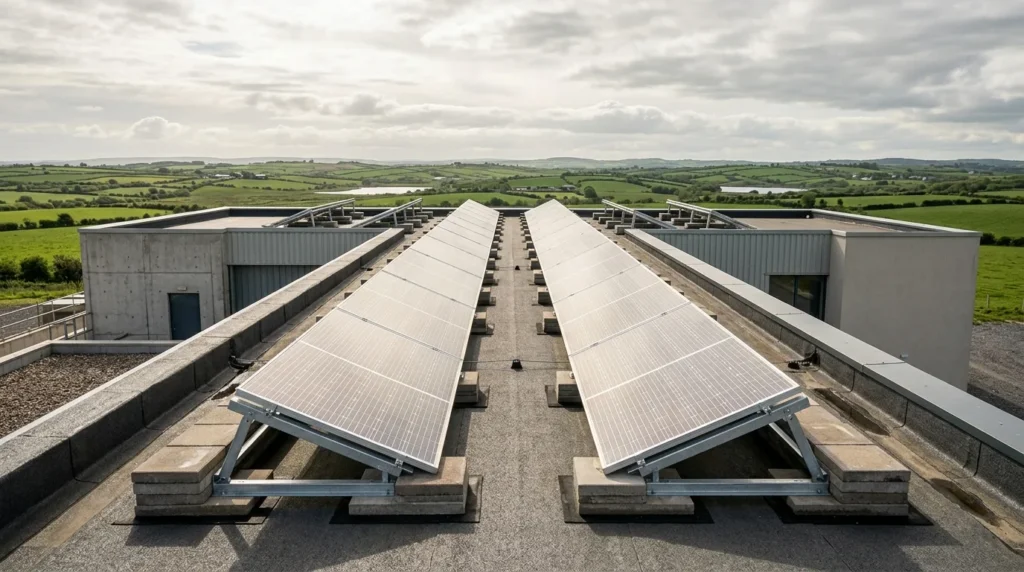
The key insight: Bifacial panels deliver their best gains on flat roofs with light-coloured surfaces and elevated ground mounts — not on typical Irish pitched roof slate installations.
Bifacial panels carry a premium of approximately €0.02–€0.06 per Wp (5–15%) over equivalent monofacial models. For a 4 kWp system:
The module cost premium is modest. However, to realise bifacial gains, the installation may also need:
Financial payback of bifacial premium (pitched roof, 4% gain):
Financial payback of bifacial premium (flat roof, light gravel, 10% gain):
Most bifacial panels use glass-glass construction — two glass sheets encasing the cells rather than a glass front and plastic backsheet. This offers advantages even for monofacially-deployed panels:
For Irish homes where durability and longevity are priorities, specifying bifacial glass-glass panels can be worthwhile for the structural and durability benefits alone — regardless of rear-side bifacial gain.
Recommend bifacial when:
Not necessary for:
Our conclusion: Bifacial panels are not a universal upgrade for Irish residential solar. On typical pitched roofs with dark tiles, the bifacial gain is too modest to justify the premium. On flat roofs with appropriate surface treatment, bifacial panels deliver genuinely worthwhile additional output and the glass-glass construction provides real durability benefits for any Irish installation.
Tell us a few quick details about your home and we’ll connect you with up to 3 SEAI-registered solar installers in your area.
Monofacial panels generate electricity from the front surface only. Bifacial panels use transparent glass on both front and rear, allowing rear-side generation from reflected light. Most bifacial panels also use glass-glass construction (both sides are glass rather than one glass and one plastic backsheet), which improves durability and moisture resistance.
We'll match you with Safe Electric-certified installers who can apply for the €300 SEAI Home Charger Grant on your behalf.
— Fraunhofer Institute for Solar Energy Systems
— European Commission Joint Research Centre

Solar advisor team
Published 15 May 2026
We'll match you with Safe Electric-certified installers who can apply for the €300 SEAI Home Charger Grant on your behalf.