Cost of an EV Home Charger in Ireland 2026: Full Price Breakdown

The total cost of a home EV charger in Ireland — unit, installation, and any electrical upgrades — typically runs €1,100–€1,500 before the €600 SEAI grant. Here is where every euro goes.
What Does a Home EV Charger Cost in Ireland in 2026?

The most common question from Irish EV buyers — and the one with the most variable answer — is simply: what will it cost to get a charger at home? The answer depends on your property, your charger choice, and your existing electrical infrastructure, but a well-informed buyer should budget €1,100–€1,500 total before the SEAI grant, leaving a net cost of €500–€900 after the €600 SEAI Home Charger Grant.

This guide breaks down every component of that cost so you know exactly what you are paying for.

The Cost Components

1. The Charger Unit (Supply Cost)

The wallbox itself — the unit that mounts on your wall — varies in price depending on brand, features, and whether it is tethered or untethered. All prices below are approximate 2026 retail prices for SEAI-approved models:

Charger

Type

Approx. Price

Project EV PRO-E 7.4 kW

Tethered

€350–€450

EO Mini Pro 3 7.4 kW

Tethered

€400–€500

Ohme Home Pro 7.4 kW

Tethered

€450–€550

Hypervolt Home 3 7.4 kW

Tethered

€450–€550

Wallbox Pulsar Plus 7.4 kW

Untethered

€450–€550

Easee One 7.4 kW

Untethered

€500–€600

MyEnergi Zappi 7.4 kW

Untethered

€550–€650

Tesla Wall Connector

Tethered

€450–€550

Most households choose a charger in the €400–€600 supply cost range. Spending more typically buys better smart features, a more refined app, or specific integration (e.g., Zappi’s solar diversion, Easee’s dynamic load management ecosystem).

Spending less is possible with budget SEAI-approved units, but check the app quality, warranty terms, and OCPP compliance before committing to the cheapest option.

2. Installation Labour

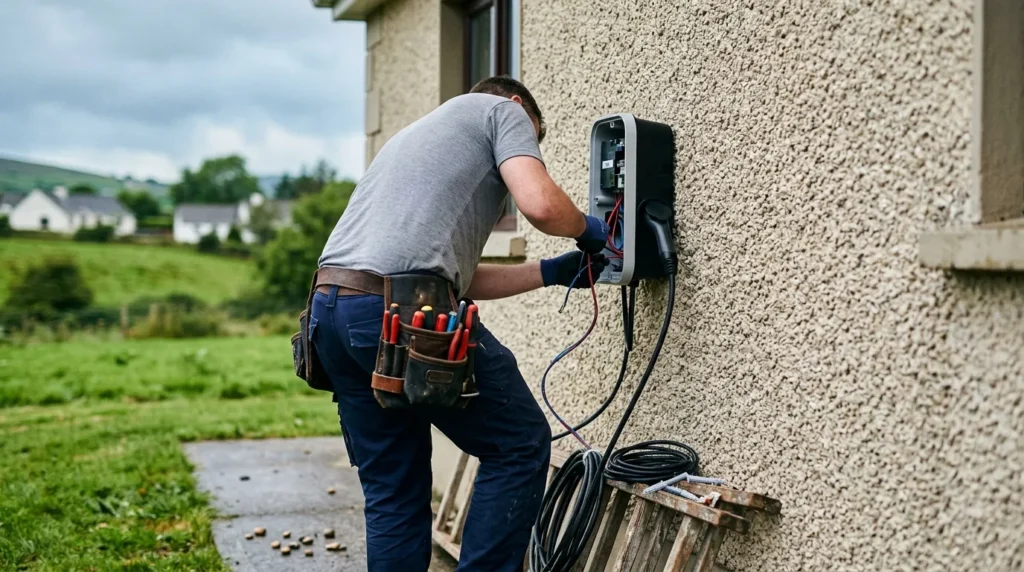
This is where costs vary most significantly. A standard installation involves:

  • Supplying and running a dedicated 32A circuit from the consumer unit to the charger location
  • Installing a 32A RCBO or MCB in the consumer unit
  • Mounting the charger and making final connections
  • Testing, commissioning, and issuing the Safe Electric completion certificate

Typical labour + materials (excluding charger unit): €500–€800

What makes installation more expensive:

  • Long cable runs (>10 metres from consumer unit to charger)
  • Difficult routing (solid walls, no cavity, multiple floors to traverse)
  • Outdoor armoured cable runs or underground cable burial
  • Consumer unit that requires upgrading (see below)
  • Premium labour rates in Dublin vs. rest of Ireland (Dublin typically 15–25% higher)

What makes it cheaper:

  • Short cable run (consumer unit near garage or front of house)
  • Easy internal routing through cavity walls or under floors
  • Modern consumer unit with spare RCBO slots

3. Consumer Unit Upgrade (If Required)

An older consumer unit — one with a main switch and individual MCBs but no RCBO protection — may need to be upgraded to a modern dual-RCD or RCBO consumer unit before a Safe Electric registered electrician can certify the installation. This is not required in every case, but if it is needed:

Consumer unit upgrade cost: €300–€600 (including supply of new board and labour)

This is a worthwhile investment regardless of the EV charger — a modern RCBO consumer unit provides better fault protection for the entire house. Some electricians will include a consumer unit upgrade in the overall installation quote; others will quote it separately.

4. ESB Networks Fees (Rare)

In almost all standard single-phase 7.4 kW installations, there are no ESB Networks fees. Notification is not required for sub-7 kW installations.

For 11 kW or 22 kW three-phase installations, notification to ESB Networks is required. There is no standard fee for this notification, but if ESB Networks requires network reinforcement work, that is carried out at their cost. In rare cases, ESB Networks may require a supply upgrade (e.g., from 7.2 kVA to 15 kVA service head), which is typically free to the homeowner but requires scheduling.

Total Cost Breakdown: Typical Scenarios

Scenario A: Simple single-phase driveway installation

  • Modern consumer unit, short cable run (8 metres), easy routing
  • Charger: Ohme Home Pro tethered 7.4 kW (€500)
  • Installation: €500
  • Total before grant: €1,000
  • After €600 SEAI grant: €400

Scenario B: Standard driveway installation

  • Modern consumer unit, medium cable run (15 metres), internal routing
  • Charger: Easee One untethered 7.4 kW (€560)
  • Installation: €650
  • Total before grant: €1,210
  • After €600 SEAI grant: €610

Scenario C: Complex installation

  • Older consumer unit requiring upgrade, long cable run (25+ metres), some external armoured cable
  • Charger: MyEnergi Zappi (€620)
  • Installation: €700
  • Consumer unit upgrade: €400
  • Total before grant: €1,720
  • After €600 SEAI grant: €1,120

Scenario B is closest to the median Irish installation. Scenario A is achievable for favourable properties. Scenario C is the upper end for typical residential installations.

What the SEAI Grant Covers

The €600 SEAI Home Charger Grant covers the combined cost of charger supply and installation — it is a flat-rate grant, not a percentage of cost. It applies equally whether your total is €1,000 or €2,000.

The grant does not cover:

  • Consumer unit upgrades (these are a separate electrical works cost)
  • Any civil works (digging, groundworks)
  • Non-SEAI-approved charger models
  • Properties where you are not the primary resident

The grant is paid by SEAI to you (not to the installer) after the work is complete and the Safe Electric certificate is uploaded. Most Irish homeowners pay the installer in full and are reimbursed by SEAI within 4–8 weeks.

Ongoing Costs After Installation

Once installed, a home EV charger has minimal ongoing costs:

  • Electricity: The dominant ongoing cost. On Electric Ireland Night Boost, Bord Gáis EV Tariff, or similar smart tariffs, night-rate electricity costs approximately 12–15 c/kWh in 2026. At 15,000 km/year and 20 kWh/100 km, annual energy cost is approximately €360–€450.
  • App subscription: Some charger brands (Ohme, Easee) offer enhanced cloud features via a subscription (typically €2–€5/month). Basic smart scheduling is usually free.
  • Maintenance: Home EV chargers are solid-state devices with no moving parts. Maintenance cost is effectively zero — the main risk is weather damage to the cable or socket over 10+ years.
  • Warranty: Most units carry a 3-year manufacturer warranty. Extended warranties to 5 years are available from some brands and installers.

Is the Home Charger Worth the Cost?

For most Irish EV owners, the answer is unambiguously yes. At typical Irish driving patterns (12,000–20,000 km/year):

  • Replacing public rapid charging (40 c/kWh) with home night-rate charging (13 c/kWh) saves roughly €500–€900 per year
  • The home charger pays for itself within 12–24 months in energy savings alone
  • The convenience of a full battery every morning is a quality-of-life improvement that is difficult to put a number on

The SEAI grant reduces the payback period further. For most Irish households, the home EV charger is one of the best energy investments available in 2026.

Get 3 free, no-obligation solar quotes

Tell us a few quick details about your home and we’ll connect you with up to 3 SEAI-registered solar installers in your area.

Frequently Asked Questions

No. The SEAI Home Charger Grant requires installation by a Safe Electric registered electrician. DIY installation is not eligible and would also be unsafe and illegal — EV charger installation involves high-current circuits that must be certified by a registered professional.
No — the grant is paid directly to you by SEAI after the installation is complete. You pay the full amount to the installer upfront, then reclaim €600 from SEAI by uploading your Safe Electric certificate and invoice. Allow 4–8 weeks for payment.
Yes — EV charger supply and installation is subject to VAT at the standard rate (23% on equipment, 13.5% on labour). The SEAI grant amount takes VAT into account in its design, but prices quoted should be confirmed as inclusive or exclusive of VAT to avoid surprises.
For private residential use, there is no specific income tax relief on home EV charger installation beyond the SEAI grant. Sole traders and company directors may be able to claim the cost as a business expense if the EV is used for business purposes — consult your accountant.
Market evidence suggests EV chargers are increasingly expected by buyers and can be a positive selling point, particularly in areas with high EV adoption. While formal valuation uplift studies are limited in Ireland, estate agents report that EV chargers are increasingly mentioned as a desirable feature in property listings.

Get 3 free quotes for your home EV charger

We'll match you with Safe Electric-certified installers who can apply for the €300 SEAI Home Charger Grant on your behalf.

More solar pv guides

Sources & further reading

Solar Expert Editorial

Solar advisor team
Published 15 May 2026

Get 3 free quotes for your home EV charger

We'll match you with Safe Electric-certified installers who can apply for the €300 SEAI Home Charger Grant on your behalf.

Request installer quotes

Free, non-binding comparison

Support Form (#3)
Support Form (#3)
Support Form (#3)