The Good News: Most EV Chargers Do Not Need Planning Permission
For the vast majority of Irish homeowners installing a home EV charger, planning permission is not required. Under Schedule 2, Part 1 of the Planning and Development Regulations 2001 (as amended), EV chargers installed on residential properties are exempted development, meaning they can be installed without applying to the local planning authority.
This is consistent with Ireland’s broader policy of encouraging EV adoption, and mirrors similar exemptions in the UK’s permitted development rights. However, understanding exactly where the exemption applies — and where it does not — is important before commissioning an installation.
The Exempted Development Rules for EV Chargers
Planning and Development Regulations (as updated to include EV charging infrastructure) provide exemption from planning permission for EV chargers on residential properties subject to the following conditions:
Condition 1: Projecting No More Than 200mm from the Wall
The charger must not project more than 200mm from the wall on which it is mounted. All standard home EV wallbox chargers meet this requirement — the Easee One, Wallbox Pulsar Plus, Ohme Home Pro, and comparable units all project less than 100mm from the mounting surface.
Condition 2: Not Forward of the Principal Elevation
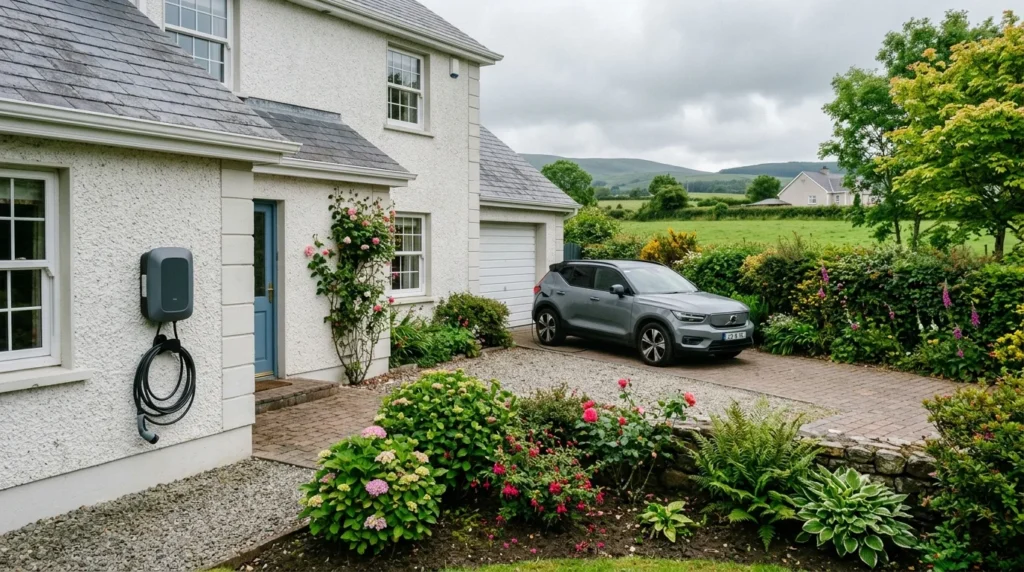
The charger should not be positioned forward of (i.e., visible from the street in front of) the principal elevation — the main front face of the house. In practice, this means chargers mounted on side walls or rear walls of houses are clearly exempt. Front wall mounting in sight of the public road is less clear-cut and may trigger the need for confirmation from your local authority.
Condition 3: Mounted on a Wall (Not Freestanding)
The exemption applies to wall-mounted units, not freestanding posts. If your preferred installation requires a freestanding charge point post (e.g., in the centre of a driveway where no wall is close enough), a planning application may be required — though many local authorities take a permissive view of discreet freestanding posts on private driveways.
Condition 4: Residential Property
The exemption applies to dwellings — houses and apartments (subject to management company and building regulations for apartments). Commercial properties, including those with a home office element, may be subject to different rules.
When Planning Permission Is Required
Despite the general exemption, planning permission is required — or strongly advisable — in the following scenarios:
Protected Structures
If your home is a Protected Structure (listed on the local authority’s Record of Protected Structures, RPS), any alterations to the exterior — including mounting a charger on an external wall — require planning permission. Protected Structure status typically applies to historic or architecturally significant buildings.
Before installing a charger on a protected structure, contact your local authority’s planning department. They will advise whether planning permission is needed and what conditions might apply. The planning authority may require the charger to be installed in a specific location to minimise visual impact.
Architectural Conservation Areas (ACAs)
Many Irish towns and villages include Architectural Conservation Areas — areas of special architectural or historical character where additional development controls apply. If your home is in an ACA:
- Exempted development thresholds may be lower or non-applicable
- The external appearance of buildings (including fixtures on exterior walls) may be regulated
- A planning application may be required even for a small wall-mounted charger
Check your local authority’s development plan (available on the local authority website) to determine whether your area is an ACA. Local planning authorities in historic town centres — including parts of Dublin, Cork, Galway, Limerick, and Kilkenny — have significant ACA coverage.
Apartment Blocks and Multi-Unit Developments
For apartments and managed developments, the external structure of the building is common area, regulated by the Owners’ Management Company (OMC). While no specific planning consent is typically required from the local authority for an individual apartment charger installation, OMC approval is a practical requirement. See our guide EV Charger in Apartment Ireland for more detail.
Freestanding or Non-Wall-Mounted Installations
If your planned installation is a freestanding post rather than a wall-mounted unit, consult your local authority’s planning department before proceeding. Some local authorities grant retrospective exemptions for minor freestanding installations on private property; others require formal planning consent.
Unusual Installation Arrangements
Any arrangement that does not clearly meet the Schedule 2 conditions — very large units, installations projecting more than 200mm, front-elevation mounting on visible main facades — should be clarified with the planning authority before commissioning.
How to Check If Your Property Is in an ACA or Is a Protected Structure
Planning maps: Your local authority’s online planning portal will have maps showing ACAs and protected structures. Dublin City Council, Cork City Council, and all other local authorities publish these.
Development plan: The local development plan (renewed every 6 years) includes lists of protected structures and ACA boundaries.
Contact your local authority: The planning department can confirm your property’s status from the address within minutes.
Your estate agent or solicitor: If you are a recent buyer, your solicitor would have flagged protected structure or ACA status during the conveyancing process.
What Happens If You Install Without Required Permission?
If planning permission was required and not obtained, the installation is unauthorised development. Consequences can include:
- A planning enforcement notice from the local authority requiring removal or regularisation
- Difficulty selling the property (solicitors will identify the unauthorised structure during conveyancing)
- Potential insurance implications (some insurers exclude coverage for unauthorised structures)
The risk is low for a discreet charger on a non-protected property, but the consequences are disproportionate to the effort of confirming status in advance. Spend 10 minutes checking your local authority’s online planning portal before proceeding.
Applying for Planning Permission (If Needed)
If your installation does require planning permission — protected structure or ACA — the process involves:
- Pre-planning consultation: Contact the local authority planning department for informal guidance on the preferred location and any specific requirements
- Planning application: Submit a planning application with drawings, fee (approximately €65 for a minor residential application), and supporting documentation
- Decision period: Up to 8 weeks from the planning authority receiving a valid application
For most EV charger installations on protected structures, planning authorities are supportive provided the charger is tastefully positioned to minimise visual impact. A rear wall position (away from the principal elevation) is almost always acceptable.
Summary: Do You Need Planning Permission?
Planning Permission Needed?
Standard house, driveway, wall-mounted
No — exempted development
Yes — contact local authority
Architectural Conservation Area
Probably — contact local authority
Freestanding post on private driveway
Check with local authority
Apartment (wall mount in designated space)
No — but OMC approval needed
Front wall, visible from public road
Confirm with local authority
When in doubt, a 10-minute call to your local authority planning department is the fastest way to get definitive guidance before any money is spent.