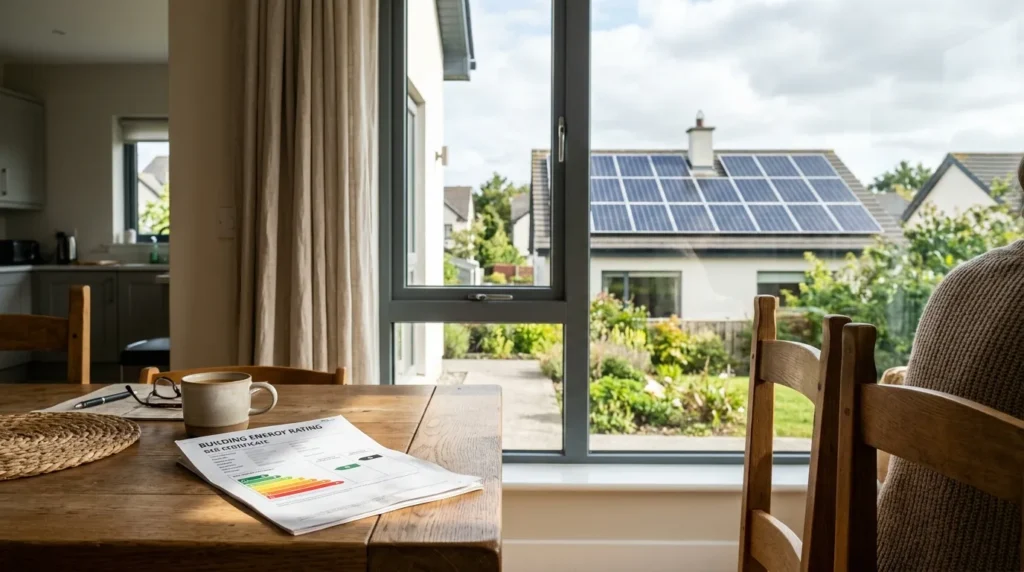
A Building Energy Rating (BER) certificate assesses how energy-efficient your home is on a scale from A1 (most efficient) to G (least efficient). The rating reflects the primary energy consumption and carbon dioxide emissions of the building — not just electricity, but all energy sources including gas, oil, and electricity.
Solar PV and BER ratings in Ireland have an important relationship: solar panels reduce a property’s primary energy consumption and CO₂ emissions in the BER calculation, often pushing homes up by one or more grade. This matters for property value, mortgage access, and compliance with NZEB requirements.
How BER Ratings Are Calculated in Ireland
BER ratings in Ireland are calculated using the DEAP (Dwelling Energy Assessment Procedure), a methodology developed by SEAI. The DEAP software models a home’s annual energy performance based on:
- Building fabric: Insulation levels, U-values of walls, roof, floor, windows
- Heating system: Type (gas boiler, heat pump, oil), efficiency, controls
- Hot water: How hot water is heated and stored
- Ventilation: Natural, mechanical, or MVHR
- Renewable energy: Solar thermal, solar PV, wind turbines
- Lighting: Proportions of energy-efficient lighting
The output is a primary energy demand in kWh/m²/year. This is converted to a BER grade:
Primary Energy (kWh/m²/year)
How Solar PV Is Modelled in DEAP
In the DEAP methodology, solar PV contributes to BER improvement through two mechanisms:
Mechanism 1: Direct Electricity Offset
Solar PV electricity generated and consumed on-site reduces the home’s net electricity demand from the grid. In DEAP, this is modelled as:
Usable solar PV generation = Annual PV output × Self-consumption fraction
This usable generation is subtracted from the home’s total electrical demand before calculating primary energy. Since Irish grid electricity has a primary energy factor of approximately 2.69 kWh primary energy per kWh of electricity delivered (reflecting the mix of fossil fuels, renewables, and grid losses in the Irish electricity system), each kWh of solar electricity self-consumed reduces primary energy demand by approximately 2.69 kWh.
Example calculation for a 4 kWp system in Dublin:
- Annual solar output: 3,800 kWh
- Self-consumption fraction (DEAP default): ~50%
- Usable solar electricity: 1,900 kWh
- Primary energy reduction: 1,900 × 2.69 = 5,111 kWh/year
- For a 120 m² home: 42.6 kWh/m²/year improvement
Mechanism 2: Grid Export Credit
DEAP also allows a credit for electricity exported to the grid — but at a lower factor than self-consumption, reflecting that exported electricity is credited at a different primary energy value (it’s valuable but different from directly substituting grid imports).
In practice, the self-consumption component drives most of the BER improvement from solar PV.
Real BER Improvement Scenarios
Scenario 1: 3-bed semi-detached, gas boiler, current BER C2
Current performance:
- BER: C2 (185 kWh/m²/year primary energy)
- House area: 100 m²
- Total primary energy: 18,500 kWh/year
After installing 4 kWp solar PV:
- DEAP primary energy reduction: ~38–45 kWh/m²/year
- New primary energy: ~140–147 kWh/m²/year
- New BER: B3 (just below B2 boundary)
One full grade improvement from C2 to B3 is typical for this scenario.
Scenario 2: 4-bed detached, oil boiler, BER D1
Current performance:
- BER: D1 (240 kWh/m²/year primary energy)
- House area: 140 m²
After installing 5 kWp solar PV:
- DEAP reduction: ~40–50 kWh/m²/year
- New primary energy: ~190–200 kWh/m²/year
- New BER: C2 (still a major improvement)
Note: For oil-heated homes, solar PV alone is unlikely to move a D or E-rated home to a B rating without also improving insulation or replacing the boiler. Solar PV is most impactful in homes that already have reasonable fabric insulation.
Scenario 3: Well-insulated 3-bed semi, heat pump, BER B3
After installing 4 kWp solar PV:
- DEAP reduction: ~35–45 kWh/m²/year
- New primary energy: ~85–115 kWh/m²/year
- New BER: B2 or B1
Heat pump homes benefit most from solar PV in BER terms because:
- Heat pump already has low primary energy factor (electricity × HP efficiency)
- Solar reduces the already-clean electricity demand further
- Combined effect can push close to A-rated territory for well-insulated homes
BER Certificate Update: What's Required
If you install solar PV and want your BER certificate updated to reflect the improvement, you need to:
- Commission a new BER assessment from a SEAI-registered BER assessor
- Provide documentation of the solar installation (SEAI grant completion documents, system specifications)
- Assessor inputs system data into the DEAP software
- New BER certificate issued (valid for 10 years)
- Register certificate with SEAI’s BER database
Cost of a new BER assessment: €100–€200 for a standard residential property.
Is it mandatory? No — there’s no legal requirement to update your BER when you install solar PV unless you’re selling, renting, or applying for certain grants. However, updating is strongly recommended before selling, as an improved BER can command a price premium.
Property Value Impact of BER Improvement
Research across Ireland and the UK consistently shows positive correlation between BER rating and property sale price:
Premium vs BER D/E Equivalent
For a typical 3-bed semi in Dublin (2026 value ~€400,000):
- Moving from C2 to B3 (typical 4 kWp solar): potential €12,000–€32,000 uplift
This property value impact often exceeds the net cost of the solar installation — making solar PV both a financially positive operating investment AND a property value-enhancing capital improvement.
Green Mortgage Access
Several Irish banks now offer preferential mortgage rates for properties with BER B3 or better:
Reduced mortgage rate for BER B3+
Green mortgage cashback for BER B+
Green home mortgage discount
For a mortgage holder with a €300,000 mortgage balance:
- Rate reduction of 0.25% (typical green mortgage benefit): €750/year saving
- Over 20 years: €15,000 in total interest savings
This green mortgage benefit alone — unlocked by improving BER through solar PV — can represent substantial long-term value.
NZEB Compliance: Solar PV's Role in New Builds
For new builds, the BER must reach A2 or better to meet NZEB (Nearly Zero Energy Building) requirements under Part L Building Regulations. Solar PV is typically one of the key contributors to achieving this:
A properly insulated A-rated new build without solar might achieve A3 primary energy. Adding a 4 kWp solar PV system typically provides the 30–40 kWh/m²/year primary energy reduction needed to cross from A3 into A2 territory.
See our guide on solar PV on A-rated new builds for the full regulatory picture.