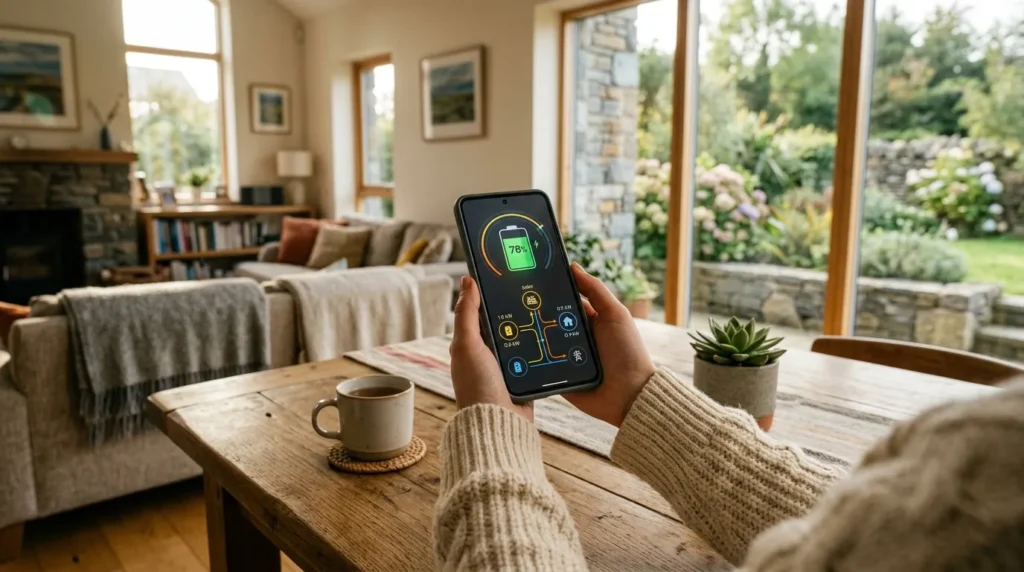
For Irish solar + battery economics, the annual battery value comes from:
Part 1: Solar Surplus Diversion (Daytime)
Solar electricity that would otherwise be exported is stored in the battery and used in the evening.
Value = kWh diverted × 10 c/kWh (arbitrage margin)
For a 4 kWp system (3,700 kWh/year) with a 9-to-5 household:
- Without battery: self-consumption 35% → 1,295 kWh used, 2,405 kWh exported
- With 10 kWh battery: self-consumption 70% → 2,590 kWh used, 1,110 kWh exported
- kWh diverted from export to battery: ~1,295 kWh
- Part 1 value: 1,295 × 10 c = €129.50/year
Part 2: Avoided Evening Grid Imports
The battery discharges in the evening to power the home instead of importing from the grid.
Value = kWh discharged × 30 c/kWh (full avoided import rate)
The 1,295 kWh stored replaces 1,295 kWh of evening grid imports:
- Part 2 value: 1,295 × 30 c = €388.50/year
Wait — doesn’t this double-count?
The actual combined net value is: kWh diverted × (30 c avoided grid – 0 c for battery self-charge). But we must subtract the foregone export income from Part 1. So:
- Total battery value = (1,295 × 30 c) – (1,295 × 20 c foregone) = 1,295 × 10 c = €129.50
No, this is wrong. Let me restate correctly:
The true incremental value of the battery:
- For each kWh the battery intercepts (stores instead of exporting): the household gains 10 c (30 c avoided grid import – 20 c foregone export)
- But the battery also covers evening grid consumption that was never going to be covered by solar anyway
The comprehensive approach:
Total battery annual value = Extra self-consumed kWh × (avoided import rate)
Without battery: consumes 1,295 kWh solar + imports 7,205 kWh grid = 8,500 kWh total With battery: consumes 2,590 kWh solar + imports 5,910 kWh grid = 8,500 kWh total
Battery reduces grid imports by 1,295 kWh:
- Grid imports avoided: 1,295 kWh × 30 c = €388.50/year saved
- Export income lost: 1,295 kWh × 20 c = €259/year lost
- Net battery benefit: €388.50 – €259 = €129.50/year
Part 3: Time-of-Use Tariff Arbitrage
Irish electricity suppliers are introducing time-of-use (TOU) tariffs where night-rate electricity is cheaper than daytime. Examples:
- Energia Night Boost: Night rate ~15 c/kWh (11pm–8am)
- SSE Airtricity Economy 7: Off-peak rate ~14 c/kWh
A battery on a TOU tariff can charge from the grid at night at 14–15 c/kWh and discharge during peak daytime at 28–33 c/kWh:
Net arbitrage value per kWh: 30 c – 15 c = 15 c/kWh
With a 10 kWh battery cycling once daily, 200 days/year on grid charging:
- Grid-charged kWh: 10 kWh × 200 days = 2,000 kWh/year
- Additional value: 2,000 × 15 c = €300/year
This “grid charging” use case can double the battery’s annual financial contribution.
Strongly justified (payback 6–9 years):
- Household with EV and smart solar charging
- TOU tariff + active battery management
- Work-from-home household with moderate-high electricity use
- Large solar system (6+ kWp) with low daytime occupancy
Marginally justified (payback 10–14 years):
- Standard 4 kWp system, 9-to-5 household, TOU tariff
- With rising electricity prices, borderline cases become financially positive
Difficult to justify purely financially (payback 15+ years):
- Small 2–3 kWp system with high daytime self-consumption already
- No TOU tariff, standard import rate
- Household with very low evening electricity use
Non-financial reasons to add a battery regardless of pure payback:
- Grid resilience (Enphase Sunlight Backup, or battery backup during outages)
- Energy independence value
- EV flexibility (charge from any-time solar, not just daytime)
- Time-shift electric heating loads