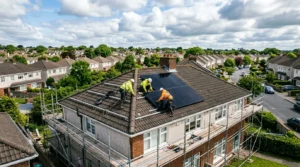
From your first quote to your first export payment, solar panel installation in Ireland typically takes 12–20 weeks when using the standard SEAI grant route. The process is straightforward but involves several agencies (SEAI, ESB Networks, your electricity supplier) with their own processing times.
This guide walks you through each phase of the process, giving you realistic timelines and the information you need to manage expectations and avoid unnecessary delays.
Overview: The Four Phases
Phase 1: Research & Quotes
Site surveys, comparing quotes
Phase 2: SEAI Grant Application
Online application, grant approval
1 day + 2–3 weeks lead time
Physical installation (1–2 days), SEAI completion
Phase 4: Grid Connection & MSS
ESB NC6, smart meter, supplier registration
First MSS payment ~6–16 weeks after installation
Phase 1: Research and Quotes (Weeks 1–4)
Week 1–2: Initial Research
- Use comparison tools, get neighbour recommendations, search the SEAI registered installer list
- Shortlist 3–4 installers
- Contact each for a preliminary quote or to arrange a site survey
Week 2–3: Site Surveys and Detailed Quotes
- Each installer conducts a site survey (typically 1–2 hours)
- Surveys include roof measurement, shade analysis, consumer unit assessment
- Detailed quotes provided within 1–5 working days after survey
Week 3–4: Quote Comparison and Decision
- Compare quotes using our checklist
- Call references from your preferred installer
- Negotiate any final terms
Total Phase 1 time: 2–4 weeks Common delay: Getting all three installers to conduct surveys within the same 2-week window — the most popular installers may have 2–3 week survey waiting lists.
Phase 2: SEAI Grant Application (Weeks 4–7)
Standard Route (DIY Application)
Step 1: Create an SEAI account and apply online
- Application at seai.ie takes approximately 30 minutes
- You need: MPRN (from your electricity bill), address details, chosen installer’s details
- Submit application BEFORE signing any contract or allowing any work to begin
Step 2: Receive grant approval
- SEAI approval is typically issued within 5–10 working days
- You receive an approval letter with a grant reference number
- The approval specifies the maximum eligible grant amount (up to €1,800)
Step 3: Sign contract with installer
- Now that grant approval is in hand, you can sign the installer contract
- Agree installation date
Total Phase 2 time (standard route): 1–3 weeks
One Stop Shop Route
If you’re using a SEAI One Stop Shop, they handle the grant application on your behalf. The process is similar but integrated — they apply and installation can often be scheduled around the expected approval date.
Important: If you start work before grant approval in the standard route, you are disqualified from the grant. This is the most costly mistake Irish homeowners make in the grant process.
Phase 3: Installation Day(s) (Weeks 7–10)
Pre-Installation Lead Time
After signing the contract, your installer will schedule an installation date. In 2026, demand for solar installation is high — lead times of 3–8 weeks are common between contract signing and installation date.
Peak installation season (April–September) typically has the longest lead times. If you’re aiming for installation by summer, start the process in February or March.
Installation Day
A standard residential solar installation (4 kWp, 10 panels, single-slope, straightforward access) typically takes 1 working day with a 2–4 person crew:
Crew arrival, scaffold setup or ladder access
Roof hook installation and rail fitting
Panel fitting and clipping
DC cable run from roof to inverter location
Inverter installation, AC connections, consumer unit circuit
Generation meter installation
System commissioning, monitoring setup, handover
More complex installations (6 kWp+, multiple roof sections, battery, complex scaffold access) take 2 days.
What Happens During Installation
- Scaffolding erected (usually morning of Day 1 or day before)
- Roof hooks installed — each hook is carefully positioned over a rafter, slate/tile lifted, hook secured through, tile refitted
- Aluminium rails fixed to hooks across the roof slope
- Panels placed and clamped to rails
- DC cabling connected: panel strings wired and routed through roof, along attic, to inverter location
- Inverter mounted and DC connected
- AC wiring: inverter output connected to consumer unit
- Generation meter installed adjacent to consumer unit
- Safety equipment: DC isolator, AC isolator, surge protection device
- System commissioned: inverter started, monitoring connected, output verified
- Handover: installer walks you through monitoring app, shows output, explains MSS registration steps
Post-Installation: SEAI Completion Documentation
Within 1–2 weeks of installation:
- Installer provides SEAI completion form
- Installer provides panel spec sheet, inverter spec sheet, generation meter details
- Installer provides ESB Networks NC6 notification reference
- You gather photos (panels, inverter, meter, consumer unit)
- Submit completion documentation via the SEAI online portal
SEAI processing time after documentation submission: typically 4–8 weeks Grant payment: direct bank transfer to your account
Phase 4: Grid Connection and MSS Registration (Weeks 10–20)
ESB Networks NC6 Notification
Your installer submits the NC6 notification to ESB Networks on the day of or shortly after installation. ESB Networks has up to 10 weeks to process NC6 notifications, though in practice:
- Urban/suburban areas (Dublin, Cork, Galway, Limerick cities and suburbs): 4–8 weeks
- Rural areas (most of Connacht, parts of Munster and Ulster): 6–12 weeks
ESB Networks then arranges a smart meter installation appointment (or confirms your existing smart meter is configured for bidirectional export metering).
Smart Meter Installation
ESB Networks contacts you to arrange a meter appointment. The appointment takes approximately 45 minutes and requires a brief power interruption (10–15 minutes). You don’t need to be home, but it’s useful to be available in case of access issues.
System Goes “Live” for Export
Once the smart meter is installed and ESB Networks confirms connection approval, your system is fully live — the export limit is lifted and electricity flows to the grid when you generate surplus.
MSS Registration With Electricity Supplier
Contact your chosen supplier (Electric Ireland, Energia, Bord Gáis Energy, SSE Airtricity) to register for the MSS Clean Export Guarantee. You need:
- MPRN
- Generation meter serial number and initial reading
- System capacity and installation date
Supplier processing time: 1–3 weeks. Once registered, export credits begin accumulating.
First MSS Payment
Most suppliers process MSS credits quarterly or annually. Your first payment may be a small credit on your electricity bill covering the partial period since registration.
Complete Timeline Summary
SEAI grant application submitted
Week 9–13 (depending on queue)
SEAI completion documentation submitted
ESB Networks NC6 submitted
MSS registration with supplier
First MSS export credit on bill
Tips to Minimise Delays
- Start in January or February — avoid the spring/summer installation queue
- Apply for the SEAI grant as soon as you’ve chosen an installer — don’t wait until you’re ready to sign
- Have your MPRN ready — it’s on your electricity bill, needed for SEAI application
- Choose an installer who manages the NC6 — some installers handle ESB Networks communication routinely, reducing back-and-forth
- Register for MSS immediately after smart meter installation — don’t delay
- Submit SEAI completion documents within 2 weeks of installation — the grant payment clock starts from documentation receipt