
- Home
- Solar PV guides
- Solar Panels on a Bungalow in Ireland: Roof Space, Output & What to Expect
Solar Panels on a Bungalow in Ireland: Roof Space, Output & What to Expect
Bungalows are one of the best house types for solar PV in Ireland — large roof areas, accessible installation, and often generous south-facing pitches. This guide covers sizing, typical output, and what to expect when fitting solar panels on an Irish bungalow.
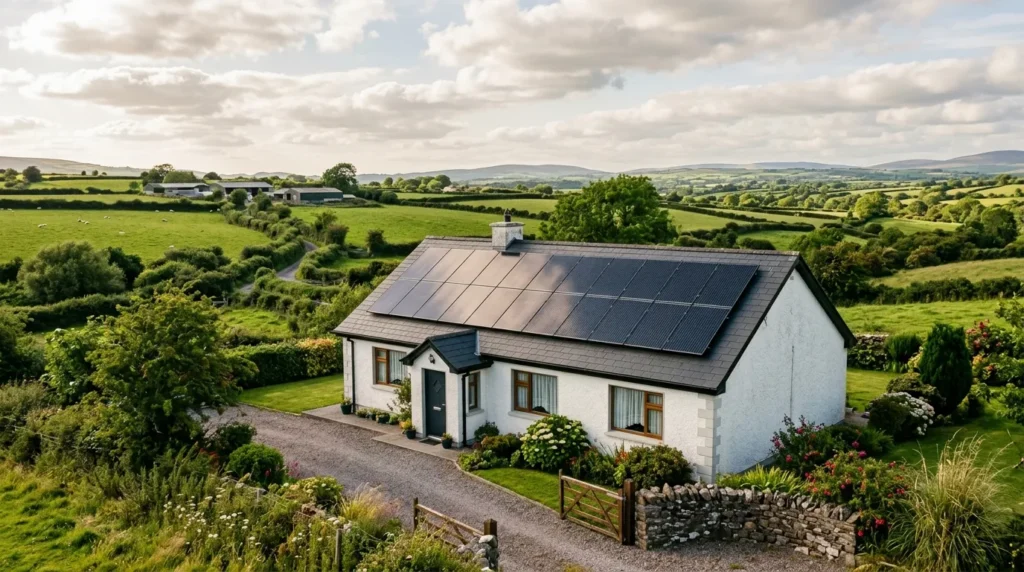
If you live in a bungalow in Ireland, you are in one of the best possible positions for solar PV. Solar panels on a bungalow in Ireland typically benefit from generous roof space, straightforward installation access, and relatively uncomplicated roof geometry compared to multi-storey houses. For rural bungalows especially — common across Connacht, Munster, and rural Leinster — large roof areas can comfortably accommodate systems of 6 kWp and above.
Bungalow Roof Characteristics for Solar
Roof Area and Available Space
A typical Irish bungalow has a total roof area of 120–180 m², spread across two or more pitched slopes. The usable solar area depends on orientation, obstructions, and structural factors, but most bungalows can accommodate a 6–10 kWp system — larger than the typical semi-detached house installation.
Key advantage: Because a bungalow spreads its floor plan horizontally across a single level, the roof footprint relative to living space is much larger than a two-storey house. A 120 m² bungalow might have 140–160 m² of roof area.
Roof Types Common in Irish Bungalows
1. Gable-ended pitched roof (most common) Two main slopes — typically east-west or approximately south-north. One slope will face roughly south (or southeast/southwest). This is ideal for solar PV. A 10 m × 15 m south-facing slope gives approximately 60 m² of usable space — enough for a 12–15 panel array (4.8–6.6 kWp).
2. Hipped roof Four slopes rather than two, with a smaller area on each face. The south-facing hip may offer only 25–40 m² of usable space, limiting the system to 4–6 kWp. Some hipped bungalows have enough east and west roof to install a split east-west array for a higher combined capacity.
3. L-shaped roof Many Irish bungalows have L-shaped footprints with a main range and a rear extension. Multiple roof planes at different orientations can allow a creative split array design — main array south-facing plus extension array southeast or southwest.
4. Flat roof (extension or garage) Many bungalows have flat-roofed rear extensions or integrated garages. Flat roofs with ballasted frames set at 15° can host additional panels — typically used to supplement a main pitched array or, on fully flat-roofed sections, as the primary array.
System Sizing for an Irish Bungalow
The ideal system size for a bungalow depends on three factors:
- Available south-facing roof area
- Household electricity consumption
- Whether EV or heat pump loads are present (or planned)
Typical consumption profiles:
Household
Annual kWh
Recommended System
Roof Space Required
2-person retirees
3,500–4,500 kWh
4 kWp
12–15 m²
Family of 4 (standard)
4,500–6,000 kWh
5–6 kWp
16–22 m²
Family with EV
6,000–9,000 kWh
6–8 kWp
22–30 m²
Family with heat pump
8–12 kWp
8,000–14,000 kWh
28–45 m²
Important note on grant sizing: The SEAI Solar PV grant caps eligible capacity at 4 kWp for grant calculation purposes, providing a maximum of €1,800 (2026 rate). Systems larger than 4 kWp can still receive the grant (calculated on 4 kWp = €1,800 maximum), and the portion above 4 kWp simply doesn’t attract additional grant funding. For bungalows with large electricity loads (EV + heat pump), a 6–8 kWp system still makes excellent financial sense even with the grant capped at €1,800.
Expected Output from a Bungalow Solar Installation
A 6 kWp south-facing system on a bungalow in rural Ireland (say, County Tipperary) with a 35° tilt would produce approximately:
- Annual output: 5,400–5,700 kWh/year
- Summer peak (June): 700–850 kWh/month
- Winter low (December): 150–200 kWh/month
- Self-consumption (without battery): 2,500–3,200 kWh/year (45–55%)
- Exported to grid: 2,200–3,200 kWh/year
At 2026 electricity prices (approximately 28–33 cent/kWh blended rate) and MSS export tariff of 18–21 c/kWh, this translates to:
- Bill savings (self-consumption): €700–€1,050/year
- Export income: €400–€650/year
- Total annual benefit: €1,100–€1,700/year
Costs for a Bungalow Solar Installation in 2026
Bungalow installations tend to be slightly less expensive per kWp than complex semi-detached or dormer installations because roof access is simpler and the installation is typically straightforward.
Typical 2026 installed costs (before grant):
System Size
Typical Cost Range
After €1,800 Grant
4 kWp
€8,500–€10,500
€6,700–€8,700
6 kWp
€11,000–€14,000
€9,200–€12,200
8 kWp
€14,000–€18,000
€12,200–€16,200
Costs vary depending on:
- Roof type: Hipped roofs and multiple-plane roofs cost more to mount on
- Roof height: Single-storey bungalow = easier scaffolding = lower cost
- Distance from grid connection: Remote rural bungalows may need longer AC cable runs
- Battery inclusion: Adding a 10 kWh battery adds €3,500–€6,000
Practical Installation Considerations for Bungalows
Scaffolding
Bungalows are single-storey, so scaffolding costs are lower than for two-storey houses. Most installers can work from lightweight scaffold towers or even from ladders for a simple pitched-roof bungalow. This can reduce installation costs by €200–€500 versus a two-storey house.
Roof Condition
The installer will check that the roof structure can support the additional load of the panel array. A standard Irish bungalow with timber roof trusses can accommodate a solar array without structural reinforcement in almost all cases. Old or damaged sarking felt should be replaced during installation to avoid future water ingress issues.
Attic Access for Cabling
DC cabling runs from the roof, through the roof space, and down to the inverter location (usually in a utility room, garage, or under-stairs cupboard). Bungalows typically have excellent attic access, making this cable run straightforward.
Inverter Location
For bungalows, the inverter is usually mounted in a utility room, porch, or — for garage-integrated bungalows — the garage wall. Proximity to the main consumer unit (fuse board) is the key consideration.
Rural ESB Connection
Most rural bungalows are on single-phase electricity supply. This is perfectly adequate for systems up to about 6 kWp. Systems above 6 kWp may require a three-phase supply or a check with ESB Networks to confirm the local network can accept the export. Rural grid connections can sometimes take longer for ESB Networks to process — allow 8–12 weeks for the NC6 notification to complete.
Grants and Incentives for Bungalow Owners
The SEAI Solar PV grant is available to all owner-occupied homes in Ireland, including rural bungalows. You must use a SEAI-registered installer and apply through the Better Energy Homes online portal before starting work (or, in some cases, through the One Stop Shop service which handles the application on your behalf).
Rural bungalow owners may also be eligible for additional supports if they are in energy poverty — contact SEAI or the MABS (Money Advice and Budgeting Service) to check eligibility for the Warmer Homes scheme, which offers free or heavily subsidised energy upgrades including solar PV for eligible households.
Is a Battery Worth It for a Bungalow?
Bungalows typically have higher electricity loads than apartments or semi-detached houses — particularly if heating is electric or if the home is a large 4-5 bedroom property. A 10 kWh battery is a good match for a 6 kWp system on a mid-sized bungalow. It can store surplus midday generation for evening use, pushing self-consumption to 70–80% and significantly reducing evening grid imports.
For rural bungalows with unreliable grid supply — particularly in parts of Galway, Mayo, and Donegal where storm-related outages are not uncommon — a battery with backup capability adds resilience value beyond pure economics. See our solar battery storage Ireland guide for full economics.
Key Takeaways
- Solar panels on a bungalow in Ireland are an ideal combination: large roof area, single-storey access, and flexible system sizing
- Most bungalows can accommodate 5–10 kWp comfortably on south-facing roof space
- SEAI grant maximum of €1,800 applies regardless of system size above 4 kWp
- A 6 kWp system can save €1,100–€1,700 per year in electricity costs and export income
- Installed costs of €11,000–€14,000 for 6 kWp before grant; €9,200–€12,200 after
- Consider a battery if you have a heat pump, EV, or rural grid reliability concerns
- Rural ESB connections may take 8–12 weeks for NC6 approval — plan accordingly
Get 3 free, no-obligation solar quotes
Tell us a few quick details about your home and we’ll connect you with up to 3 SEAI-registered solar installers in your area.
Frequently Asked Questions
Can you put more than 4 kWp of solar on a bungalow in Ireland?
Is a bungalow better for solar than a two-storey house?
How long does it take to install solar panels on an Irish bungalow?
Are rural bungalows eligible for the SEAI solar grant?
Do I need planning permission for solar panels on my bungalow?
Get 3 free quotes for your home EV charger
We'll match you with Safe Electric-certified installers who can apply for the €300 SEAI Home Charger Grant on your behalf.
- No obligation · Free · Takes 2 minutes
More solar pv guides

Sources & further reading
— ESB Networks

Solar Expert Editorial
Solar advisor team
Published 15 May 2026
Get 3 free quotes for your home EV charger
We'll match you with Safe Electric-certified installers who can apply for the €300 SEAI Home Charger Grant on your behalf.
- No obligation · Free · Takes 2 minutes