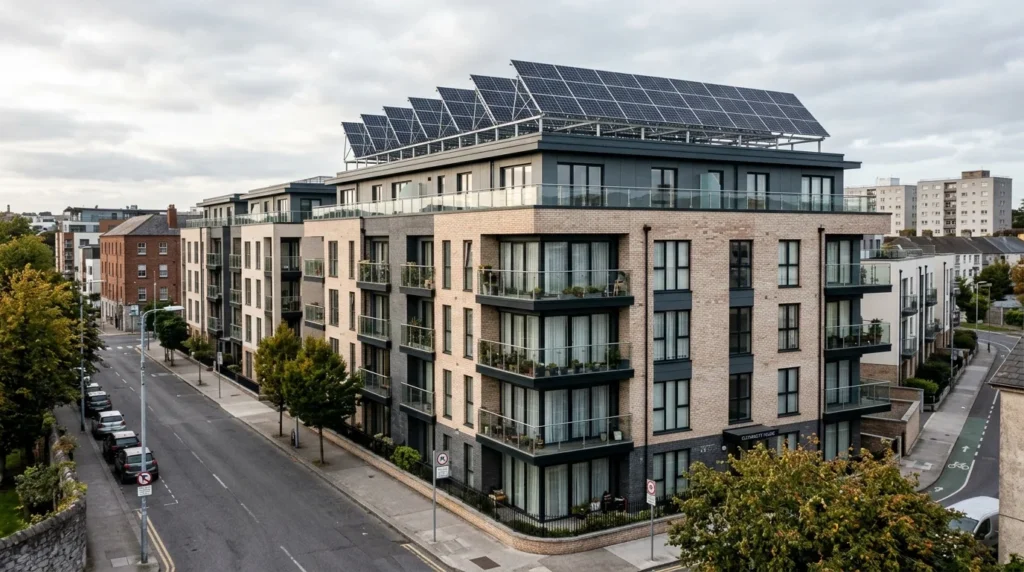
Solar panels on apartment blocks in Ireland sit at the intersection of renewable energy ambition and complex property law. Individual apartment owners cannot simply install panels on the building’s roof — the roof is typically common property managed by an Owners’ Management Company (OMC). But that doesn’t mean apartments can’t benefit from solar. Collective solar PV systems for apartment buildings are growing, and the regulatory framework is evolving rapidly.
This guide explains the current reality, the pathway to collective solar for apartment buildings, and what individual apartment owners can do to advance the agenda.
Why Apartments Are Different from Houses
For a house owner, solar PV involves a simple chain: apply for SEAI grant, get quotes, install, notify ESB Networks, register for MSS. The homeowner controls their own roof and makes all decisions.
For apartments, the roof is common property. Any installation requires:
- OMC board approval — and typically a vote at an AGM (Annual General Meeting) or EGM
- Legal agreement on how costs and benefits are shared between apartment owners
- A single grid connection covering the whole building, potentially serving individual units differently
- A different financing structure — no SEAI residential grant applies to apartment blocks directly
What Systems Are Possible for Apartment Blocks?
1. Common Areas Only System
The simplest and most common form of apartment solar in Ireland. Panels are installed on the roof and wired to power common area electricity only — lifts, corridor lighting, stairwell heating, car park lighting, and security systems. This reduces the OMC’s electricity bill (paid from service charges) without any complexity around individual unit metering.
Advantages:
- Legally straightforward — OMC already pays the common area electricity bill
- No individual metering required
- Direct reduction in service charges (which benefits all owners)
- Eligible for SEAI commercial/non-domestic grants in some cases
- Easiest to get approved at OMC level
Limitations:
- Individual apartments don’t directly benefit in their own electricity bills
- Common area loads are typically smaller than the roof solar potential
2. Collective Self-Consumption (CSS) System
The more ambitious option — a collective solar system that supplies electricity to both common areas and individual apartments. Each unit has a share of the solar generation proportional to their floor area or unit share, which is deducted from their individual electricity bill.
This requires:
- A behind-the-meter distribution arrangement where solar generation flows to individual units before the grid connection
- Smart metering for each apartment (or allocation by formula)
- Legal agreement within the OMC rules on how solar allocation is governed
- Potentially a licensed electricity intermediary or aggregator to handle the billing complexity
Ireland’s CRU (Commission for the Regulation of Utilities) has been developing the collective self-consumption framework since 2022. As of 2026, the regulatory framework is in place but implementation is still in early stages in most apartment buildings.
3. Energy Community Model
Under the EU Clean Energy Package and Ireland’s transposing legislation, renewable energy communities can be formed by groups of consumers (including apartment owners) to collectively own and consume renewable energy. An energy community can:
- Collectively own a rooftop solar installation
- Share the generated electricity among members
- Apply for available supports as a community
- Export surplus electricity and share the income
This model is particularly relevant for larger apartment complexes of 20+ units where the collective self-consumption economics are compelling.
The OMC Decision-Making Process
Getting solar approved at OMC level is the critical first step. The process typically involves:
Step 1: Raise at OMC Board An apartment owner or OMC director tables the idea with the board. Request that a solar feasibility study be commissioned — costs €500–€1,500 for a professional assessment covering roof condition, structural loading, connection costs, and financial analysis.
Step 2: Present at AGM/EGM The feasibility study results are presented to all owners at a formal meeting. Under Irish property law, significant capital expenditure decisions require a majority vote (typically 50%+ or 75%+ depending on the OMC’s articles of association).
Step 3: Appoint a Solar Installer The OMC invites tenders from SEAI-registered commercial solar installers (or solar installers with commercial/multi-unit experience). At least three quotes should be obtained.
Step 4: Funding Decision The OMC must decide how to fund the installation:
- From sinking fund reserves if sufficient funds exist
- By special levy spread across all unit owners
- By OMC loan from a green finance provider (e.g., AIB Sustainability Loan, Bank of Ireland Green Loan)
- Power Purchase Agreement (PPA) where a solar developer installs for free and the OMC pays a fixed rate per kWh for electricity generated (no upfront cost)
Step 5: Installation and Connection Commercial and apartment solar installations connect to the grid under NC7 application (not NC6), processed by ESB Networks. This can take longer — 8–16 weeks typically.
Grants and Supports for Apartment Solar
The standard SEAI Better Energy Homes residential grant does not apply to apartments or apartment blocks. However:
- SEAI Better Energy Communities scheme: Available to groups of community buildings including apartment communities — provides grants up to €1M for community energy projects
- SEAI Climate Action Fund: For larger projects
- SEAI Pathfinder programme: For innovative collective self-consumption pilots
- Commercial solar incentives: 50% accelerated capital allowances under Irish tax law for businesses — may apply to OMC entities in some structures
Financial Analysis: Common Area Solar for a 24-Unit Apartment Block
Scenario: 24-unit apartment block in Dublin 8, flat roof, 100 m² available south-facing area.
15 kWp (flat roof, east-west ballasted)
Common area annual consumption
Self-consumption of solar
Current common area electricity cost
Per-unit annual saving (service charge reduction)
This is a compelling return for apartment owners when framed as a service charge reduction.
What Can Individual Apartment Owners Do?
If you’re an apartment owner who wants to push solar forward:
- Table it at the AGM — formally request a feasibility study be commissioned
- Research similar projects — several Dublin apartment blocks have successfully installed collective solar, including complexes in Sandyford, Ranelagh, and the Cork docklands
- Contact SEAI — they have a communities programme team who can advise on collective solar pathways
- Commission an independent feasibility study — even at personal cost (€500–€1,500), this gives you data to present at OMC level
- Find allies — identify other apartment owners who support solar and build a coalition before the AGM vote
The Future: Solar Rights for Apartment Dwellers
The European Commission’s Energy Performance of Buildings Directive (EPBD) 2024 revision includes provisions requiring member states to introduce “solar rights” — removing barriers to solar self-consumption for apartment residents. Ireland must transpose this into national law, which will likely ease the path for collective solar in the coming years.
Watch for developments from the CRU on collective self-consumption regulations and from the Department of the Environment on the renewable energy communities framework.