Solar + Battery Storage

Solar PV and EV Charging in Ireland: The Perfect Combination Explained
Home Solar guides Solar PV and EV Charging in Ireland: The Perfect Combination Explained Solar PV and EV Charging in

An electric vehicle is solar PV’s perfect partner in Ireland. When your roof generates surplus electricity at midday, your car battery can store it for the evening commute. This guide explains exactly how solar EV charging works and what it saves Irish drivers.
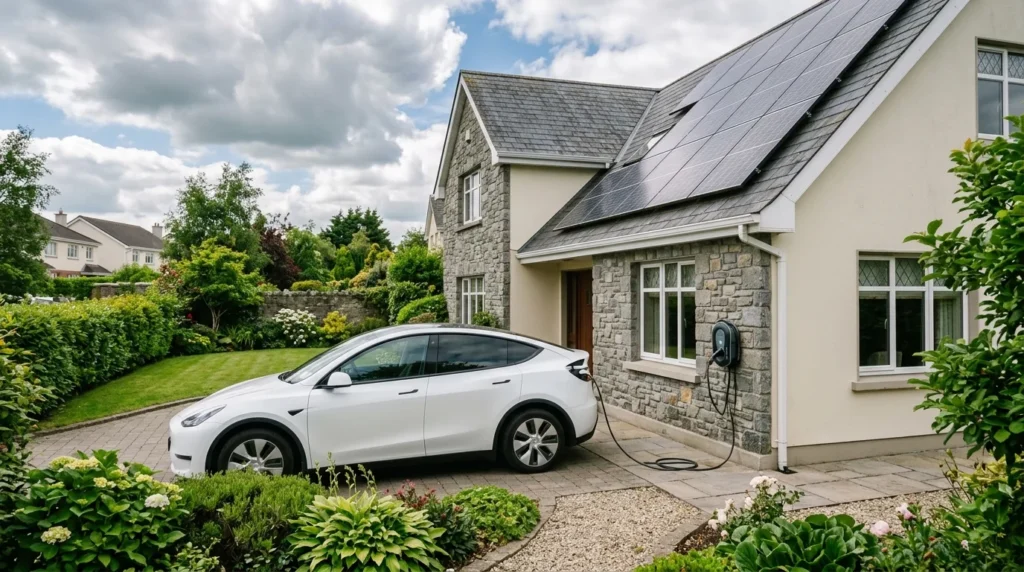
Solar PV and EV charging in Ireland is one of the most compelling combinations in the home energy market. Your solar panels generate surplus electricity from midday to mid-afternoon. Your car is parked in the driveway most of that time. A smart EV charger connects the two, turning your car battery into an effective solar energy store — for free.
For Irish drivers making the switch to electric vehicles, adding solar PV (or upgrading an existing system) dramatically reduces the cost of EV ownership. For existing solar owners buying an EV, a smart charger is one of the highest-value upgrades available.
The economics are intuitive once you see the numbers:
A typical Irish EV driver covers 15,000–25,000 km/year, consuming approximately 3,000–5,000 kWh for charging. If 50% of that charging comes from solar surplus:
Add the improved self-consumption rate (boosted from ~40% to ~60%) and the total system economics improve substantially.
A standard EV charger (or a 3-pin extension lead) draws electricity from the grid regardless of whether your solar panels are generating surplus. To charge from solar surplus, you need a smart EV charger that monitors your solar generation and grid import/export in real time.
This requires the charger to communicate with either:
Green-Only Mode (Solar Surplus Only): The charger waits until solar surplus exceeds the minimum charge threshold (typically 1.4 kW for single-phase EVSE) before starting. If the sun goes behind clouds, charging pauses. This maximises solar self-consumption.
Eco Mode (Solar + Grid): The charger uses all available solar surplus plus a configurable amount of grid top-up to maintain a minimum charge rate. Useful if you need the car charged by a specific time but still want to maximise solar use.
Boost Mode (Maximum Rate): Standard grid charging at full charger capacity. Used when you need a full charge quickly regardless of solar generation.
The myenergi Zappi is the most popular solar-integrated EV charger in Ireland and the UK. It was specifically designed for solar surplus charging and integrates directly with all major solar inverter brands.
Zappi specifications:
The Zappi’s hub system (myenergi Hub, ~€100) enables advanced integration with myenergi’s product ecosystem:
All devices share solar generation data and prioritise solar surplus intelligently — the hub decides in real time whether surplus goes to the EV, the immersion, or the battery.
The myenergi Zappi’s purpose-built solar surplus mode makes it the go-to recommendation for Irish solar homeowners.
Scenario: Dublin family, 4 kWp solar, Nissan Leaf, 18,000 km/year
EV electricity consumption: 18,000 km × 0.18 kWh/km = 3,240 kWh/year
With standard grid charging (no solar): 3,240 × 30 c = €972/year fuel cost
With solar surplus charging (Zappi, Eco mode):
The total EV fuel cost with solar drops from €972/year to approximately €730/year — a saving of ~€242/year.
But the bigger picture: the EV dramatically boosts overall solar self-consumption, which means:
If you’re buying solar PV alongside (or in anticipation of) an EV, size up by 1.5–2 kWp compared to what you’d choose without the EV:
The additional kWp generates surplus that the EV absorbs, improving self-consumption and reducing fuel costs proportionally.
The next frontier beyond solar EV charging is bidirectional charging — where the EV battery can power your home (V2H) or the grid (V2G) when needed.
V2H (Vehicle to Home): Your car battery (typically 40–80 kWh) becomes a giant home battery. Surplus midday solar charges the car; evening household loads drain the car battery. Currently limited to a few EV models that support bidirectional AC or DC charging.
V2G (Vehicle to Grid): Your car earns money by exporting electricity to the grid during peak demand periods. Requires a V2G charger and a grid operator agreement.
Both V2H and V2G are in early adoption phases in Ireland as of 2026 — watch for developments from the CRU on V2G licensing and from EV manufacturers supporting CHAdeMO or CCS bidirectional standards.
Tell us a few quick details about your home and we’ll connect you with up to 3 SEAI-registered solar installers in your area.
We'll match you with Safe Electric-certified installers who can apply for the €300 SEAI Home Charger Grant on your behalf.
Home Solar guides Solar PV and EV Charging in Ireland: The Perfect Combination Explained Solar PV and EV Charging in
— myenergi
— Commission for the Regulation of Utilities
— Sustainable Energy Authority of Ireland

Solar advisor team
Published 15 May 2026
We'll match you with Safe Electric-certified installers who can apply for the €300 SEAI Home Charger Grant on your behalf.