Solar PV on an A-Rated New Build in Ireland: What the Regulations Require

New homes in Ireland must achieve an A2 BER rating, and solar PV is almost always part of the solution. This guide explains what the regulations require, how solar integrates with heat pumps and EVs, and how to get the most from your new-build solar system.
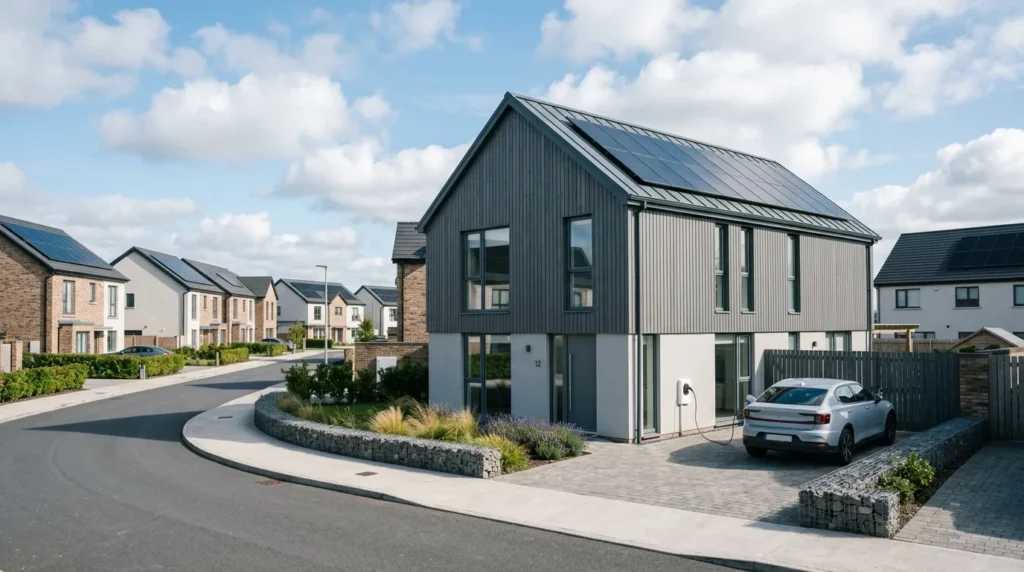
Solar PV has moved from optional upgrade to near-universal standard in Irish new-build housing. Under Ireland’s Nearly Zero Energy Building (NZEB) regulations — which implement EU Directive 2010/31/EU as amended — all new dwellings must achieve a minimum A2 BER rating (Building Energy Rating) and meet primary energy and carbon emission targets that virtually always require on-site renewable energy generation.

For most Irish new builds, solar PV on an A-rated new build is not a luxury; it’s built into the architectural design and BER calculation from the planning stage.

What the Building Regulations Require

Ireland’s Building Regulations Part L (Conservation of Fuel and Energy) sets the NZEB standard for new dwellings. Key requirements include:

  • Maximum primary energy consumption: 50 kWh/m²/yr for dwellings
  • Maximum carbon dioxide emission rate: 70% reduction versus 2005 reference building
  • Minimum 20% of energy from renewable sources

For a typical 130 m² house, the primary energy limit is approximately 6,500 kWh/yr — an aggressive target that requires a combination of:

  1. High-performance insulation and airtightness (BER wall, roof, floor U-values)
  2. Mechanical ventilation with heat recovery (MVHR)
  3. Heat pump for space heating and hot water
  4. Solar PV for on-site renewable electricity generation

A 3–4 kWp solar PV array generates sufficient on-site renewable energy to meet the 20% renewable requirement for most new-build house sizes. Developers of housing estates often specify 4 kWp as standard for this reason.

SEAI Grant Eligibility for New Builds

Homes built in 2021 or later are not eligible for the standard SEAI Solar PV grant (Better Energy Homes scheme), which is restricted to homes built before 2021. This is because new-build homes are already required by regulation to include renewable energy — so a separate grant for solar would represent double subsidy.

However, new builds do benefit from:

  • VAT relief: Solar panels on new builds are zero-rated for VAT at the construction stage
  • The Microgeneration Support Scheme (MSS) applies from day one — you can export surplus electricity and receive 18–21 c/kWh
  • The NC6 grid connection notification process is the same as for older homes

Solar PV Integration in New-Build Design

The advantage of solar PV on an A-rated new build is that it can be designed in from the start, rather than retrofitted. This creates several opportunities:

Optimised Roof Orientation

Good builders and architects orient the main ridge of new-build houses east-west so that the principal slope faces south, maximising solar yield. This was uncommon in older Irish housing developments but is now standard practice in new-build design.

Integrated Wiring

DC cable runs from the roof to the inverter location can be hidden within the building fabric during construction — much cleaner than retrofitting conduit on an existing home. The consumer unit (fuse board) can be positioned optimally for the solar circuit, and dedicated conduit can be routed for future battery connection.

Pre-Plumbed Battery Space

Forward-thinking builders pre-plumb an internal space (utility room alcove or garage wall) for future battery storage, including appropriate cable sizing and earthing.

EV Charging

Most A-rated new builds include a pre-wired EV charging point as standard (required for new homes with parking since 2022 under the EPBD). The solar PV system can be configured to charge the EV from surplus solar through a smart EV charger, maximising self-consumption.

Typical Solar PV Specification for Irish New Builds

Developer-standard solar PV for Irish new builds in 2026 typically includes:

Component

Standard Specification

Panels

10 × 400–425 W monocrystalline PERC (4–4.2 kWp)

Inverter

4 kW string inverter (Fronius Primo, Huawei SUN2000, or Sungrow)

Generation meter

Calibrated per SEAI/DECC requirements

Monitoring

WiFi-connected app monitoring

ESB NC6

Notified to ESB Networks pre-occupancy

Warranty

25-year panel performance, 10-year inverter

What developer-standard specs often omit:

  • Power optimisers (add for complex roofs or where shading is possible)
  • Battery storage (significant upgrade — typically €4,000–€6,000)
  • Immersion diverter (add for ~€400 — excellent value)
  • Upgraded inverter to hybrid-ready (enables future battery without rewiring)
  • Extended inverter warranty (10→20 years, typically €200–€400)

If you are purchasing a new build, negotiate these additions before signing contracts — they are far cheaper to include at construction stage than to retrofit later.

Interaction with Heat Pumps

The solar PV + heat pump combination is the defining energy technology package for Irish new builds in 2026. Understanding how they interact helps you optimise the system:

Heat pump electricity consumption:

  • Air-to-water heat pump (typical): 2,000–6,000 kWh/year for space heating + hot water
  • Total annual electricity load for new build family of 4 with heat pump: 6,000–10,000 kWh

Solar PV contribution to heat pump load:

  • A 4 kWp system generates ~3,800–4,200 kWh/year in Ireland
  • Most heat pump electricity demand is in winter (when solar output is low) — solar cannot fully offset the heat pump load without battery storage
  • Spring/autumn: Solar can power the heat pump’s hot water heating cycle during sunny periods
  • Summer: Solar surplus can run the heat pump in hot water mode during the day, storing heat in the cylinder

See our detailed guide on solar PV with heat pump in Ireland for optimisation strategies.

Microgeneration and the MSS for New Builds

From the day your new build is occupied, you can register for the Microgeneration Support Scheme (MSS) with your electricity supplier. With a 4 kWp system and a family of 4, you’ll likely export 1,500–2,500 kWh/year:

  • At 18–21 c/kWh MSS export rate: €270–€525/year in export income
  • This income continues for the duration of the MSS, currently with no fixed end date

Apply to your supplier (Electric Ireland, Energia, Bord Gáis Energy, SSE Airtricity) by providing:

  • Your MPRN (Meter Point Reference Number)
  • Generation meter serial number and reading
  • Confirmation of system capacity

BER Rating Impact

Adding solar PV to a new build’s BER calculation has a substantial positive effect. Under the DEAP 4 (Dwelling Energy Assessment Procedure) methodology:

  • A 4 kWp system on a south-facing roof can reduce the calculated primary energy consumption by 15–25 kWh/m²/yr
  • This can be the difference between an A3 and A2 rating, or A2 and A1
  • For homes targeting the A1 rating (primary energy under 25 kWh/m²/yr), a larger 5–6 kWp system may be necessary

See our guide on solar PV and BER ratings in Ireland for the full DEAP methodology explanation.

Key Takeaways

  • All new Irish homes must achieve A2 BER — solar PV is almost always part of meeting this target
  • New builds built in 2021+ are not eligible for the SEAI grant — but do benefit from zero VAT on the system, MSS access from day one, and optimised installation at construction stage
  • Design your solar system in from the start: optimised roof orientation, hidden cable runs, hybrid-ready inverter, and EV charger integration
  • A 4 kWp developer-standard system is typical — consider negotiating upgrades (battery, optimisers, immersion diverter) before contracts are signed
  • Solar PV pairs best with heat pumps and EVs in new builds — the combination covers most of a new home’s energy needs

Get 3 free, no-obligation solar quotes

Tell us a few quick details about your home and we’ll connect you with up to 3 SEAI-registered solar installers in your area.

Frequently Asked Questions

No. The SEAI Solar PV grant under the Better Energy Homes scheme is restricted to homes built before 2021. New builds are required by law (Part L Building Regulations) to include renewable energy as part of achieving NZEB standards, so the grant is not applicable. New builds do qualify for the MSS export tariff from day one.


There is no fixed requirement — solar PV capacity is part of a BER calculation that considers all the home’s energy characteristics. For a well-insulated 130 m² new build with a heat pump, a 3.5–4 kWp south-facing solar array is typically sufficient to achieve A2 BER. Your BER assessor will confirm the required system size.


Yes. You can add more panels (if roof space allows), upgrade to a hybrid inverter, add a battery, or add an immersion diverter after moving in. These upgrades are more expensive to retrofit than to include at construction — always negotiate them into the build contract if possible.


Solar PV can power the heat pump directly during sunny periods, reducing running costs. In spring and autumn, solar can fully power the heat pump’s hot water heating. In summer, solar surplus can heat the cylinder even when no space heating is needed. In winter, solar contribution to heat pump load is limited but still meaningful. A battery and smart heat pump controller optimise the interaction.

The monitoring app depends on the inverter brand. Fronius uses Solar.web, Huawei uses FusionSolar, Sungrow uses iSolarCloud, and SolarEdge uses its own monitoring portal. All provide real-time production data via smartphone. Ask the developer which brand is specified and confirm monitoring app access is included.

Get 3 free quotes for your home EV charger

We'll match you with Safe Electric-certified installers who can apply for the €300 SEAI Home Charger Grant on your behalf.

More solar pv guides

Sources & further reading

— Sustainable Energy Authority of Ireland

— Department of Housing, Local Government and Heritage

— Department of the Environment, Climate and Communications

Get 3 free quotes for your home EV charger

We'll match you with Safe Electric-certified installers who can apply for the €300 SEAI Home Charger Grant on your behalf.

Request installer quotes

Free, non-binding comparison

Support Form (#3)
Support Form (#3)
Support Form (#3)