
- Home
- Solar guides
- Solar PV vs Solar Thermal in Ireland: Which System Is Right for Your Home?
Solar PV vs Solar Thermal in Ireland: Which System Is Right for Your Home?
Both solar PV and solar thermal harness the sun’s energy, but they do it in completely different ways. This guide breaks down the key differences for Irish homeowners and explains why solar PV has become the dominant choice — while solar thermal still has a place in certain homes.
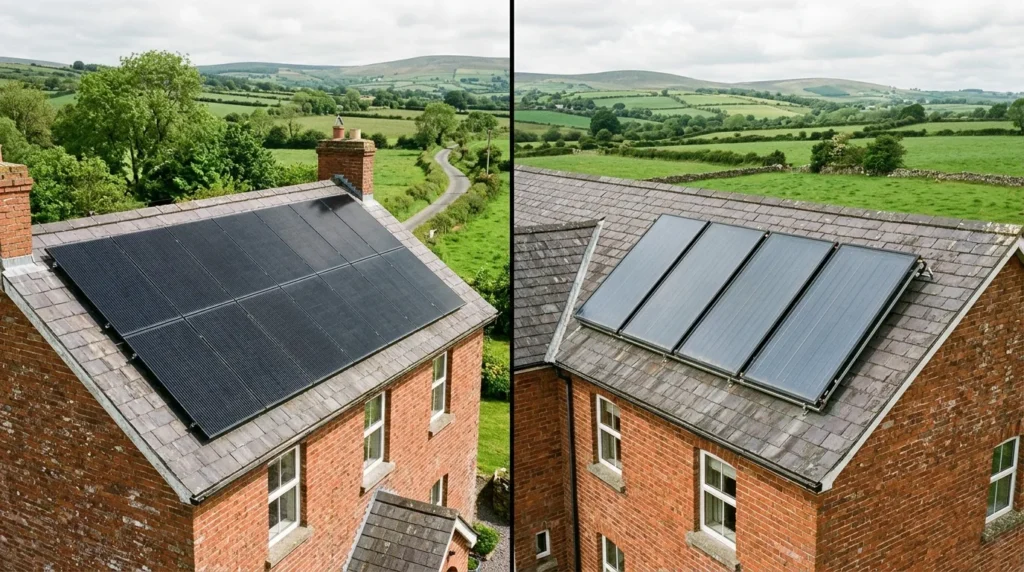
When Irish homeowners start researching solar energy, one of the first questions is: solar PV vs solar thermal — what’s the difference, and which one should I install? The confusion is understandable. Both technologies sit on rooftops and use the sun, but they convert solar energy in fundamentally different ways and serve different purposes in your home.
In short: solar PV (photovoltaic) converts sunlight into electricity that powers everything in your home. Solar thermal converts sunlight into heat, used almost exclusively to warm domestic hot water. Understanding this distinction is the starting point for making the right investment for your household.
How Solar PV Works
Solar PV uses semiconductor cells (almost always silicon) to convert photons from sunlight directly into direct current (DC) electricity through the photovoltaic effect. An inverter converts this to 230 V AC for your home’s circuits. Surplus electricity is exported to the grid for a payment under Ireland’s Microgeneration Support Scheme (MSS), earning 18–21 cent per kWh depending on your supplier.
A typical Irish domestic solar PV system is 4–6 kWp in capacity, using 10–16 panels, and generates 3,600–6,300 kWh of electricity per year. This electricity is completely flexible — it powers your lights, heating, cooking, EV charger, appliances, and yes, it can also heat your hot water through an immersion diverter device.
For a detailed explanation of how PV works, see our guide on how solar panels work in Ireland.
How Solar Thermal Works
Solar thermal systems use collectors — either flat-plate collectors or evacuated tube collectors — to absorb solar radiation and transfer the heat to a fluid (usually a glycol-water mix) that circulates to a hot water cylinder. A twin-coil cylinder stores both solar-heated water and a backup heat source (immersion or boiler coil).
A standard residential solar thermal system in Ireland consists of:
- 2–4 m² of flat-plate or evacuated tube collectors
- A circulating pump and controller
- A twin-coil hot water cylinder (typically 250–300 litres)
On a good Irish summer day, a properly sized solar thermal system can provide 60–70% of a household’s annual hot water demand. In winter, output drops significantly and the backup immersion or gas boiler covers the shortfall.
The Core Difference in Plain English
Feature
Solar PV
Solar Thermal
Output
Electricity (flexible)
Heat for hot water only
Annual yield (typical system)
3,600–5,000 kWh electricity
1,500–2,000 kWh thermal equivalent
SEAI grant available?
Yes — up to €1,800 (2026)
Separate SEAI Solar Thermal grant
Average installed cost (2026)
€9,000–€14,000
€2,500–€4,500
Payback period
6–9 years
8–15 years
Lifespan
25–30+ years
20–25 years
Maintenance
Minimal
Annual pump/glycol check
Flexibility
Very high (powers everything)
Low (hot water only)
Roof space needed
15–25 m²
4–8 m²
Grid export income?
Yes (MSS, 18–21 c/kWh)
No
SEAI Grants in 2026: PV Gets the Better Deal
Under the Better Energy Homes scheme, the SEAI Solar PV grant in 2026 offers €900 per kWp up to a maximum of €1,800. A 4 kWp system costing €10,000 would receive the full €1,800, leaving a net cost of €8,200.
The SEAI also offers a Solar Thermal grant for homes with oil or gas boilers — typically around €1,200 for flat-plate collectors. However, if your home already has or is planning a heat pump, the solar thermal grant is not available (heat pumps and solar thermal collectors don’t work efficiently together because the heat pump operates at low temperatures that the solar thermal system also targets).
The net financial advantage clearly favours solar PV in most cases. Its ability to generate exportable electricity, power EVs, and work with heat pumps makes it far more versatile.
Why Solar PV Has Largely Replaced Solar Thermal in Ireland
Five years ago, solar thermal was the more cost-effective way to use the sun’s energy for an Irish home. That calculus has shifted dramatically:
1. PV panel prices fell 80% since 2010 The cost per watt of PV panels has crashed. A complete 4 kWp system now installs for €9,000–€11,000 before grant, versus €12,000–€16,000 a decade ago.
2. Immersion diverters make PV do solar thermal’s job Devices like the Solar iBoost, Eddi (myenergi), or iBoost+ monitor grid export from your PV system and redirect surplus electricity to your immersion heater before it leaves your home. This means you get free hot water from PV surplus — without any extra panels, cylinders, or plumbing. The diverter typically costs €300–€600 fitted.
3. MSS export payments reward flexibility A solar thermal system generates no export income. A solar PV system can earn 18–21 c/kWh on exported electricity while also indirectly heating your water through a diverter. The dual benefit makes PV economics far stronger.
4. Heat pumps don’t combine well with solar thermal Ireland’s Climate Action Plan targets 400,000+ heat pump installations by 2030. Heat pumps require low-temperature hot water (typically 45–55°C), while solar thermal collectors can raise water to 60–80°C — creating legionella risk management complications and thermostatic mixing requirements. PV + heat pump is a much cleaner combination and is now widely installed in Irish A-rated new builds.
When Solar Thermal Still Makes Sense
Solar thermal is not obsolete. There are specific scenarios where it remains a sensible choice:
- Oil or gas-heated homes with high hot water demand: Large families using a gas boiler where replacing the boiler is not on the cards in the near term. A solar thermal system can offset 60% of annual hot water bills with lower upfront cost than full PV.
- Limited roof space or budget: If budget is tight and the goal is purely to reduce the gas/oil bill for hot water, a solar thermal system with 4 m² of collectors is less expensive than a full PV system.
- Holiday homes or low electricity demand: A property used seasonally with little electrical load but regular hot water needs may benefit more from solar thermal’s targeted heat output.
Can You Install Both?
Yes — and some Irish homeowners do. A small solar thermal system (2–3 m² of collectors) for hot water, combined with a 3–4 kWp PV array for electricity, covers both energy needs directly. However, the added complexity, dual maintenance requirements, and tighter roof space allocation mean this approach is increasingly rare. Most SEAI-registered solar installers now recommend solar PV with an immersion diverter as the simpler, more versatile, and ultimately better-value solution.
Summary: Which Should You Choose?
For the vast majority of Irish homeowners in 2026, solar PV is the right choice. It’s more flexible, benefits from a strong SEAI grant, earns MSS export income, and can cover your hot water needs via an immersion diverter. The economics are better, and the technology integrates seamlessly with EVs, heat pumps, and battery storage.
Choose solar thermal only if:
- You have a gas or oil boiler and no plans to switch
- You have limited roof space (under 15 m²)
- Your budget is under €3,000 and hot water savings are the sole goal
- Your installer has assessed that thermal is genuinely better for your property
For most Irish families on a typical mortgage-era budget, a 4–6 kWp solar PV system with an immersion diverter will outperform solar thermal across every meaningful metric over a 25-year horizon.
Get 3 free, no-obligation solar quotes
Tell us a few quick details about your home and we’ll connect you with up to 3 SEAI-registered solar installers in your area.
Frequently Asked Questions
Is solar thermal still eligible for an SEAI grant in Ireland in 2026?
Can solar PV heat my hot water?
What is the payback period for solar thermal in Ireland?
Does solar thermal work with a heat pump?
How much roof space does each system need?
Get 3 free quotes for your home EV charger
We'll match you with Safe Electric-certified installers who can apply for the €300 SEAI Home Charger Grant on your behalf.
- No obligation · Free · Takes 2 minutes
More solar pv guides

Solar PV vs Solar Thermal in Ireland: Which System Is Right for Your Home?
Home Solar guides Solar PV vs Solar Thermal in Ireland: Which System Is Right for Your Home? Solar PV vs Solar Thermal in Ireland: Which
Sources & further reading

Solar Expert Editorial
Solar advisor team
Published 15 May 2026
Get 3 free quotes for your home EV charger
We'll match you with Safe Electric-certified installers who can apply for the €300 SEAI Home Charger Grant on your behalf.
- No obligation · Free · Takes 2 minutes