Ireland's Universal EV Connector
If you have bought or are considering buying an electric vehicle in Ireland, you will almost certainly encounter the Type 2 connector — also known as the Mennekes connector after the German company that invented it, or by its IEC standard number, IEC 62196-2. Since 2014, EU regulations have mandated Type 2 as the standard socket for AC charging at home and public points across Europe, including Ireland.
Understanding this connector — its pin layout, cable ratings, and compatibility — helps you buy the right charging equipment and avoid expensive mistakes.
Pin Layout and What Each Pin Does
A Type 2 socket has seven contacts arranged in a distinctive flat-top D-shape:
Live phase 1 (single or three-phase)
Live phase 2 (three-phase only)
Live phase 3 (three-phase only)
Protective earth (ground)
Control pilot — pilot signal for handshake
Proximity pilot — cable rating detection
The control pilot (CP) pin carries the PWM signal that tells the car how much current is available. The proximity pilot (PP) carries a resistor code that tells the car what ampere rating the cable is — 13A, 20A, 32A, or 63A. This is how the system automatically limits power when you use a lower-rated cable.
On a single-phase installation (the vast majority of Irish homes), only L1, N, PE, CP, and PP are energised. L2 and L3 are present in the socket but carry no voltage.
Single-Phase vs Three-Phase: What Changes?
At home, most Irish properties have a single-phase 230V supply, which means a Type 2 socket on a 32A circuit delivers a maximum of 7.4 kW (230V × 32A). This is the standard home charger rating in Ireland.
Properties with three-phase supply — some new builds and many rural homes with larger service heads — can use all three live pins, delivering up to 22 kW (3 × 230V × 32A). The physical connector is identical; only the wiring behind the socket differs. Whether your car can use 11 kW or 22 kW depends on its on-board charger rating, not the plug.
Tethered vs Untethered Sockets
Home chargers in Ireland come in two socket configurations:
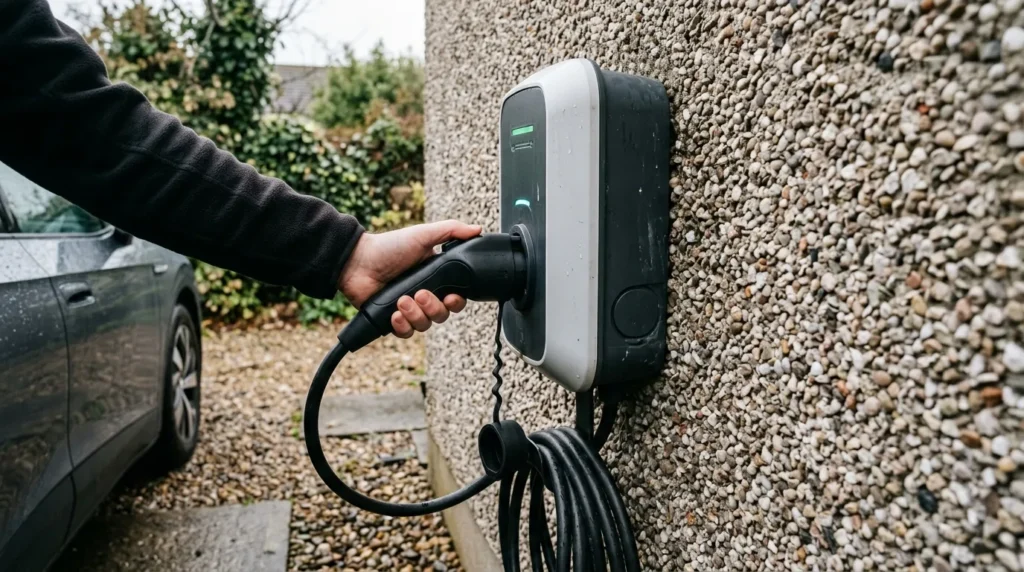
- Tethered: A cable is permanently attached to the wallbox. You simply pick up the plug end and connect it to the car. Brands like Ohme Home Pro and EO Mini Pro 3 offer popular tethered options.
- Untethered (socketed): The wallbox has a Type 2 socket and you supply your own cable. This is useful if different household members drive different cars, or if you want to upgrade cable ratings independently.
For most Irish households with a single EV, a tethered charger is more convenient — no cable to uncoil and store. For households with two different EVs (particularly one non-Type-2 vehicle), a socketed charger with multiple cables can be more flexible.
Cable Ratings: Why This Matters
Type 2 cables are rated by their maximum continuous current: 16A, 32A, or occasionally higher. The PP pin resistor tells the car which cable is connected, and the car limits its draw accordingly.
- A 16A cable limits charging to approximately 3.7 kW (single-phase). Adequate for overnight top-ups but slow if you need a full charge quickly.
- A 32A cable allows the full 7.4 kW from a standard Irish wallbox. This is what most homeowners should buy.
Cable length also matters. For home use, a 5–7 metre cable suits most driveways. Longer cables introduce slight voltage drop and are bulkier to store.
When buying a Type 2 cable, look for:
- IEC 62196-2 certification marking
- IP54 or higher weatherproofing rating (important for Ireland’s wet climate)
- 32A / 7.4 kW rating unless your car’s OBC is limited to 3.7 kW
Reputable cable brands available in Ireland include Ratio Electric, Besen, and cables supplied directly by charger manufacturers such as MyEnergi and Wallbox.
CCS and CHAdeMO: The DC Connectors
Type 2 is an AC connector. For DC rapid charging — the kind found at motorway services, Ionity stations, and ESB eCars fast chargers — a different connector is used.
Almost all European EVs now use CCS2 (Combined Charging System, Combo 2), which is essentially a Type 2 socket with two additional large DC pins below it. Your home wallbox uses the upper Type 2 portion; a rapid charger uses all seven Type 2 pins plus the two DC pins simultaneously.
Older Nissan Leaf models use CHAdeMO for rapid charging, though even Nissan has moved to CCS on newer models. For home charging, CHAdeMO vehicles still use a Type 2 cable on the AC side.
Tesla vehicles sold in Europe — Model 3, Model Y, Model S, Model X — all use the Type 2 / CCS2 standard. The proprietary Tesla connector is only used in North America.
Locking Mechanism
One feature of the Type 2 standard that Irish drivers appreciate is the cable lock. When the vehicle is locked, it electrically actuates a pin inside the charge port that prevents the Type 2 plug from being pulled out. On the wallbox side, premium chargers like the Easee One and Wallbox Pulsar Plus also lock the cable at the wallbox end via the CP signal, preventing cable theft when you leave the car charging unattended on the driveway.
IP Rating for Irish Weather
Ireland averages over 1,200 mm of rain per year in many areas. Any Type 2 socket installed outdoors must have an appropriate IP (Ingress Protection) rating:
- IP44: Protected against solid objects >1 mm and water splashes from any direction. Minimum for outdoor sockets.
- IP55 / IP65: Dust-tight and protected against water jets. Better for exposed locations.
- IP66: Protected against powerful water jets — appropriate for fully exposed installations on coastal or very exposed sites.
Most SEAI-approved chargers are rated IP54 or IP55 as standard. Check the data plate on the charger, especially if your installation site is particularly exposed.
The EU Mandate and What It Means for You
European Regulation 2014/94/EU requires Type 2 as the standard connector at all publicly accessible AC charging points. In practice, this means:
- Every ESB eCars public AC point in Ireland is Type 2
- Every SEAI-approved home charger is Type 2 compatible
- Any Type 2 cable you buy for home use also works at public charge points
- There is no need for adapters within the AC charging ecosystem
This standardisation is one of the genuine success stories of EU energy regulation — Irish EV owners can confidently buy a single cable and use it everywhere.
Choosing the Right Setup for Your Home
For a typical Irish home with single-phase supply and one EV:
- Wallbox type: Tethered 7.4 kW charger with integrated Type 2 cable (5m). No separate cable needed.
- If you choose socketed: Buy a quality 32A/7.4 kW Type 2 to Type 2 cable (5–7m).
- Check your car’s OBC: If your car’s on-board charger is limited to 3.7 kW or 11 kW, a wallbox that can deliver more is harmless but not fully utilised.
- IP rating: Confirm IP54 minimum for any outdoor socket installation.
The Type 2 standard is mature, well-understood, and universally supported in Ireland. Getting the connector right means you will never be caught with the wrong cable at home or at a public charge point.